
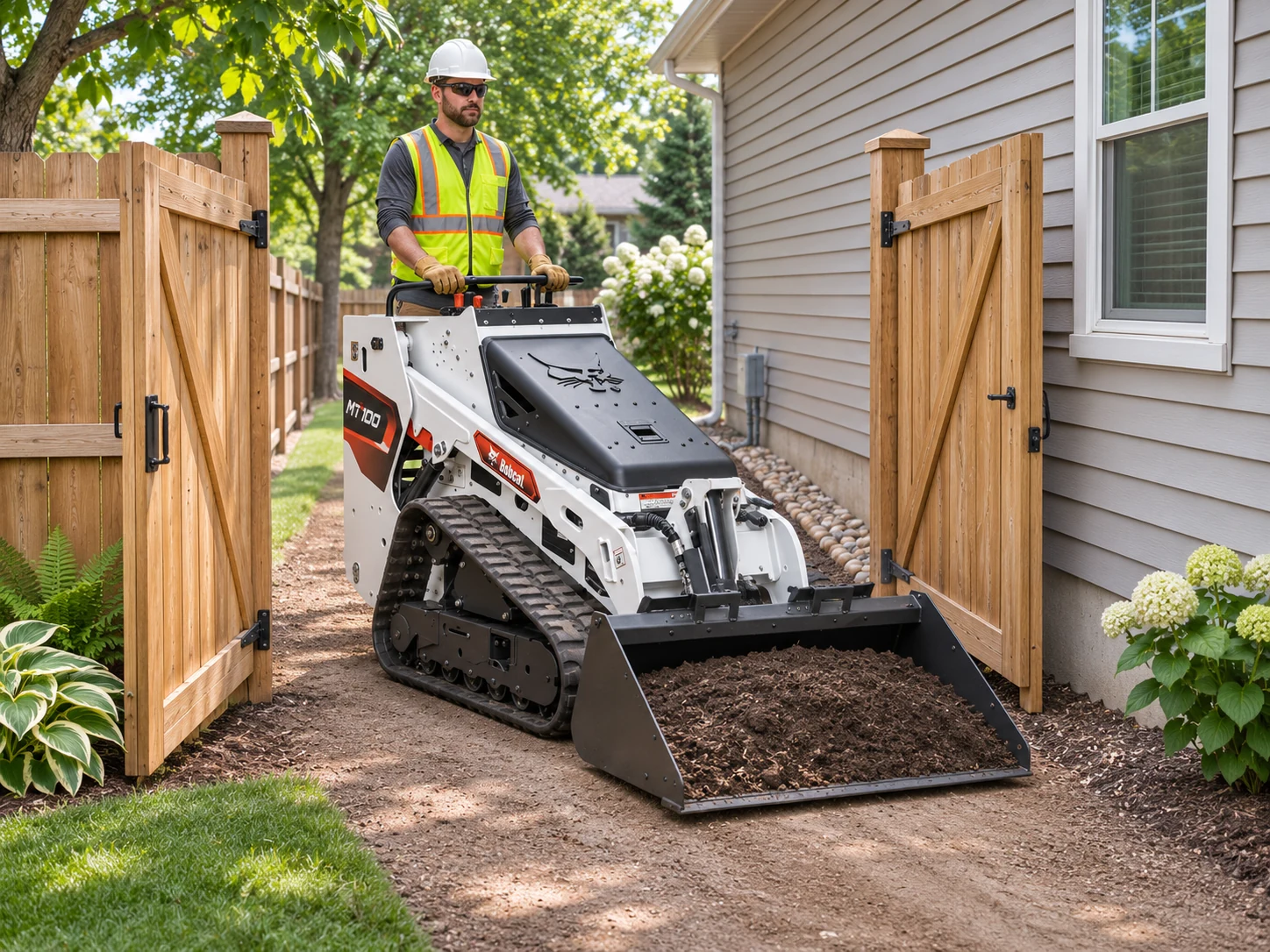
Measure the route, not the gate
The gate is one point on the route. The air conditioner, the meter, the window wells, the fence posts, the downspouts and the turn at each end are the rest of it. The narrowest of those sets the machine.
Find the narrowest point
Walk the route with a tape. Measure at the gate with it fully open and the latch counted, between the house and the fence at the tightest spot, and at anything that sticks out: AC unit, meter, hose bib, window well, downspout. Write down the smallest number. That is your clear opening.
Check the turns and the slope
A machine that fits straight on may not make the turn from the driveway into the gate or from the side yard into the back. Pace out the turning room at each end. Note the grade: side yards often slope toward the back and have a step or a retaining edge. A buggy handles a slope that would make a loaded loader tippy.
Check the ground and what is under it
Side yards are where the sewer lateral, the sump discharge, the downspout lines and the AC line set run. Note soft spots and standing water. Tracks spread weight and still mark lawn; they do not make saturated ground workable. Plan plywood over the soft stretch, and give it a day after a hard rain.
What passes a narrow route, from our product pages
Width is the machine body. The MT100 bucket is machine width; its 48 in soil conditioner is 56.75 in overall and will not pass a 36 in opening on the machine. The E10 enters retracted and needs 43 in where it extends to dig. Nothing on this list is promised to fit your gate; measure the clear opening and the turns, then call.
Bobcat E10 mini excavator — 28 in retracted / 43 in extended
Canycom tracked buggy — 35 in
Vermeer SC30TX stump grinder — 35 in
Bobcat MT100 stand-on loader — 35.6 in
Trencher 6 in x 36 in — 35.8 in
Whiteman wheeled buggy — 44 in
Bobcat T66-2 track loader — 67 in
Nothing under 35 in: — if the clear opening is under 35 in, no machine in the fleet passes. Removing one fence panel or the gate itself is usually easier than doing the whole job with a wheelbarrow.
Matching the machine to the route
Three machines pass a standard gate. Which one depends on what you are carrying and what the route does.
- The Bobcat MT100 stand-on loader is the default when the route is 36 in clear and reasonably level. It scoops from the pile, carries 1,000 lb rated per load, and back-drags to spread what it drops, so it covers moving and placing in one machine. Add forks for pallets of pavers or block; the machine's 1,000 lb rating governs, not the fork rating. The 36 in root grapple fits for brush and roots. The 48 in soil conditioner is 56.75 in overall and will not ride through the gate on the machine.
- The Canycom tracked buggy is the pick when the route has a slope, a soft stretch, steps the loader cannot cross, or when nobody on the job has run a loader. It carries 2,200 lb in a tub with nothing to raise, dumps straight ahead and runs on tracks at 35 in wide. It does not spread; you rake. Someone has to load it, by shovel or with a loader at the pile.
- The Bobcat E10 mini excavator passes at 28 in retracted and is the answer when the job behind the house is digging, not carrying: a footing, a drain line, a small stump. It extends to 43 in to work and digs to about 6 ft. It can carry a bucket of material along a side yard, slowly; for volume, pair it with a buggy or the MT100 and plan a dual-machine delivery.
Protecting the house, the lawn and the neighbor's fence
- A side yard puts the machine inches from siding, a meter, an AC unit and a fence you may not own. Mark anything that sticks out with a flag or tape at machine height. Lay plywood over the lawn stretch you want to keep and over soft spots; it spreads the load and keeps the tracks from carving a single rut on a route you will travel fifty times. Carry low. A raised bucket on a stand-on loader beside a fence is how fences and loaders both get damaged.
- Call MISS DIG 811 at least three business days before any digging on the route; it is free, required by Michigan law, and marks public utilities only. The sump discharge, downspout lines, irrigation and the AC line set are private. If you are only driving over the ground, the concern is weight on shallow lines, not digging; stay on plywood over anything you know is there.
When the route does not work
- If the clear opening is under 35 in, or the turn cannot be made, you have three options. Remove a fence panel or the gate for the day, which is usually the least work. Come in from another side, such as a neighbor's yard with permission or across the back lot line. Or change the job: have the material dropped in the back by a supplier with a conveyor or a smaller truck, or do the carrying by hand with a wheelbarrow and rent only the machine for the work in the back. Tell us the measurements and we will say which one we would do.
Your route checklist
Save these details before you request equipment.
- Narrowest clear opening on the route, in inches, and where it is
- Turning room at the driveway end and the backyard end
- Slope, steps and soft spots along the route
- Obstacles at machine height: AC unit, meter, window wells, downspouts
- Buried lines you know about: sewer, sump, downspout, irrigation
- Material type, yards and where the pile will be dropped
- Lawn sections to cover with plywood
- Delivery location and preferred dates
Let's match the machine to your job.
Tell us what you're working on. Our Hamburg team serves Southeast Michigan, seven days a week.
(810) 231-7368
Explore equipment for this guide
Questions before you rent
My gate is 36 inches. Which machines fit?
On the product pages, the MT100 is 35.6 in, the Canycom buggy and the SC30TX stump grinder are 35 in, the trencher is 35.8 in and the E10 retracts to 28 in. A nominal 36 in gate is often less than that clear once the latch and the hinge side are counted, and the turn into it matters as much as the width. Measure the clear opening with the gate fully open and tell us the number along with the narrowest point elsewhere on the route. We will tell you what we would send.
Loader or buggy for carrying through a side yard?
The MT100 loader when the route is level and you also need to spread or grade in the back; it loads itself and back-drags what it drops. The Canycom buggy when there is a slope, a soft stretch or a step, or when nobody has run a loader: the load rides low in a tub, and it dumps where you point it. The buggy carries more per trip (2,200 lb rated against 1,000 lb) but someone has to fill it. Big pile plus a narrow route is often both machines: the loader fills the buggy at the pile.
Can I bring pavers or block through on forks?
The MT100 takes forks with 42 in tines. The attachment is rated higher, but the machine's 1,000 lb rated operating capacity is the limit, so a full pallet of pavers is more than one trip. Split the pallet at the driveway. Carry low and slow, and check the fork width against your clear opening; a pallet is wider than the machine. For full pallets with a 6 ft route, the forks on a T66-2 carry far more per trip.
Will the tracks wreck the grass in my side yard?
Tracks spread the weight over more ground than wheels, so they rut less, but a 3,400 lb machine running the same strip fifty times will flatten and mark it. Plywood over the lawn stretch spreads the load and keeps the tracks off the turf. Stay off the yard for a day after a hard rain; no machine makes saturated ground workable. Expect some repair seeding along the route whatever you do, and plan for it.
How does the machine get to the house?
The MT100 rides on our 12 ft ramp trailer with a 2 in ball, and a half-ton pickup typically handles it; we confirm your setup at the counter. The Canycom buggy and the E10 ride on the 5x10 utility and 16 ft equipment trailers respectively. Delivery runs seven days a week on our own trucks, priced by drive time from Hamburg: $85 round trip within 45 minutes for a single machine, $125 at 46 to 75 minutes or for a dual-machine load, confirmed at checkout. Beyond 75 minutes we quote by phone.
How long should I book for?
You pay for the time the machine is out, with unlimited run hours and no daily cap, in periods of 1 to 4 hours, 4.5 to 24 hours, one week (3 to 7 days) and four weeks. A narrow route means more trips than an open yard, so a job that would be a half day with a full-size loader is often a full day with the MT100 or the buggy. If the pile lands one day and you spread the next, the week rate often costs the same as two days. Extra time is prorated, never more than the next full period.