
STIHL TS420 handheld cut-off saw
Reach. Angle. Detail.
A 14 in blade you carry to the cut. Goes where a cart cannot.
- Cuts up to 4.9 in deep
- Walls, curbs, pipe, block, pavers in place
- 21.2 lb; cut wet

Text us at (810) 231-7368
Send a text from your phone, or open your computer's messaging app.
Menu
Not sure what you need? Our team can help.
Hamburg, Michigan • Serving Southeast MichiganEquipment comparison
Depth and the shape of the cut decide it. Both saws cut wet.
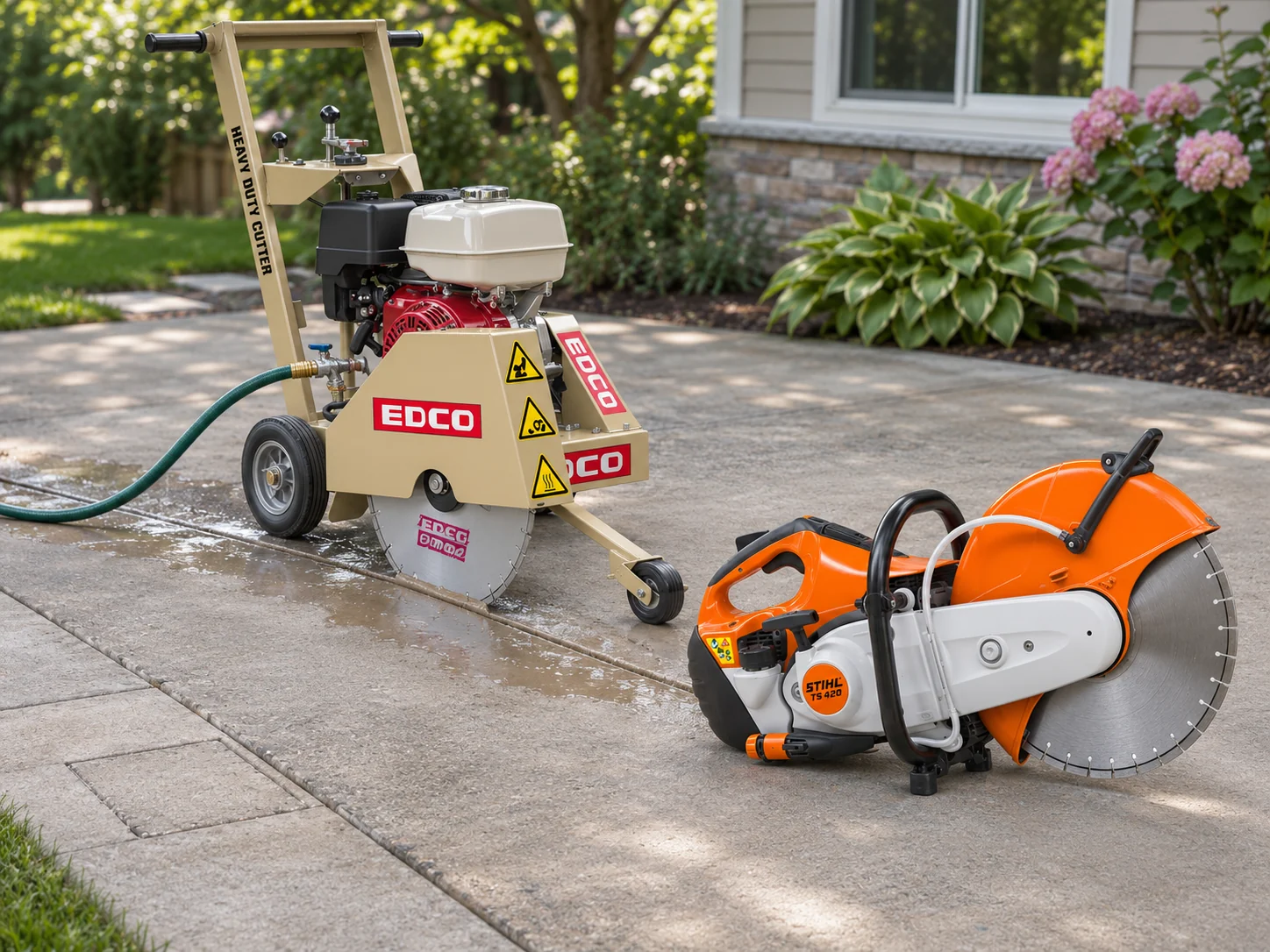
STIHL TS420 handheld cut-off saw
A 14 in blade you carry to the cut. Goes where a cart cannot.

EDCO 18 in walk-behind saw
A 13 hp cart saw for long, deep cuts in cured concrete and asphalt.
The short version: the walk-behind saw cuts flat work, the handheld saw cuts everything else. The walk-behind rides on wheels, holds a set depth and tracks straight, so it is the tool for scoring a slab, cutting a joint, or squaring a patch in a driveway. The handheld saw cuts vertical faces, curves, curbs and pieces you cannot roll a cart over, and it stops at 4.9 in. Neither cuts fresh concrete; that is the early-entry saw. Both make silica dust, so both cut wet and both need a respirator.
A 14 in blade you carry to the cut. Goes where a cart cannot.
A 13 hp cart saw for long, deep cuts in cured concrete and asphalt.
Choose the cut to see which saw starts the job.
Scoring is long straight cuts at a controlled depth across flat concrete. The walk-behind holds depth and line for you, and at 6.75 in it gets through most residential slabs in one pass.
Cut the perimeter where the slab meets anything you are keeping, then a grid sized to the pieces you can handle. Cut most of the way through the thickness so the break follows the line. Run water the whole time. Tell the counter the thickness and that it is concrete, not asphalt, so the blade matches.
A wall is vertical. Only the handheld saw cuts a vertical face, and it cuts block, brick and concrete up to 4.9 in deep. Standard block is cut from both sides to get through.
Mark the opening on both faces, cut the lines wet, and knock out the block from the inside of the cut. Tell the counter what you are cutting so the right blade goes on; rebar and pipe take a different blade from block. The saw is gas powered, so it is not a tool for an enclosed basement without serious ventilation.
A patch needs clean, vertical, straight edges so the new material bonds and does not feather out. The walk-behind cuts those lines flat and at full depth in both asphalt and concrete.
Mark a rectangle outside the damage. Cut the four sides wet, then break out the middle. For asphalt, tell the counter so the asphalt blade is mounted; the two materials wear blades differently. Compact the base before you fill. For a gravel base under the patch, the plate compactor does it.
Curbs, pipe, rebar and steel posts are shapes a cart saw cannot follow. The handheld saw cuts them in place at any angle, and the blade changes with the material.
Tell the counter exactly what you are cutting. Concrete, block and pavers take one blade; rebar, steel pipe and posts take another. Cutting masonry wet keeps dust down and the blade cool. Cut from a stable stance with both hands on the saw and keep the cut line clear of anything that can pinch the blade.
Control joints go in within hours of finishing, while the concrete is too green for either of these saws. The Diamond Products early-entry saw is built for that window. Once the slab has cured, the walk-behind saw cuts joints at depth.
If you are pouring, book the early-entry saw for the same day as the pour. If the slab was poured days ago and has no joints, use the walk-behind saw now; it may already have cracked where it wanted to. Joint depth comes from your mix supplier or spec, not from us.
Save these details before you request equipment.
Tell us what you're working on. Our Hamburg team serves Southeast Michigan, seven days a week.
(810) 231-7368
The 18 in walk-behind saw cuts up to 6.75 in deep. The 14 in STIHL TS420 cuts up to 4.9 in. Those are maximums with a full blade, and a worn blade cuts less. For a slab thicker than the saw's reach, cut from both sides where you can or score as deep as the saw allows and break from the cut. Measure the thickness at an exposed edge before you book.
Yes. Asphalt and concrete wear a blade differently and the wrong one cuts slowly or glazes over. Tell the counter which material you are cutting and we put the right blade on the walk-behind saw. The same goes for the handheld saw: block and pavers take one blade, rebar and steel pipe another. If you are cutting both materials on one job, say so.
Cut wet. Dry cutting concrete throws silica dust that is a serious lung hazard and it overheats the blade. The slurry from wet cutting rinses off if you do it before it sets. Wear a silica-rated respirator even when cutting wet, since the water does not catch everything. Keep other people out of the area while you cut.
No. Fresh concrete spalls and tears under a conventional blade. The early-entry saw is built to cut control joints within hours of finishing and is the tool for that window. After the slab has cured, the walk-behind saw cuts joints and the handheld saw does detail work. Plan the early-entry saw for pour day.
The handheld saw rides in a trunk. The walk-behind saw is 212 lb and fits in a pickup bed with a ramp or two people, or on the 5x10 utility trailer. Delivery is priced by drive time from Hamburg and confirmed at checkout, $85 round trip within 45 minutes for a truck load. Most people pick the saws up themselves and have them delivered only when they are riding along with a skid steer or trailer.