
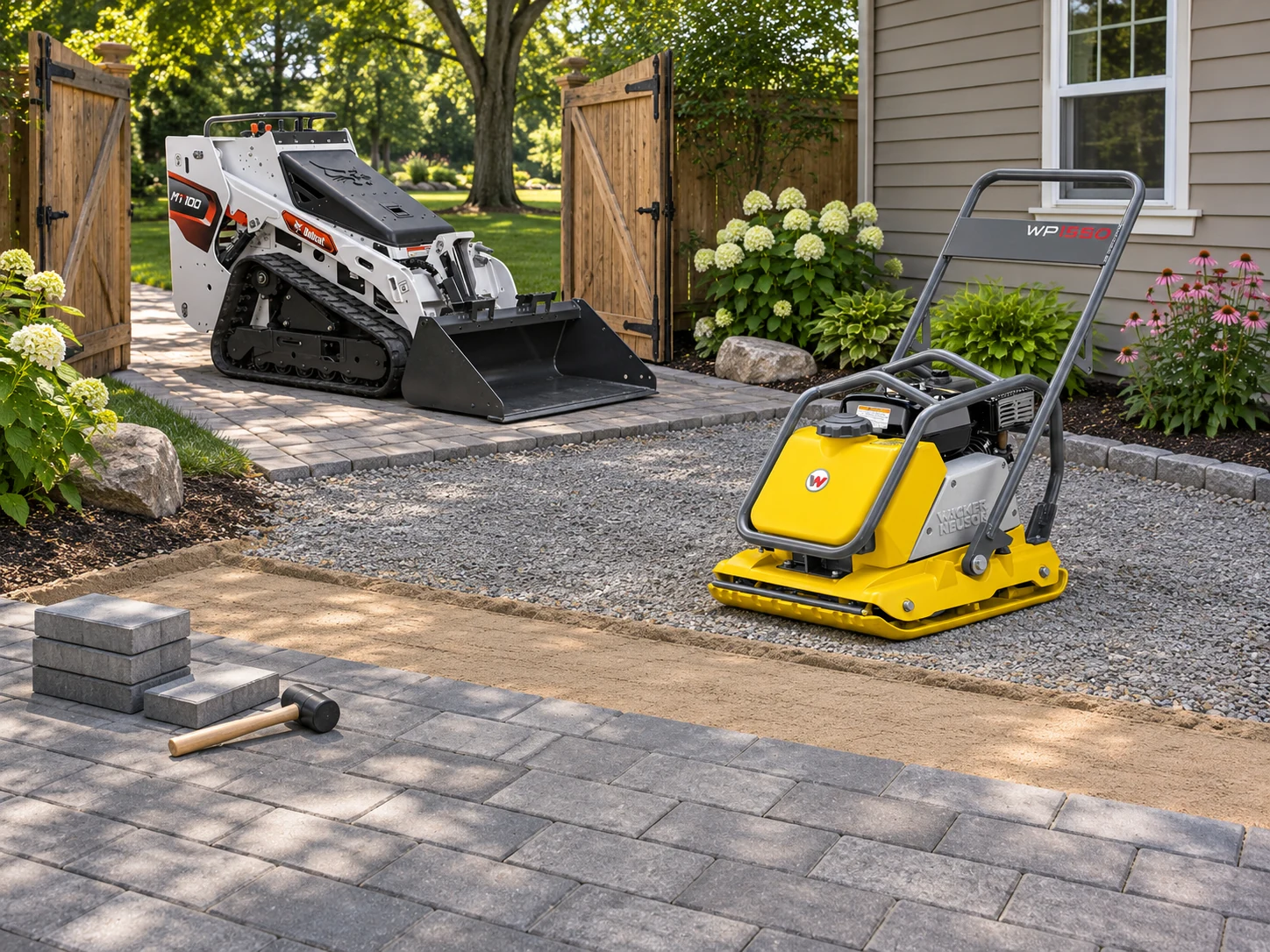
What is under the pavers decides how long the patio lasts
- A paver patio is a layer of pavers sitting on a thin bed of sand, which sits on a compacted crushed stone base, which sits on undisturbed subsoil. The pavers are the part you see. The base is the part that keeps them flat. Nearly every sunken corner, rocking paver or heaved edge traces back to a base that was too thin, not compacted in lifts, or built on loose fill.
- That is why most of the equipment in this guide is for what happens before the first paver goes down: cutting sod, digging to depth, moving stone, and compacting it. Plan the machine time around those steps. The pavers themselves are hand work with one saw.
- Your paver supplier's spec sheet sets the excavation depth, base thickness and bedding depth for your pavers and your soil. Bring those numbers to the counter. They decide how much material moves and which machine makes sense.
When to change the plan or call someone
- A patio against the house needs a slope away from the foundation, and the dig should not undermine footings or cut into a septic field, a drain field, or buried lines. If the footprint sits over any of those, confirm what is there before you excavate. MISS DIG marks public utilities, not private ones.
- If the site holds water after rain, fix drainage before you build. A patio on soil that stays saturated will move no matter how well the base is compacted. Our drainage guides and a call to the counter are the right first step.
- Retaining walls over a couple of feet tall, raised patios that need engineered fill, and anything that involves structural work on the house are outside what a rental guide should cover. Those are jobs for a landscape contractor or an engineer.
The seven steps and the machine for each
Each step names the Ward's equipment that fits and the condition that would change the pick.
Rent it as a package: the typical patio weekend package is the gas sod cutter, the MT100, the plate compactor and the paver saw. Projects like this often run three days or more, and the week rate covers 3 to 7 days, so compare it against single days when you book. Delivery runs seven days a week and is priced by drive time from Hamburg, confirmed at checkout.
Mark the footprint and call MISS DIG 811
Mark the patio with paint or stakes and string. Plan a slight fall away from the house so water drains off the finished surface. Contact MISS DIG 811 at least three business days before you dig; it is free and required by Michigan law. It does not mark private lines such as irrigation, landscape lighting or a line to a shed.
Tape, stakes and string. A rental metal detector can help find property pins and buried metal; it does not replace the MISS DIG locate.
Cut and roll the grass
The gas sod cutter cuts an 18 in strip up to 2.5 in deep so the grass rolls up in pieces you can reuse elsewhere in the yard. Water the area the day before and mark sprinkler heads. A small patch or a bed edge can be done with the manual kick-style cutter instead.
Classen gas sod cutter; manual sod cutter for small patches.
Dig to the depth on your spec sheet
Dig deep enough for the stone base, the bedding sand and the paver thickness. With a backyard gate, the Bobcat MT100 stand-on loader at 35.6 in wide digs and carries spoil out in bucket loads. A larger footprint, a deeper dig, or a footprint tight against the house favors a Bobcat E35 mini excavator for the dig with a dump trailer for the spoil. The E35 is about 70 in wide and needs a clear 6 ft opening plus a route the tracks can travel.
Bobcat MT100 for gated yards; Bobcat E35 plus 7x14 dump trailer for larger digs; Bobcat E10 where only a doorway-width opening exists.
Spread crushed stone in lifts and compact each one
This step makes or breaks the patio. Spread crushed stone a few inches at a time and run the plate compactor over each lift before adding the next. One thick layer compacted once settles later. Move stone from the driveway pile with the MT100 bucket, or with the Canycom tracked buggy if a loader is not on the job; both pass a 36 in opening when the route allows. Check grade and slope as each lift goes down.
Wacker Neuson plate compactor; Bobcat MT100 or Canycom tracked buggy to carry stone.
Screed the sand and set the pavers
Screed a smooth, even layer of bedding sand over the compacted base using pipes and a straightedge. Lay pavers in your pattern working from the laid surface so you never step on screeded sand. Pallets of pavers are heavy; forks on the MT100 move them through a gate, within the machine's 1,000 lb rated capacity, and forks on a full-size loader handle full pallets where access allows.
Hand tools. Optional: forks on the MT100 or on the T66-2 for pallets.
Cut the edge, corner and curve pieces
Edges and curves need cut pavers. The DeWalt 10 in brick and paver saw cuts wet on a stand, so edges are clean and dust stays down; it handles a 3 1/8 in depth and a 25 in rip. For curves and for many cuts marked in place, the STIHL TS420 handheld cut-off saw with a 14 in blade is faster. Cut wet with either saw and plan for silica dust control.
DeWalt 10 in paver saw with stand; STIHL TS420 cut-off saw for curves and in-place cuts.
Compact the pavers and fill the joints
Run the plate compactor over the laid pavers to seat them into the sand. Ask for a pad for the plate so the paver faces are not scuffed. Sweep joint sand into the gaps, compact again, and top up the joints. Edge restraint along open sides keeps the field from spreading.
Wacker Neuson plate compactor with pad.
Check the route before you pick the digging machine
The excavation step is where access decides the machine.
Measure the clear opening
Gate fully open, latch to post, at the narrowest point. The MT100 body is 35.6 in; a bucket is machine width, but forks and the soil conditioner are wider. The E35 needs a clear 6 ft.
Walk the route
Slopes, soft lawn, septic fields, irrigation heads and the turn into the gate. Tracks spread weight; they do not prevent rutting on wet ground. After a hard rain, give it a day.
Know the volume
Square footage times excavation depth gives the spoil volume; the same footprint times base thickness gives the stone volume. Both move through the same opening.
Widths of the machines in this guide
Width is the machine body from our product pages. Confirm the attachment width and the route before calling anything a fit.
Bobcat E10 mini excavator — 28 in retracted / 43 in extended
Canycom tracked buggy — 35 in
Bobcat MT100 stand-on loader — 35.6 in
Bobcat E35 mini excavator — 69.7 in
Before ground disturbance: — arrange utility locating through MISS DIG 811 at least three business days ahead, and locate private lines yourself or with a private locator.
Your patio checklist
Bring these to the counter or put them in a text.
- Patio square footage and shape (straight edges or curves)
- Excavation depth, base thickness and bedding depth from your paver supplier
- Clear width of the narrowest gate or opening on the route
- Where spoil goes and where stone and pavers will be dropped
- Slope direction away from the house
- MISS DIG 811 ticket date
- Delivery address and preferred dates
Let's match the machine to your job.
Tell us what you're working on. Our Hamburg team serves Southeast Michigan, seven days a week.
(810) 231-7368
The weekend package and the alternatives
Questions before you rent
Do I need an excavator, or will the MT100 do the whole job?
It depends on footprint, depth and access. Many backyard patios with a shallow dig and a 36 in gate run entirely on the MT100: it cuts the footprint in passes, carries spoil out and brings stone back in. A larger footprint, a deeper base spec, or a footprint tucked against the house pushes toward the E35, which digs below grade without driving on the finished edge and loads a dump trailer directly. If the E35 cannot reach the backyard, the choice is the MT100 or the E10, which retracts to 28 in. Tell us the square footage, depth and gate width and we will say which way we would go.
How thick should each lift of base stone be?
Follow your paver supplier's spec for total base thickness, and compact in lifts of a few inches rather than all at once. The plate compactor works on the top few inches of loose material; a thick layer compacts on top and stays loose underneath, which shows up as settling a season later. Check grade after each lift so the finished base already has the slope you want. Keep the stone slightly damp while compacting if it is dusty and dry.
Can I run the plate compactor directly on the pavers?
Yes, with a pad between the plate and the paver faces. Ask for the pad when you book the compactor; running bare steel on pavers scuffs and can chip them. Make one pass to seat the pavers into the bedding sand, sweep in joint sand, then compact again to work the sand down into the joints. Stay off the field until the joints are filled.
Will the equipment fit through my gate?
Measure the clear opening with the gate fully open, latch hardware included. The MT100 body is 35.6 in and the Canycom buggy is 35 in, so either can pass a 36 in opening when the attachment and the route allow it; a bucket is machine width, forks and the soil conditioner are wider. The E35 needs a clear 6 ft. Also check the turn into the opening and what the tracks will cross between the driveway and the patio. Our backyard access guide covers the full check.
Should I have it delivered?
The sod cutter, compactor and paver saw fit in a pickup or on the 5x10 utility trailer. The MT100 rides on the 12 ft ramp trailer with a 2 in ball, which a half-ton pickup typically handles; we confirm your setup at the counter. The E35 rides on the 16 ft equipment trailer with a 2 5/16 in ball and needs a 3/4-ton truck or larger. Delivery runs seven days a week on our trucks, priced by drive time from Hamburg: $85 round trip within 45 minutes for truck and trailer loads, $125 for a dual-machine load, and confirmed at checkout.
How many days should I book?
Most people split it: sod cutter and digging machine first, compactor for the base and the finish, saw for the cutting day. Rental time is the time the machine is out, including weekends, with unlimited run hours. The week rate covers 3 to 7 days, and if the job runs long the extra time is prorated, never more than the next full period. Fuel is billed at our cost. Book the saw and compactor for the days you will use them rather than for the whole project.