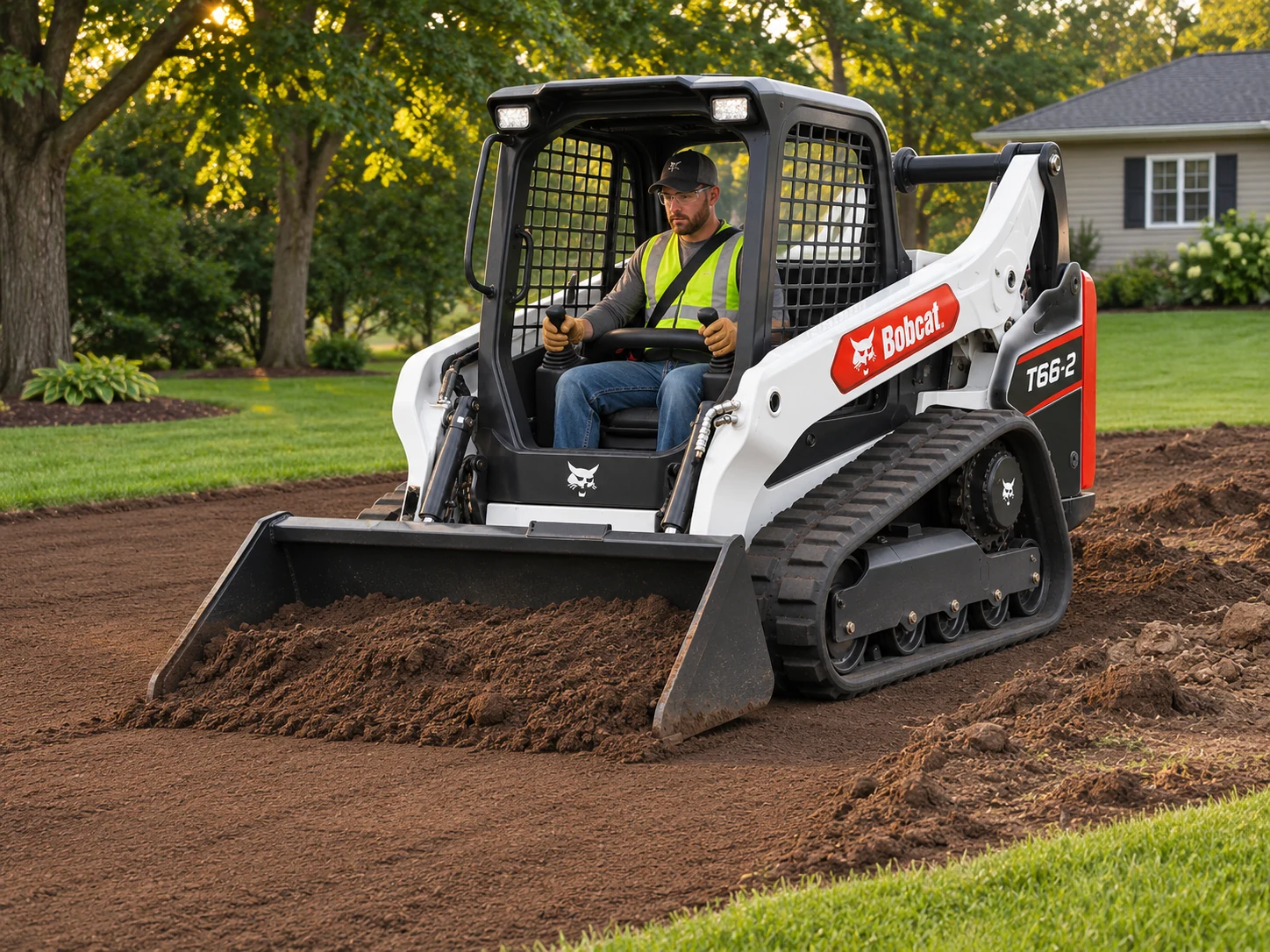
Skid steer / track loader
Move. Spread. Grade.
Best starting point for moving piles and shaping surfaces.
- Move gravel, soil and mulch
- Spread and level material
- Use forks, augers or grapples

Text us at (810) 231-7368
Send a text from your phone, or open your computer's messaging app.
Menu
Not sure what you need? Our team can help.
Hamburg, Michigan • Serving Southeast MichiganEquipment comparison
See what each machine does. Choose a starting point for your project.
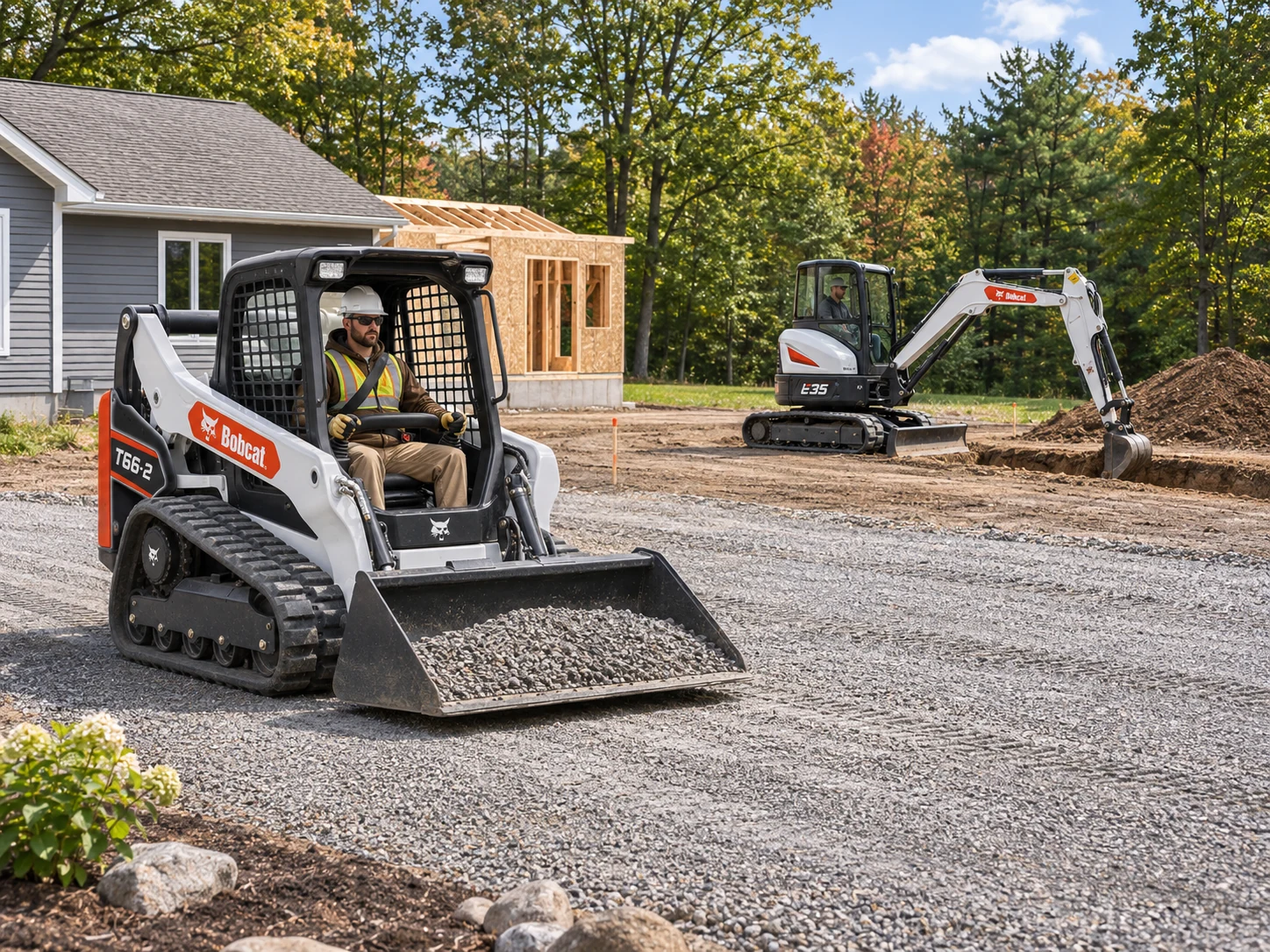
Skid steer / track loader
Best starting point for moving piles and shaping surfaces.
Mini excavator
Best starting point for digging below ground and placing spoil.
The short version: an excavator digs down and swings; a loader drives forward and carries. An excavator removes a bucket of soil from below grade and places it beside the hole or in a trailer without moving its tracks. A loader takes a few inches per pass and moves large volumes across the site fast. Each machine does the other's job slowly and badly.
Best starting point for moving piles and shaping surfaces.
Best starting point for digging below ground and placing spoil.
Choose your main task to see where to start.
Good for repeated trips between a material pile and the work area. A loader scoops, carries and dumps in one motion, then spreads what it dropped.
The Bobcat MT100 stand-on loader is 35.6 in wide for gated yards and lighter loads (1,000 lb rated capacity). The full-size Bobcat T66-2 or Kubota SVL65-2 carries more than twice that per trip when the route allows it. For a wheelbarrow-scale path, a slope, or no loader experience, the Canycom tracked buggy (35 in wide, 2,200 lb payload) carries material without a bucket to operate.
A trencher cuts a narrow, consistent slot and leaves the spoil beside it. A mini excavator digs a wider trench, handles rocks and roots, and places spoil where you want it. Neither is always right.
Ward's tracked trencher cuts a 6 in wide trench up to 36 in deep and is 35.8 in wide, so it suits a straight run of conduit, irrigation line, drain tile or dog fence through a gate, in soil without large rock. Anything that must reach frost depth (about 42 in in most of southeast Michigan, so a potable water line), footings, a trench wider than 6 in, or ground with roots and rock starts with a mini excavator: the E10 for doorway access and digs to about 6 ft, the E35 for most jobs (124 in), the E48 when you need more reach and lift, not more depth.
Grading is a surface job: cut the high spots, fill the low ones, crown the center so water runs off. A loader does this across the whole width of a drive in passes. An excavator can only pull material toward itself.
A full-size tracked loader (Bobcat T66-2 or Kubota SVL65-2) with a bucket handles cutting and back-dragging. For a gravel drive that has washboarded or lost its crown, the 72 in soil conditioner on the T66-2 (it does not fit the Kubota) reshapes and re-levels the existing stone before you add new material. Compaction after grading is a separate step: the 36 in ride-on roller for a full drive, the plate compactor for patches.
A paver patio has four equipment stages: remove what is there, excavate to depth, bring in and spread base, and compact it. Small patios with easy access can do all of it with one loader. Larger or deeper footprints go faster with an excavator for the dig and a loader for the carry.
Stage 1, removal: the gas sod cutter for lawn (18 in, up to 2.5 in deep), or the electric demolition hammer for an old slab. Stage 2, excavation: the E10 or E35 for a deeper dig or a tight footprint against the house; an MT100 or T66-2 bucket for a shallow dig over open ground. Stage 3, material: the loader carries base stone from the driveway pile to the footprint; the tracked buggy does it through a 36 in gate without a loader. Stage 4, compaction: plate compactor in lifts. The paver saw comes last. The typical weekend package in our patio guide is sod cutter, MT100, plate compactor and paver saw.
Neither machine's bucket is the tool here. The question is which auger drive matches your hole count, soil and access. Your fence or deck plans set the hole diameter and depth; the equipment just has to reach them.
A handful of holes in workable soil with tight access: the Little Beaver gas handheld auger (6, 8 or 10 in bits; its engine sits apart from the drill head so it doesn't twist your arms). A full fence line, clay, rock, or holes deeper than a handheld unit reaches: a hydraulic auger on the MT100 (fits a 36 in gate) or on the T66-2 or S570 (more torque; bits to 36 in; 72 in depth without an extension). The first bit is included with every auger; extra bits are added at booking.
Grinding chews the stump into chips below grade and leaves the roots to rot, so you can seed or sod over it. Excavating pulls the entire root ball out, which is what you need if something is being built or planted in that exact spot.
For a stump you just want gone from the lawn, the Vermeer SC30TX tracked stump grinder is 35 in wide, passes a 36 in gate, works on slopes and soft ground, and leaves the lawn around the stump mostly intact. For a stump where a footing, patio or drain line is going, the Bobcat E35 lifts the root ball out; the E48 adds reach and lift for large hardwoods, and the E10 handles small stumps with tight access. Either way, plan for the hole and the debris: a stump grinder leaves chips and a depression to backfill; an excavated root ball fills a dump trailer fast.
A patio project can involve digging, moving material and preparing the base.
Both machines on one delivery truck is routine for us; a dual-machine load is priced at its own delivery tier and confirmed at checkout. Renting both for the days you need them usually costs less than forcing one machine to do a job it isn't built for.
A mini excavator handles the digging and sets spoil aside or straight into a trailer.
A loader carries material across the site and spreads it in lifts.
Match the compactor and method to the base material and your supplier's spec.
Include latches, posts, turns and the attachment width. A bucket or auger is often wider than the machine.
Consider slopes, soft ground, septic fields, irrigation heads and buried structures between the drop point and the work.
Bring digging depth, material quantities and the height you need to load into or reach over.
Width is the machine body. Add the attachment and a few inches each side before you call it a fit: the 66 in grapple on a 67 in loader, or the 56.75 in soil conditioner on a 35.6 in MT100, decide the answer, not the machine. If you're a few inches short, pulling one fence panel is often easier than running the whole job on a smaller machine.
Bobcat E10 mini excavator — 28 in retracted / 43 in extended
Vermeer SC30TX stump grinder — 35 in
Canycom tracked buggy — 35 in
Bobcat MT100 stand-on loader — 35.6 in
Trencher 6 in x 36 in — 35.8 in
Bobcat T66-2 track loader — 67 in
Kubota SVL65-2 track loader — 68 in
Bobcat E35 mini excavator — 69.7 in
Bobcat E48 mini excavator — 72.8 in
Before ground disturbance: — arrange utility locating through MISS DIG 811, including private lines where needed. Review site hazards with our team.
Save these details before you request equipment.
Tell us what you're working on. Our Hamburg team serves Southeast Michigan, seven days a week.
(810) 231-7368
Measure the clear opening with the gate fully open, including the latch hardware. The MT100 body is 35.6 in wide and the E10's undercarriage retracts to 28 in, so either can pass a 36 in opening when the attachment and the route allow it. Full-size loaders and the E35 need a clear 6 ft; the E48 needs more. Width is only half the question: also check the turn into the opening and what the tracks will cross on the way in. Our backyard access guide walks through it.
A standard bucket comes with every loader and excavator rental. Add forks for pallets, an auger for post holes, a root grapple for brush and debris, or a soil conditioner for seedbed and driveway reshaping. Attachments rented with the machine are half price. Tell us the task and we'll confirm the attachment is compatible with the machine you're booking.
Mini excavators and full-size loaders ride on our 16 ft equipment trailer with a 2 5/16 in ball and need a 3/4-ton truck or larger; the MT100 rides on the 12 ft ramp trailer with a 2 in ball, which a half-ton pickup typically handles. The E48 is close to 10,000 lb, so most customers take delivery. Your tow rating has to cover trailer plus machine plus attachments, and we confirm the setup at the counter. Delivery runs 7 days a week on our own trucks, priced by drive time from Hamburg: $85 round trip within 45 minutes, $125 at 46 to 75 minutes, and a quote beyond that. The fee is confirmed at checkout.
You pay for the time the machine is out, including weekends and holidays, not the hours on the meter, and there is no daily or weekly hour cap. Rental periods run 1 to 4 hours, 4.5 to 24 hours, one week (which covers 3 to 7 days) and four weeks. Keep it longer than planned and the extra time is prorated, never more than the next full period. Fuel is billed at our cost with no markup.
Yes. Michigan law requires contacting MISS DIG 811 at least three business days before digging, trenching, augering or grinding below grade, and the service is free. Private lines (irrigation, invisible fence, landscape lighting, a line from the house to a shed or pole barn) are not marked by MISS DIG; use your own records or a private locator. A rental metal detector helps you look for pins and buried metal but does not replace the locate.
Narrow buckets dig cleaner trenches; wide buckets move more dirt and clean up faster. The first bucket is included (E10: 8 or 15 in; E35: 12 or 24 in toothed; E48: 24 in toothed). Additional buckets, including smooth grading buckets, add $30 for a day, $90 for a week or $270 for four weeks. Tell us what is going in the trench and we'll match the bucket to it.