
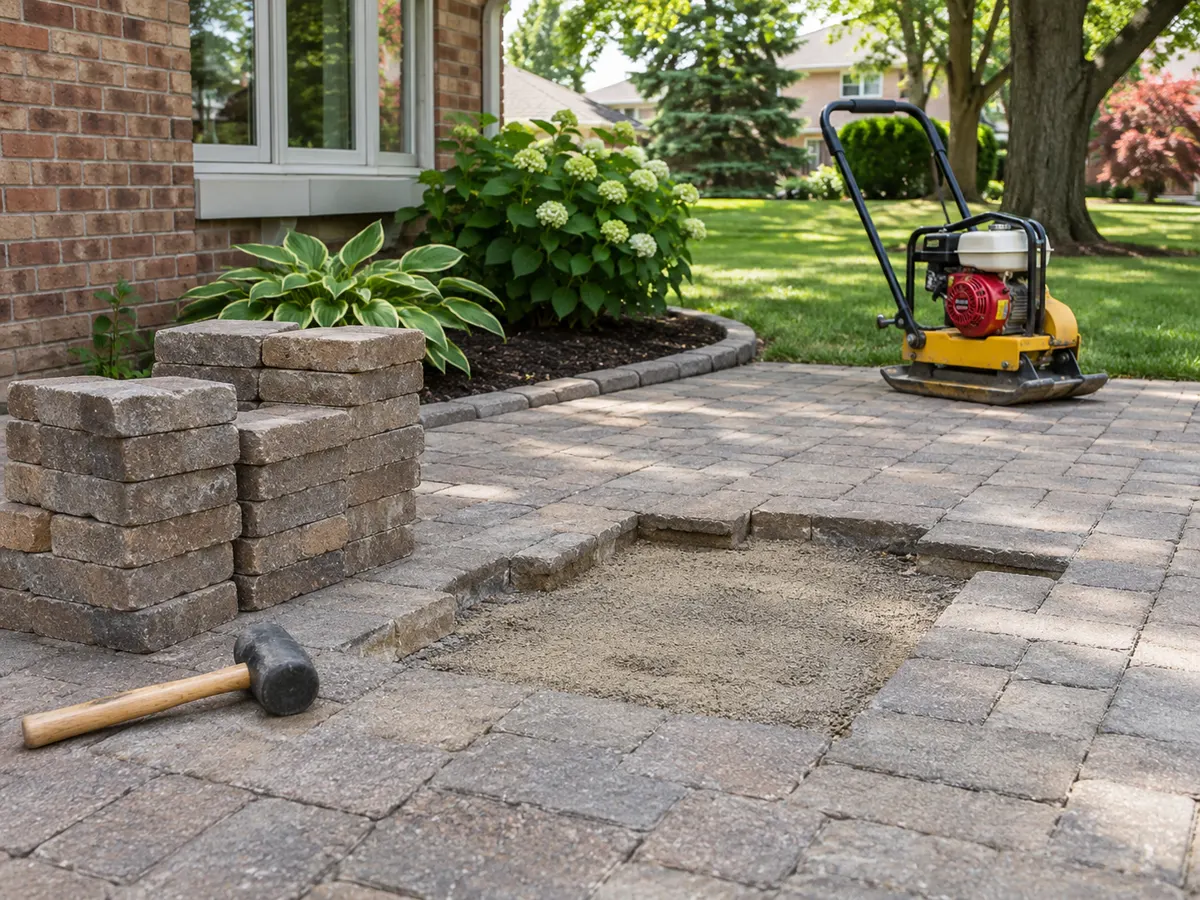
Why pavers sink, and why the fix is under them
- Pavers do not sink. The base under them does. A low spot in the field, a dip along the house, or a border that leans out all mean something moved below the sand: a thin base, a base that was never compacted in lifts, soil that washed out from a downspout or a leaking hose bib, an old stump rotting away, or bedding sand laid too thick and compressing. Heaving after winter usually means water got into the base and froze.
- The repair is to lift the pavers over the bad area plus a border of good ones, dig the base down until you reach material that is firm, rebuild it in compacted lifts to the right height, screed fresh sand, and relay the same pavers. If you only pour sand into the low spot and set the pavers back, it sinks again.
- The equipment is light: a plate compactor and hand tools for most repairs, plus a sod cutter or the MT100 if the bad area is big enough to need real digging and carrying. The diagnosis step is what saves you from doing it twice.
When the whole patio has to come up
- If more than a third of the surface is low, if the base turns out to be a couple of inches of stone over topsoil, or if several areas have failed in different places, patching will chase the problem around the patio. At that point it is a rebuild: lift everything, stack the pavers, and start again from our paver patio walkthrough with a proper base.
- If the sunken area sits over a septic tank, a drain field, a buried downspout line or a utility, stop digging and find out what is there. If the settling is next to the foundation and the grade now runs toward the house, that is a drainage problem to solve first. For a retaining wall that has moved along with the pavers, or for settlement that keeps progressing, bring in a landscape contractor.
Lift, diagnose, rebuild, reset
Six steps. The rebuild steps are the same ones used when the patio was first built.
Most repairs rent one machine: the plate compactor, often on the day rate. Rental time is the time it is out, including weekends, with unlimited run hours. If the area is large enough to need the MT100 for digging and carrying, book both on the same trailer.
Find the full extent of the low area
Lay a straightedge or run a string across the surface and mark every paver that sits low, then mark one more course of good pavers around that. The base failure extends past the visible dip. Note the pattern so you can relay it the same way; a phone photo of the marked area is enough.
Straightedge, string line, chalk, camera.
Pull the pavers and stack them in order
Pry out the first paver with two flat screwdrivers or a paver extractor, then lift the rest by hand. Scrape old joint sand off and stack them near the work in the order they came out. If the border is bonded or the edge restraint is in the way, free it carefully; you will reuse it.
Hand tools. A rented STIHL TS420 cut-off saw frees a glued or mortared border if needed.
Dig into the base and find out what failed
Scrape the bedding sand aside and look at the base. Is there enough crushed stone, or did you hit topsoil an inch down? Is it wet? Is there a void, a root, a rotted stump, or a channel from a downspout? Probe with a bar: firm stone resists, washed or loose material gives. Dig out everything that is loose or wet down to firm material, even if that goes deeper than the original base.
Shovel, digging bar. Bobcat MT100 if the area is large and the spoil has to leave the yard.
Fix the cause, then place stone in compacted lifts
If a downspout fed the washout, extend it before you backfill. Then bring the hole back up with crushed stone a few inches at a time, misting each lift and compacting it with the plate compactor before adding the next. The plate is about 23 by 20 in and reaches most repair areas; use a hand tamper in corners. Stop at the height where the original base meets the sand, and check that the new base slopes the same way as the rest.
Wacker Neuson plate compactor; hand tamper for edges.
Screed fresh sand and relay the pavers
Screed bedding sand to the same thickness as the surrounding field, using two pipes and a straightedge set to the existing paver bottoms. Relay the pavers in the original pattern, working from the good edge inward, and keep them tight. Tap each one level with its neighbors using a rubber mallet. Put the edge restraint back and re-spike it.
Hand tools, rubber mallet, screed pipes.
Compact the pavers and refill the joints
Run the plate compactor with a pad over the reset area and a course or two beyond it to seat the pavers evenly into the sand. Sweep joint sand into the gaps, compact again, and top up until the joints are full. Keep foot traffic off until the joints are filled.
Wacker Neuson plate compactor with pad.
Your paver repair checklist
Have these ready before you book.
- Size of the low or heaved area, plus one course around it
- What is near it: downspout, hose bib, tree, septic, foundation
- Whether the pavers are loose-laid or any border is bonded
- Where excavated material and old sand will go
- Crushed stone, bedding sand and joint sand on hand before you start
- Clear width of any gate if the MT100 is coming
Let's match the machine to your job.
Tell us what you're working on. Our Hamburg team serves Southeast Michigan, seven days a week.
(810) 231-7368
Equipment for a paver repair
Questions before you rent
Can I just add sand under the low pavers?
You can, and it will sink again. The sand did not fail; the base under it did. Adding sand puts a thick compressible layer where there should be a thin one, and the next season's rain and frost press it back down. Lift the pavers, take the base down to firm material, rebuild it in compacted lifts, then screed sand at the original thickness. It is more work once instead of a little work every spring.
Do I need a plate compactor for a small repair?
For anything bigger than a couple of pavers, yes. The repair only lasts if the new stone is compacted in lifts, and a hand tamper does not get the same density across an area. The plate compactor also seats the relaid pavers evenly at the end; ask for a pad so the plate does not scuff them. For a patch of two or three pavers along an edge, a hand tamper and a rubber mallet will do.
The base under the pavers is wet. What do I do?
Find where the water comes from before you rebuild. The usual suspects are a downspout discharging near the patio, a hose bib dripping, lawn grading that runs toward the patio, or a low spot in the yard that holds water. Fix the source, let the hole dry, then dig out everything that is soft and rebuild with clean stone in compacted lifts. If water keeps coming from below after rain, that is a drainage project and we can talk through the options.
How do I know if I should patch or redo the whole patio?
Patch when the failure is local and has an obvious cause: one downspout, one rotted stump, one washout. Redo when the base under the lifted area turns out to be too thin everywhere, when several unrelated areas have settled, or when more than about a third of the surface is off. Lift a few pavers at the edge of a good area and look at the base there too; if it is also thin, the rest will follow. Our paver patio walkthrough covers the rebuild from the base up.
How do I get the compactor home?
The plate compactor weighs about 194 lb and fits in a pickup bed or on the 5x10 utility trailer; it is a two-person lift or a ramp job. If the MT100 is coming too, it rides on the 12 ft ramp trailer with a 2 in ball, which a half-ton pickup typically handles; we confirm your setup at the counter. Delivery runs seven days a week, priced by drive time from Hamburg and confirmed at checkout: $85 round trip within 45 minutes for a truck and trailer load.