
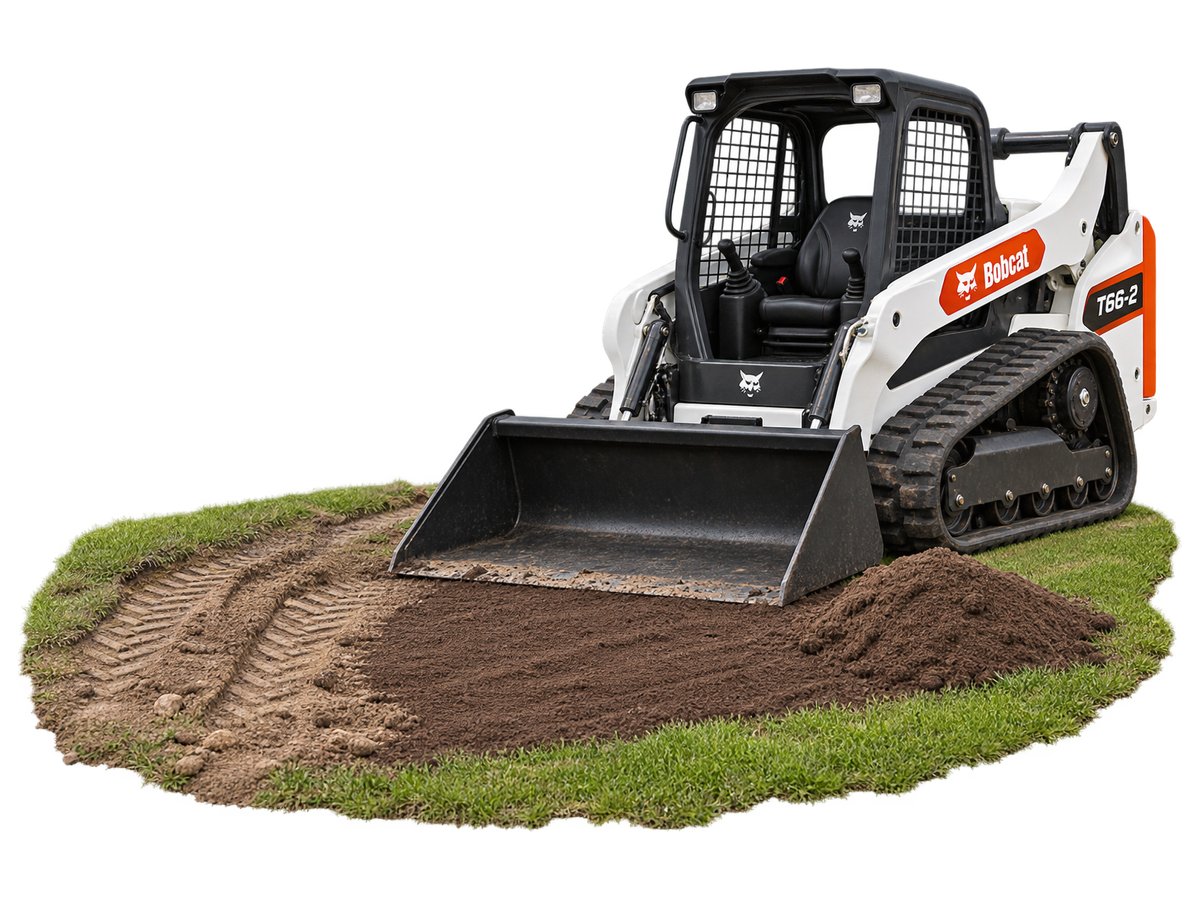
Putting the yard back, in order
Six stages. Which ones you rent for depends on how hard the yard was hit. A few ruts need stage 3 and 5; a lot that was a staging area for a season needs all six.
If the construction job isn't finished, wait. Restoring the lawn before the last concrete truck or trailer load comes through means doing it twice. Plywood over soft spots and a single marked route for remaining traffic limits the new damage.
Walk it and sort the damage
Construction leaves three kinds of damage, and each needs different equipment. Ruts and low spots are a grading problem. Hard, packed soil is a compaction problem; push a screwdriver in after a rain and compare it to an untouched corner of the yard. Debris (gravel, nails, concrete splatter, lumber offcuts, buried scraps) is a cleanup problem. Mark where each shows up, note where water now collects, and measure the area. Also check what's under it: a new water, electric or septic line often runs through exactly the strip the trucks drove on.
Tape, flags, a screwdriver. Metal detector for nails and buried scrap in a yard you'll mow.
Get the debris off and out
Surface debris first. The 66 in root grapple on the Bobcat T66-2 picks up lumber, brush, chunks of concrete and root wads and lets soil fall through the tines; the 36 in grapple does the same on the MT100 through a backyard gate. Loose gravel that got spread over the lawn is a bucket job, scraped into a pile and hauled. The 7x14 dump trailer takes the load away; it fills by weight long before volume with concrete or wet soil. Nails and metal scrap that will end up in a mower are worth a pass with the metal detector before you seed.
Root grapple (66 in on T66-2, 36 in on MT100); loader bucket; 7x14 dump trailer; metal detector.
Break up the compacted soil
Soil that carried loaded trucks is packed well below the surface, and grass roots won't go into it. For a whole yard, a soil conditioner on a loader tills the top layer, pulls rocks and debris to the surface and starts leveling in the same pass: the 72 in hydraulic soil conditioner on the Bobcat T66-2 or wheeled S570 (it is not compatible with the Kubota SVL65-2), or the 48 in unit on the MT100 for a fenced yard. For a strip or a small area, the Maxim mid-tine tiller breaks ground to 10 in. For light compaction on an otherwise intact lawn, a core aerator may be enough. If the yard was a staging area for months and the soil is hard well below what these tools reach, talk to a landscaper before you seed over it. Call MISS DIG 811 at least three business days before deep tilling anywhere near the new utility runs.
72 in soil conditioner on T66-2 or S570; 48 in soil conditioner on MT100; Maxim mid-tine tiller; core aerator for light compaction.
Fill the ruts and set the grade
Ruts filled from the top settle back into ruts. Loosen the bottom of each one first (stage 3 handles this if you conditioned the whole area), then fill with topsoil. Bring in enough topsoil to replace what the trucks displaced and what you hauled out with the debris; a loader bucket moves it from the pile, or the Canycom tracked buggy carries it through a 36 in gate. The soil conditioner's blade sets the final grade: angle it to push soil toward low spots, keep the grade falling away from the house and any new slab, and finish with a smooth, firm surface. Look at where water collected during the build and make sure the new grade moves it somewhere better.
T66-2 or MT100 with bucket; Canycom tracked buggy; soil conditioner for finish grade.
Cover the bare soil
Seed is the usual choice for a large restored area; sod for a strip you want green now or a slope that would wash. Spread seed at the rate your supplier gives you, or lay sod the day it arrives. Fall is the best seeding window in Michigan. If you seed, this is the time to think about erosion on any slope the trucks cut into, since bare conditioned soil washes in a hard rain. Your seed or sod supplier is the source for rates and watering.
Your spreader, or sod. No rental for this stage.
Press seed or sod into contact
A water-filled lawn roller presses seed into the soil or seats sod roots against it. Part-fill the roller; you spent stage 3 loosening the soil and you don't want to pack it again. Roll when the ground is damp, not soggy. For a large restored area the 48 in roller (480 lb full) covers ground fastest; the 24 in and 36 in sizes suit smaller yards. Drain the roller before you return it. A lawn roller is not a compactor. If you need a firm base under a new drive or pad, that's the plate compactor or the 36 in ride-on roller, and a separate job.
Lawn roller, 24, 36 or 48 in, water-filled.
What changes the plan
- A few tire ruts across an otherwise good lawn: skip the loader. Loosen the bottom of each rut with a fork or the mid-tine tiller, fill with topsoil, seed and roll. The core aerator helps the surrounding compacted strip.
- A whole lot that was graded flat and driven on: this is a loader job. The 72 in soil conditioner on the T66-2 covers ground fast and pulls the rocks the build left behind. Attachments rented with a Ward's skid steer are half price.
- A fenced backyard the trucks reached through a gate: the MT100 and its 48 in conditioner, if the conditioner can get in. It is 56.75 in overall and will not pass a 36 in gate on the machine; measure the opening and ask us about getting it inside.
- Wet ground: wait for it to dry. Tracks spread weight and reduce rutting, but they don't prevent lawn damage and don't make saturated soil workable. Conditioning wet soil makes clods, not seedbed. After a hard rain, give it a day.
- A new septic field, drain field or shallow utility run under the damaged area: keep the conditioner and tiller off it until you know the depth, and call MISS DIG 811. Your contractor knows where the private lines went; MISS DIG does not mark those.
When to bring in a landscaper
- Grading that has to move water away from a new foundation, a slope that needs to be rebuilt, soil so compacted that the conditioner only scratches it, or a yard where the topsoil was scraped off and sold during the build: these are design questions as much as equipment questions. A landscaper can tell you whether you need new topsoil by the truckload or a drainage fix before any seed goes down. We're glad to supply the machines either way.
Check access before you book a loader
The route the trucks used is usually the route your loader uses. Make sure it still works.
Measure the clear opening
Gate fully open, latch to post, and the turn into it. The MT100 body is 35.6 in; its 48 in soil conditioner is 56.75 in overall. The 72 in conditioner on the T66-2 is 86.2 in wide, more than the 67 in machine.
Walk the route
Soft spots the trucks left, new septic or drain fields, fresh utility trenches that haven't settled, and the parts of the lawn you want to keep. Plywood over soft spots helps.
Know the quantities
Square footage of damaged lawn, roughly how many yards of debris are leaving and how many yards of topsoil are coming in. It decides the loader size and the trailer.
Machine and attachment widths, from our product pages
Width is the body or the attachment as listed. An attachment wider than the machine decides the fit, not the machine. Measure the clear opening and the route before calling anything a fit.
Canycom tracked buggy — 35 in
Bobcat MT100 stand-on loader — 35.6 in
48 in soil conditioner for MT100 (overall) — 56.75 in
66 in root grapple — 66 in
Bobcat T66-2 track loader — 67 in
Bobcat S570 wheeled loader (with bucket) — 68 in
72 in soil conditioner (overall) — 86.2 in
Before tilling or conditioning near new utilities: — contact MISS DIG 811 at least three business days ahead. It is free and required by Michigan law. It does not mark private lines; get those from your contractor's drawings. A rental metal detector helps you find nails and scrap but does not replace the locate.
Your restoration checklist
Save these details before you request equipment.
- Construction finished, or a single route marked for remaining traffic
- Square footage of damaged lawn
- Debris on site: gravel, concrete, lumber, buried scrap
- Compaction check: screwdriver test vs an untouched corner
- Location and depth of new utility lines, septic or drain fields
- Narrowest opening and route for a loader
- Topsoil quantity needed and where it will be dropped
- Seed or sod lined up for right after grading
Let's match the machine to your job.
Tell us what you're working on. Our Hamburg team serves Southeast Michigan, seven days a week.
(810) 231-7368
Explore equipment for this guide
Questions before you rent
What does a soil conditioner actually do?
It's a tiller, a rock rake and a grading blade in one attachment. A rotating drum breaks up the top layer of soil, the teeth pull rocks, roots and debris to the surface and windrow them to one side, and the frame acts as a blade that levels as you drive. The 72 in unit on the T66-2 angles 25 degrees left or right so you can push material toward a low spot. On a yard that a build left hard, rocky and uneven, it does in one pass what a tiller, a rake and a box blade do in three. It is also called a Harley rake or power rake.
Can I just aerate a compacted construction yard?
If the lawn is still mostly intact and the compaction is from foot traffic and the odd wheelbarrow, core aeration helps. Where loaded trucks and a skid steer ran for months, the compaction is deeper and the grass is usually gone anyway. In that case loosening the soil with a conditioner or tiller and regrading is the realistic fix, and aerating is something you do in later years. If the soil is hard well below what the conditioner reaches, ask a landscaper before you seed.
Will the loader fit through my gate?
Measure the clear opening with the gate fully open, latch to post. The Bobcat MT100 is 35.6 in wide and passes most 36 in gates when the approach allows it. Its 48 in soil conditioner is 56.75 in overall and does not, so it has to be brought in separately or through a wider opening. The T66-2 is 67 in and the 72 in conditioner is 86.2 in overall, so those need a clear route well over 6 ft. If you are a few inches short, removing one fence panel is often easier than doing the job with a smaller machine. Our backyard access guide covers the details.
How do I get rid of the debris and bring in topsoil?
Our 7x14 dump trailer holds 10.9 cubic yards and is rated at 14,000 lb GVWR, and it needs a truck with a brake controller. Concrete and wet soil hit the weight limit before the trailer looks full, so load by weight. The 5x10 utility trailer handles lighter loads up to 2,000 lb. Topsoil usually comes from your supplier by the truckload; have it dropped where a loader can reach it without crossing the lawn you're keeping.
Should I rent for a day or a week?
A yard restoration with a loader, grapple and soil conditioner usually runs across a few days once you count debris hauling and topsoil delivery. The week rate covers 3 to 7 days, and attachments rented with a Ward's skid steer are half price. You pay for the time the machine is out, with no hour cap on the meter. Keep it longer than planned and the extra time is prorated, never more than the next full period. Delivery runs 7 days a week, priced by drive time from Hamburg: $85 round trip within 45 minutes for a truck and trailer load, $125 at 46 to 75 minutes, confirmed at checkout.