
A pole barn, in order
Each phase has its own machine. Book them in sequence and have the site ready when each one arrives.
The loader is on site in three of six phases; a four-week rental with half-price attachments (grapple, auger, forks) usually beats booking it three times. The telehandler and the lift are the opposite: book them tight to their phase, because they are delivered on our trucks and sit idle otherwise. The week rate covers 3 to 7 days, and fuel is billed at our cost.
Clear and grade the pad
Strip the sod and topsoil off the footprint plus a working margin for the telehandler and the material drops. Pull brush and small stumps with the 66 in root grapple so you are not hauling soil with the roots. Rough-grade the pad so it drains away on every side, and stockpile the topsoil where the trucks will not need to drive. Tracks keep the T66-2 working on soft ground; they do not make saturated ground workable, so after a hard rain give it a day.
Bobcat T66-2 (or Kubota SVL65-2) with bucket and 66 in root grapple; 7x14 dump trailer for brush and spoil
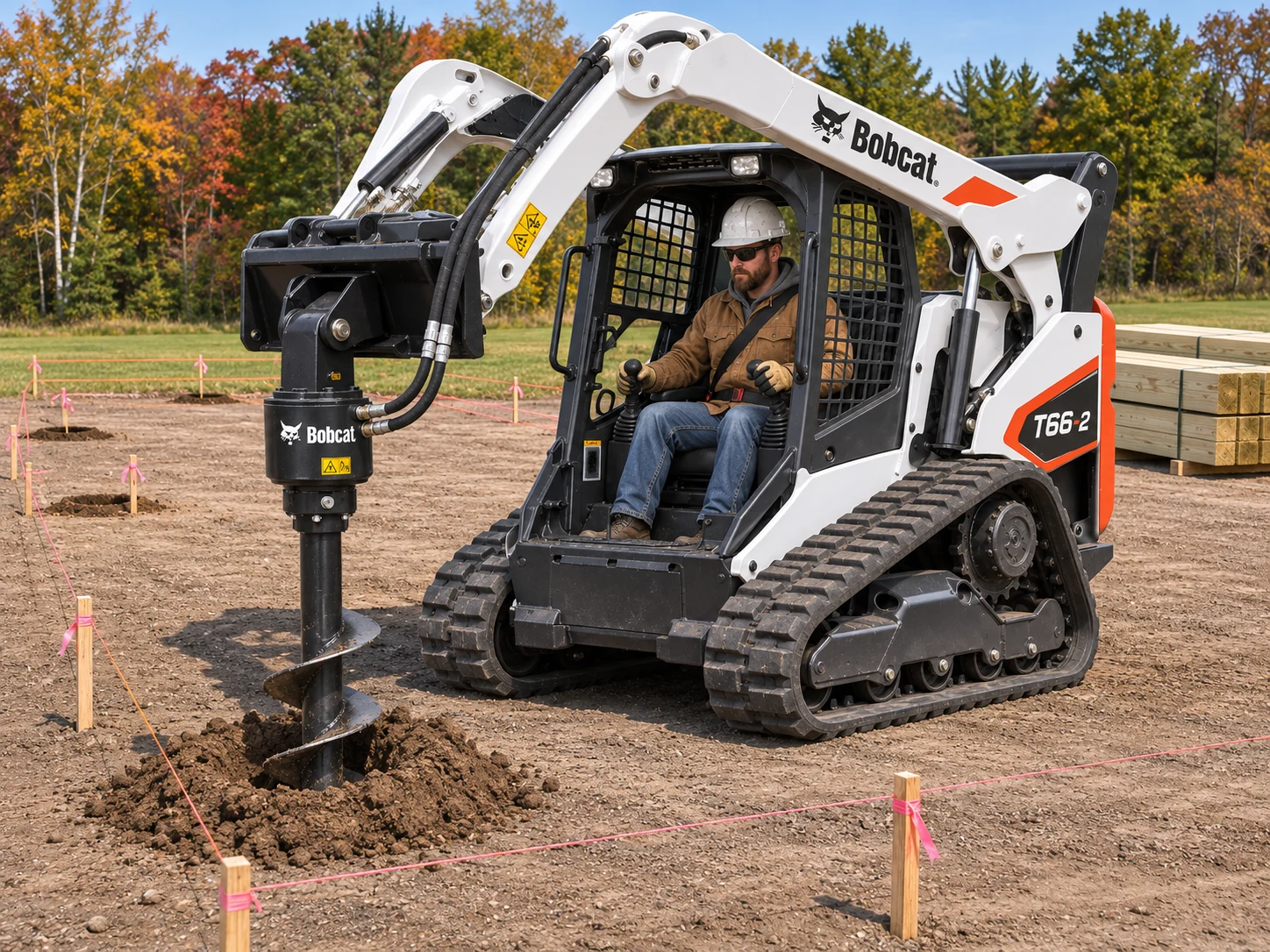
Auger the post holes
Post-frame buildings put a lot of holes in a straight line, often in clay. The hydraulic auger on the T66-2 has the torque for it, with bits from 6 to 36 in and 72 in of depth without an extension; the first bit is included and bit sizes are confirmed at booking. Hole diameter and depth come from your plans and your building department. Contact MISS DIG 811 at least three business days before you drill; it is free, required by Michigan law, and does not mark private lines. Keep the loader on site after the holes are drilled; it backfills and sets the stone or concrete collars.
Bobcat T66-2 with hydraulic auger (S570 auger package on firm ground only); concrete mixer for post collars
Stand the posts and stock the site
Laminated posts and the girts, headers and skirt boards arrive as bundles. A telehandler with forks picks the bundle off the truck, carries it to the wall line and lifts a post upright into its hole for the crew to plumb and brace. The SkyTrak 6034 handles this on most residential barns; if the same machine will set the trusses in the next phase, book the 6042 now and keep it. Operators must be trained, and the chart in the cab governs every lift.
SkyTrak 6034 or 6042 telehandler with forks; T66-2 with forks for ground-level staging
Set the trusses with a truss boom
Pole barn trusses are long and the sidewalls are tall, so the set is high and far from where the machine parks. The 6042 reaches 42 ft 4 in up and 29 ft 6 in forward; the 6034 does a lower barn on a tight lot; the 8042 keeps more capacity on the chart for heavy or doubled trusses. The 15 ft truss boom hangs the truss from a 2,000 lb hook so the crew can walk it onto the plates. The boom and the extension reduce what the machine can lift, so read the chart with the attachment on. Tag lines on both ends. Have the heaviest truss weight from the drawings before you call.
SkyTrak 6034, 6042 or 8042 with the 15 ft truss boom
Work the walls and roof from a lift
Steel siding, trim and roof panels mean hours along every wall and up the roof slope. A 45 ft boom lift puts the crew at the eave and ridge with 27 ft of outreach. The Haulotte 4527A tows behind a properly rated pickup and sets outriggers on firm ground or pads; the 45XA drives along the building without re-setting, which suits a long sidewall. Occupants wear a harness tied off. The telehandler forks can land roof panel bundles while it is still on site. The 10 ft 6 in aluminum brake bends trim on the ground.
Haulotte 4527A towable or 45XA drivable boom lift; aluminum brake; 32 ft extension ladder for a quick task
Base, pour and cut the slab
Spread stone inside the skirt boards in lifts and compact each one. The 36 in ride-on roller covers a barn floor quickly; the plate compactor handles edges and around posts. Ready-mix trucks often cannot reach the back of the barn, so the Canycom tracked buggy carries 2,200 lb a trip across soft ground, and the towable mixer handles small pours and post collars. Cut control joints with the early-entry saw within hours of finishing, before the slab decides where to crack on its own.
36 in ride-on roller and plate compactor; concrete mixer; Canycom tracked buggy; early-entry saw
The ground decides the week
- A pole barn site is a field, and fields are soft in spring and after rain. Every machine on this page except the mixer needs firm ground to do its job: the auger to stay plumb, the telehandler to lift at full chart, the boom lift to set its outriggers. The stone you spread for the floor and the drive is also your staging pad. Put it down early, before the telehandler is booked, and have a firm spot for the truss stack and the machine's parking place.
- Tracks spread weight and reduce rutting on a lawn or a pasture. They do not prevent damage to the surface and they do not make saturated ground workable. After a hard rain, give it a day before the loader or the telehandler arrives. If your schedule cannot wait for the ground, the week rate gives room to work the dry days without paying by the single day.
When the barn is bigger than the fleet
- Residential and small agricultural pole barns are within what we rent. A wide-span commercial building with steel trusses that land outside the 10042's chart at reach, or a set that must be placed over a structure the telehandler cannot approach, is a crane job. Full-depth basements or large cut-and-fill grading need excavators and dozers we do not carry. Call with the drawings and we'll tell you which parts of the job fit the fleet and which need a contractor with larger equipment.
Before the first delivery, check the site.
Measure the lane and the set
A clear lane at least a foot wider than the machine from the road to the pad, with room for our truck to unload a telehandler. For the truss set, the horizontal distance from where the telehandler can park to the far plate, and the plate height.
Check the ground and the drainage
Firm, level staging for pallets and machines, off any septic field. Watch where water ran across the field during the last rain; the pad has to shed it.
Look up and look down
Overhead lines along the lane and at the set. MISS DIG 811 at least three business days before drilling, plus any private lines: a run to an existing barn, a well line, invisible fence.
Machine widths, from our product pages
Width is the machine body; the grapple is 66 in on a 67 in loader, and telehandler forks and a truss boom add length that swings. These machines want a field lane, not a backyard gate.
Bobcat T66-2 track loader — 67 in
Kubota SVL65-2 track loader — 68 in
SkyTrak 6034 telehandler (14,500 lb) — 7 ft 11 in
SkyTrak 6042 telehandler (19,100 lb) — 7 ft 11 in
SkyTrak 8042 telehandler (21,200 lb) — 8 ft 3.6 in
Before ground disturbance: — arrange utility locating through MISS DIG 811 at least three business days ahead, including private lines where needed. Telehandler and lift operators must be trained; boom occupants tie off.
Your pole barn checklist
Save these details before you request equipment.
- Building footprint, post count, hole diameter and depth from the plans
- MISS DIG 811 ticket date and private lines located
- Heaviest truss weight and span from the truss drawings
- Plate height and horizontal distance from the telehandler spot to the far wall
- Ground condition, slope and where the stone pad goes
- Overhead lines on the lane and at the set
- Ready-mix access to the floor, or a buggy route
- Phase dates, operators and their training
Let's match the machine to your job.
Tell us what you're working on. Our Hamburg team serves Southeast Michigan, seven days a week.
(810) 231-7368
Explore equipment for this guide
Questions before you rent
Which auger for pole barn posts?
The hydraulic auger on the Bobcat T66-2. Long runs of large holes in clay want machine torque, and the tracks keep it working on a soft field. Bits run from 6 to 36 in and it drills 72 in deep without an extension; the first bit is included and we confirm sizes at booking. The S570 wheeled auger package does the same on firm, dry ground. The handheld Little Beaver and the MT100 auger are for fence posts and deck footings, not a barn's post count. Hole size and depth come from your plans and your building department.
6034, 6042 or 8042 for the trusses?
It depends on the heaviest truss and how far the machine sits from the far plate. The 6034 lifts 34 ft 5 in with 23 ft 2 in of forward reach and suits a lower barn on a tight lot. The 6042 lifts 42 ft 4 in with 29 ft 6 in of reach and is the usual pole barn machine. The 8042 has the same reach with more capacity left on the chart for heavy or doubled trusses. All three are rated at the carriage with the boom retracted; the truss boom reduces capacity, and the chart in the cab decides. Bring the truss weight from the drawings and the two distances and we'll pick with you.
How does delivery work across the phases?
Each machine is its own delivery and pickup, seven days a week on our trucks, priced by drive time from Hamburg and confirmed at checkout. The loader and a mini excavator run $85 round trip within 45 minutes and $125 at 46 to 75 minutes, or ride together as a dual-machine load at $125 and $200. Towable booms are $125 and $200. Telehandlers are delivered on our trucks only at $350 and $450. Beyond 75 minutes we quote by phone. The T66-2 can also go home on our 16 ft trailer behind a 3/4-ton or larger truck, and the 4527A tows behind a properly rated pickup.
How long will each phase take?
We do not give completion times; they depend on your crew, the soil and the weather. What we can say is how the billing works: you pay for the time the machine is out with unlimited run hours, the week rate covers 3 to 7 days, and four weeks is much cheaper per day for a machine that stays the whole build. Most barns keep the loader for weeks and the telehandler and lift for days. Overruns are prorated, never more than the next full period. Fuel is billed at our cost.
Can the crew work from the telehandler instead of renting a lift?
For a short task, the safety work platform on the telehandler lifts workers and tools: 1,000 lb, up to 4 people, fall protection worn by everyone on it. Nobody rides the forks. For siding and roofing, which is hours along every wall, a boom lift is the safer machine and the right one; the 4527A and 45XA reach 45 ft with 27 ft of outreach and move with the work. Operators of both machines must be trained.
Do I need MISS DIG for post holes?
Yes. Augering is excavation. Contact MISS DIG 811 at least three business days before you drill; the service is free and required by Michigan law. It marks public utilities only. A line to an existing barn or well, invisible fence or landscape lighting is private and yours to find, with your own records or a private locator. A rental metal detector helps you look for buried metal and property pins but does not replace the locate.