
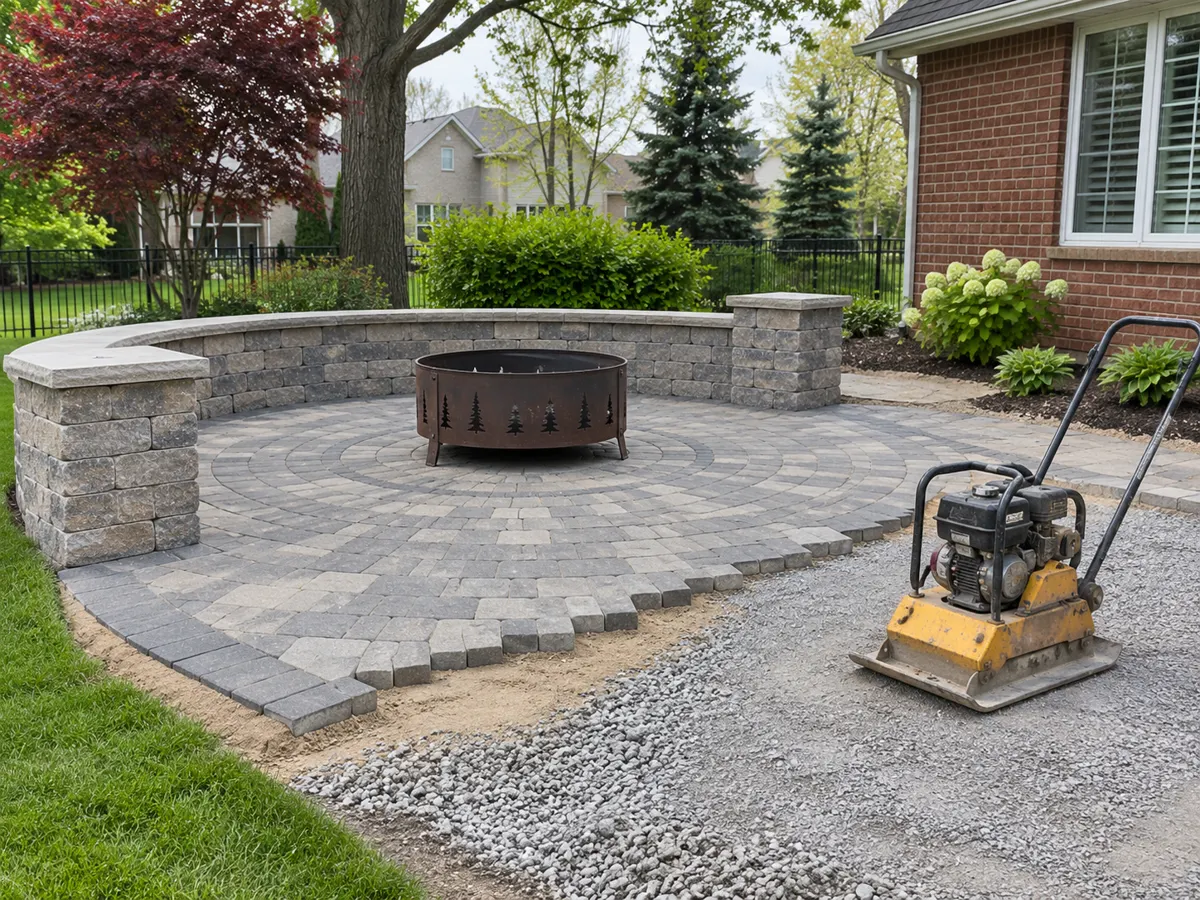
What is different about a fire pit circle
- A fire pit area is usually out in the yard rather than against the house. That means a longer carry for spoil and stone, often across lawn, and often through a gate. It also means the slope does not have to run away from a foundation; it just has to shed water off the surface, so a gentle fall from the center out, or across the whole circle, both work.
- The shape is the other difference. A circle or a curve has no straight edge to lay from, and almost every edge paver is a cut. Paver circle kits take most of the cutting out of a round pattern, but the outer edge, the pit ring, and any path leading in still need cuts, and most of them are curves.
- Everything else is a patio. The base is what keeps it flat, and the base is built the same way: sod off, topsoil out, crushed stone in compacted lifts to the depth your paver supplier gives you.
Check before you dig and before you light it
- Townships set how far an open fire pit must sit from the house, decks, fences, trees and property lines, and some require a permit or ban open burning outright. Check before you lay out the circle; moving it later means moving the whole patio.
- Contact MISS DIG 811 at least three business days before digging. It is free and required by Michigan law. A circle in the back yard can sit over the septic tank, the drain field, an invisible fence or a line to a shed. MISS DIG marks public utilities; private lines are yours to locate, and nothing should be built over a septic tank or drain field.
- The fire pit itself follows its kit instructions: liner, materials rated for heat, and the gap between the pit wall and the pavers. If you are building a masonry pit from scratch rather than a kit, talk to a mason about the heat-rated materials.
Building the circle
Same sequence as our paver patio guide, with notes on the curved layout and the longer carry.
The typical package is the same as a patio: gas sod cutter, MT100, plate compactor and a saw, with the STIHL TS420 instead of or alongside the paver saw for a circle. The week rate covers 3 to 7 days, with unlimited run hours.
Set the center pin and swing the circle
Drive a pin at the center of the pit, tie a string to it, and swing the outer radius with marking paint. Swing a second ring for the pit itself. Add the excavation margin outside the finished edge for edge restraint. Check the clearances your township requires from the house, fence, trees and lines, and contact MISS DIG 811 at least three business days ahead.
Pin, string, tape, marking paint.
Cut the sod in strips across the circle
The gas sod cutter runs straight strips, so cut back and forth across the circle and trim the curved edge with a spade. Water the area the day before. The strips reuse well for patching the lawn where the machines traveled.
Classen gas sod cutter.
Dig to depth and carry spoil across the yard
Dig the circle to the depth on your supplier's spec. The MT100 at 35.6 in wide passes a 36 in gate when the route allows, digs in passes and carries spoil to the driveway. A long carry across lawn means the tracks cross it many times; tracks spread weight but still mark turf, so plan the route and use plywood over soft spots. A large circle with open access can use the E35 for the dig and a loader for the carry.
Bobcat MT100; Bobcat E35 plus Bobcat T66-2 with open access and a big footprint.
Carry stone in and compact in lifts
Stone travels the same route back. The MT100 bucket or the Canycom tracked buggy (35 in wide, 2,200 lb payload) brings it to the circle. Spread a few inches, mist it, run the plate compactor in overlapping passes, check the fall with a straightedge from the center pin, and repeat to finished base height. The pit footprint gets the same base; a kit pit sits on compacted stone, not on bare soil.
Bobcat MT100 or Canycom tracked buggy; Wacker Neuson plate compactor.
Screed from the center and lay the rings
Screed bedding sand in sections; curved screed rails are awkward, so many people screed in pie slices off the center. Lay a circle kit from the center ring outward, or lay a field pattern and let it run past the edge to be cut. Set the fire pit ring on its own compacted base per the kit instructions, with the gap it calls for. Work from the laid surface, never on the sand.
Hand tools. MT100 forks optional for part pallets, within the machine's 1,000 lb rated capacity.
Cut the curves
Mark the outer curve on the laid pavers with the string from the center pin and cut in place with the STIHL TS420 14 in cut-off saw, which follows a curve and is fast for many cuts. Straight cuts, such as a path leading into the circle, go to the DeWalt 10 in paver saw on its stand. Cut wet with either saw, wear a respirator, and keep people out of the dust.
STIHL TS420 cut-off saw for curves; DeWalt 10 in paver saw for straight pieces.
Edge restraint, compact, joint sand
Flexible edge restraint follows the curve; spike it tight to the cut edge. Run the plate compactor with a pad over the pavers, sweep in joint sand, compact again, and fill the joints. Put the sod strips back along the route the machines used and water them in.
Wacker Neuson plate compactor with pad.
Plan the route across the yard
The gate
Clear opening, gate fully open. The MT100 body is 35.6 in and the Canycom is 35 in; the bucket is machine width, forks are wider. The E35 needs a clear 6 ft and open ground.
The lawn between
Every bucket of spoil out and stone in crosses the same turf. Tracks spread weight; they do not prevent marks, and wet lawn ruts. Give it a day after a hard rain and lay plywood on soft stretches.
What is under the circle
Septic tanks and drain fields are common in backyards here. Never build over either. Get the MISS DIG locate and find your private lines before you set the center pin.
Before ground disturbance: — contact MISS DIG 811 at least three business days ahead and check township fire pit rules. Private lines and septic components are not marked by MISS DIG.
Your fire pit area checklist
Have these ready before you book.
- Circle diameter and pit diameter
- Township clearance and permit rules checked
- Excavation depth and base thickness from the paver supplier
- Clear gate width and the route across the lawn
- Where spoil goes and where stone and pavers will be dropped
- Location of septic tank, drain field and private lines
- MISS DIG 811 ticket date
Let's match the machine to your job.
Tell us what you're working on. Our Hamburg team serves Southeast Michigan, seven days a week.
(810) 231-7368
Equipment for a fire pit circle
Questions before you rent
Which saw for a round patio?
Mostly the STIHL TS420 handheld cut-off saw. A circle's edge is all curves, and the TS420 follows a marked line on pavers that are already laid, which is faster than lifting each one and carrying it to a stand. It cuts to 4.9 in deep with a 14 in blade. The DeWalt 10 in paver saw on its stand makes cleaner, squarer cuts and is the better tool for a straight path into the circle or for pieces you want to look crisp. Many people rent both for the cutting day. Our cutting guide covers the choice in detail.
Do I still need the full base if the patio is out in the lawn?
Yes. Distance from the house changes the slope, not the base. The pavers sit on sand, the sand sits on compacted crushed stone, and the stone is what keeps the circle flat through freeze and thaw. Strip the sod and topsoil, dig to the depth your paver supplier gives for your paver, and build the stone back in lifts of a few inches with the plate compactor. The fire pit footprint gets the same base.
How do I get stone across the lawn without wrecking it?
Fewer, larger trips and a planned route. The MT100 bucket carries more per trip than a wheelbarrow and the Canycom buggy carries 2,200 lb without needing loader skills. Both are tracked, which spreads weight, but tracks still mark turf and rut it when it is wet, so wait a day after heavy rain and lay plywood on soft stretches and at the turn into the gate. Keep to one path and put the sod strips back on it when you are done.
Can I build over my septic field?
No. Do not build a patio, a fire pit or anything compacted over a septic tank or drain field, and do not drive machines across the field. Find out where yours is from the county health department's record or your installer before you set the center pin. Contact MISS DIG 811 at least three business days before you dig for public utilities; septic components and private lines are not marked, so that part is on you.
What about delivery for this package?
The sod cutter, plate compactor and saws fit in a pickup or on the 5x10 utility trailer. The MT100 rides on the 12 ft ramp trailer with a 2 in ball, which a half-ton pickup typically handles; we confirm your setup at the counter. Delivery runs seven days a week on our trucks, priced by drive time from Hamburg and confirmed at checkout: $85 round trip within 45 minutes for a truck and trailer load, $125 if the Canycom rides along as a dual load.