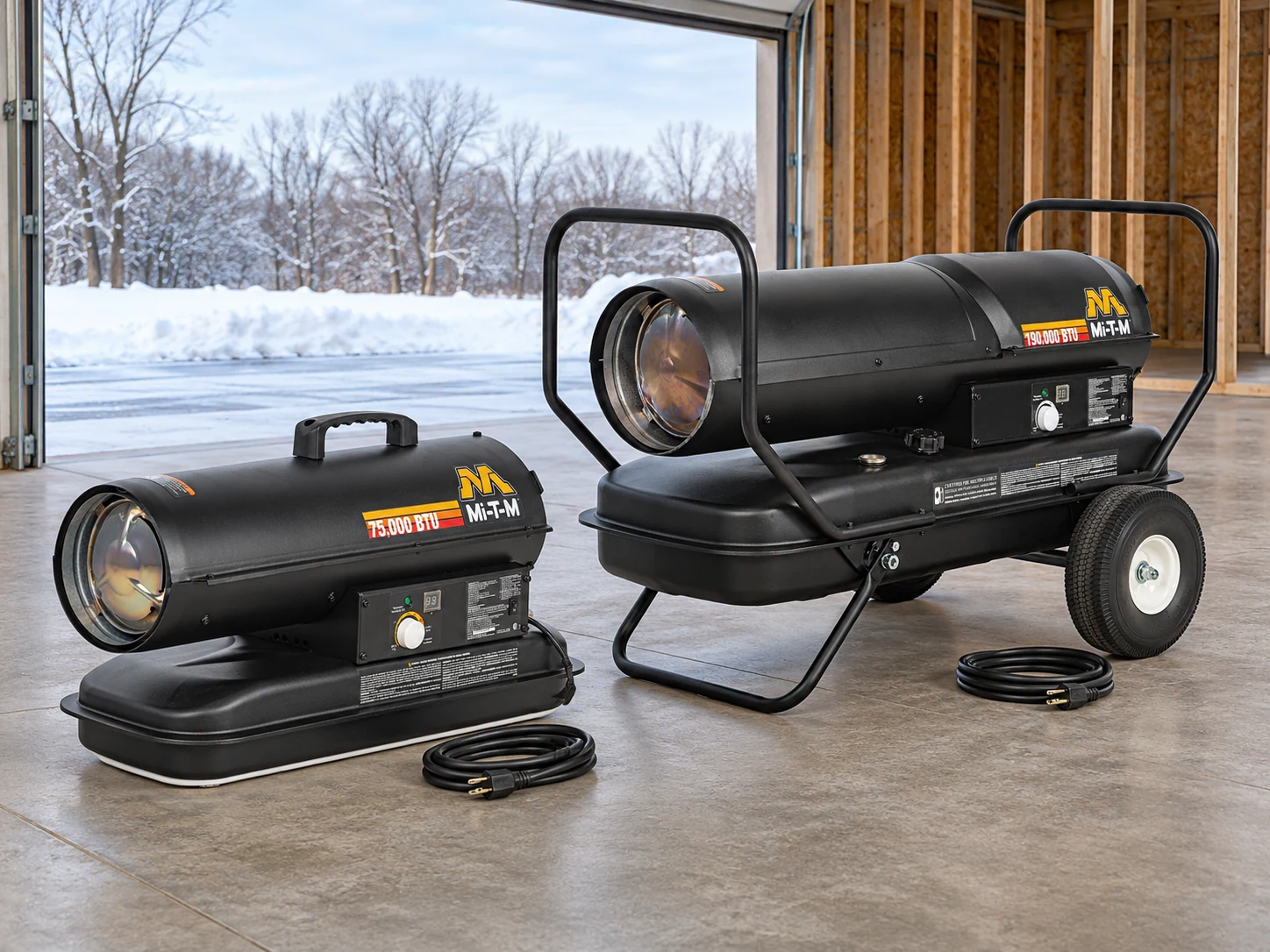
Our two heaters
Both are forced-air heaters that burn fuel in the space and blow hot air out the front. The difference is how much heat and how much air. The 75k holds a closed garage comfortably; the 190k is for the open pole barn with the big door that has to stay open for the lift, where the 75k would run flat out and lose. When in doubt, size up. A heater that runs comfortably beats one that cannot keep up.
Garages, shops, additions.
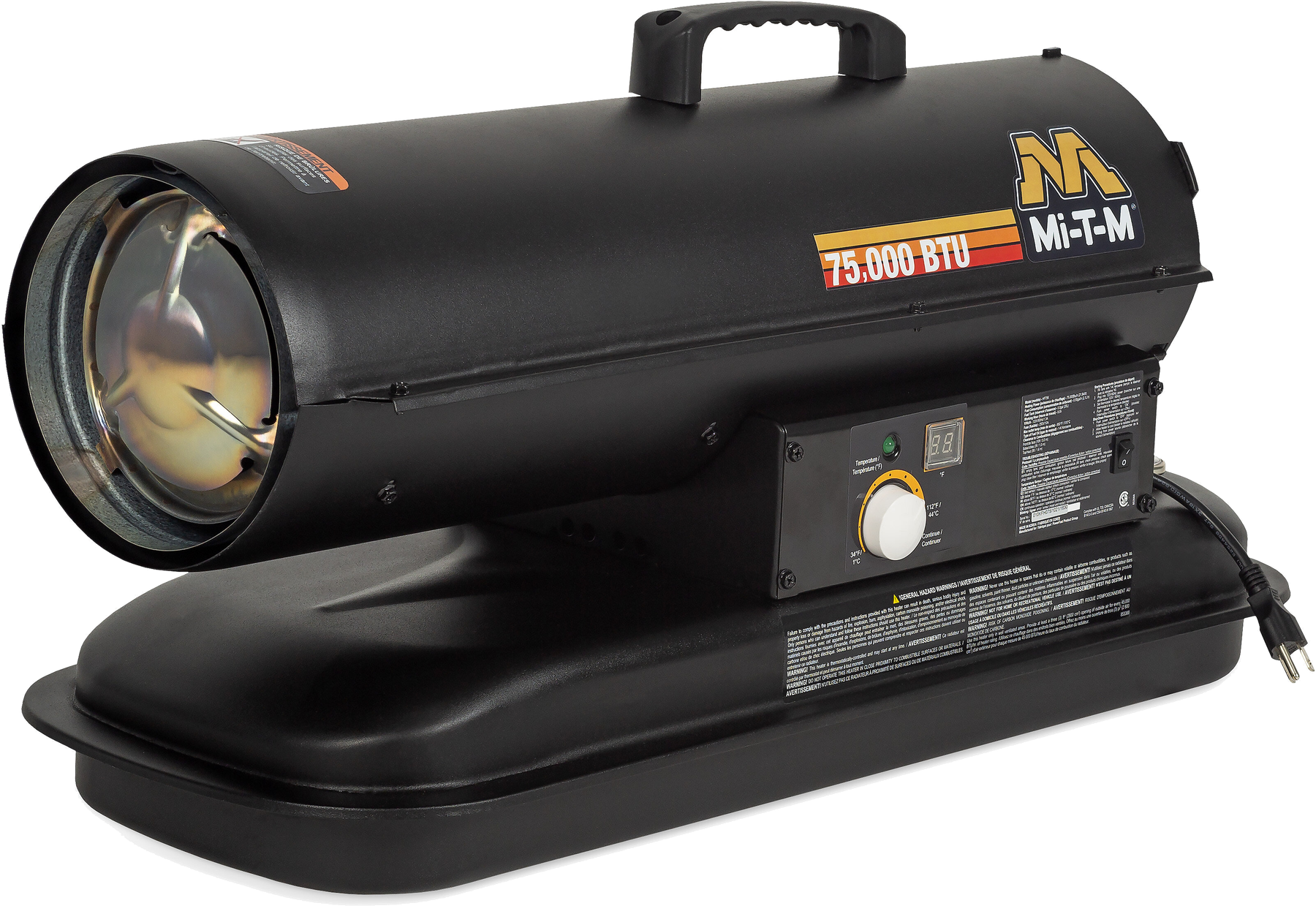
The pick for enclosed spaces up to a two- or three-car garage, and for thawing.
See the 75,000 BTU heater
- Rated for about 1,875 sq ft
- Kerosene, diesel or fuel oil; 5.3 gal tank, about 9.5 hours a fill
- About 28 lb, one person carries it
Barns, open buildings, big sites.
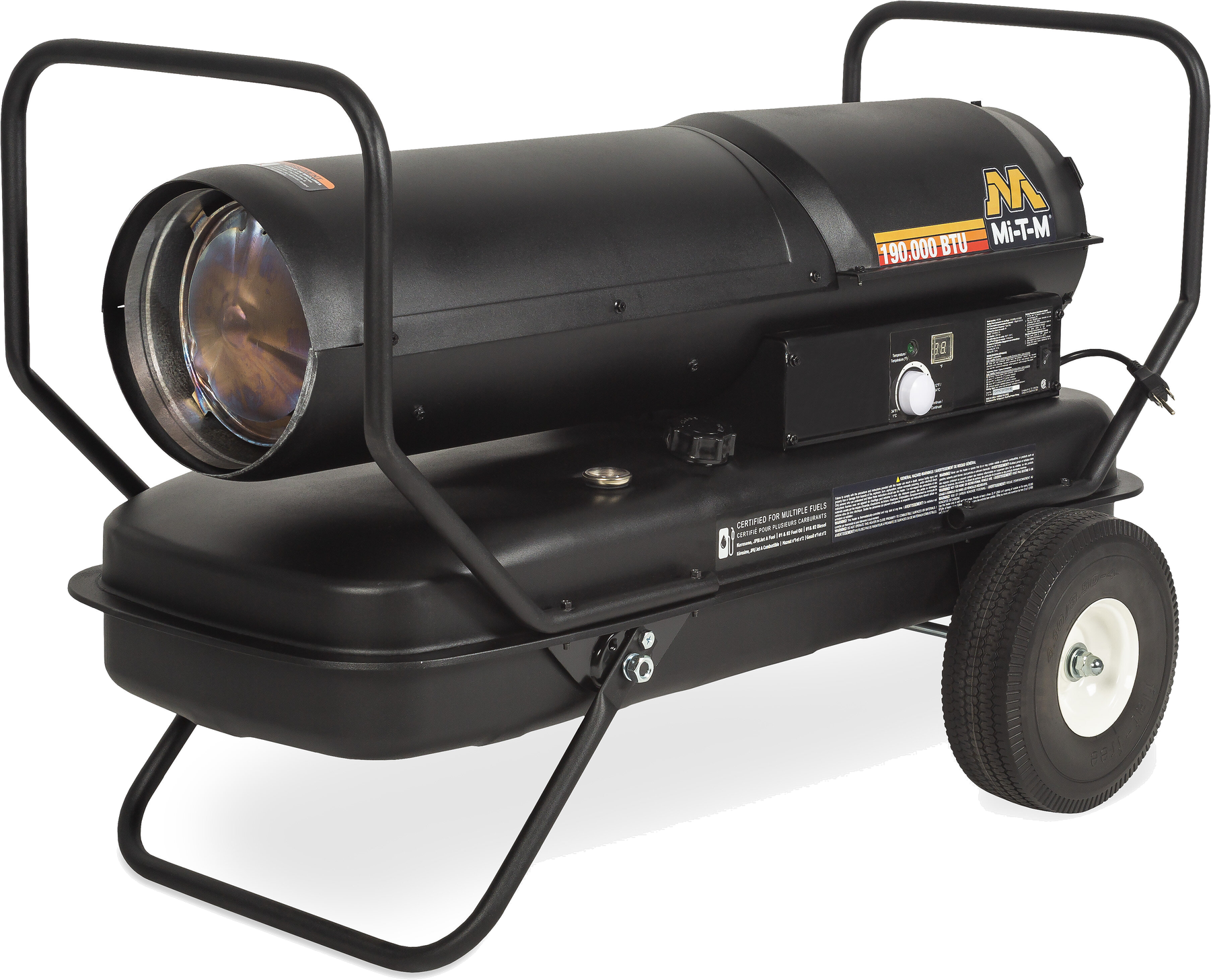
The pick when the space is large, leaky or has doors that stay open.
See the 190,000 BTU heater
- Rated for up to 4,750 sq ft
- Multi-fuel; 13.2 gal tank, about 10 hours a fill
- About 62 lb
What are you heating?
Pick the space to see where to start.
Attached or detached garage
The 75,000 BTU heater
A 24 by 24 garage with 9-foot ceilings is about 5,200 cubic feet. Raising it 30 degrees needs roughly 21,000 BTU by the rule of thumb, so the 75k has plenty of headroom even with the door cracked for air.
Set it on the slab pointed into the open bay, well back from stored lumber, fuel and anything on the walls. Crack a door or window at each end so fresh air comes in and exhaust leaves. A CO detector in the bay is a good idea, and if the garage is attached, keep the door to the house closed; the heater must not serve the living space.
- Uninsulated garage with the main door open for a lift or a truck: the 190k.
- Three or four bays, high ceilings: run the numbers; the 190k may be the comfortable choice.
- Attached garage with a bedroom above: ventilation and the CO detector matter more, and the door to the house stays shut.
- Length, width and ceiling height, to get cubic feet?
- Outdoor low for the days you work, and the temperature you want inside?
- Where will fresh air come in and exhaust go out?
- mitm-75000-btu-forced-air-heater
- high-volume-fan-24
Pole barn or open building
The 190,000 BTU heater
An open pole barn with big doors and no insulation loses heat as fast as you make it. The 190k moves more than twice the air of the 75k and is rated for up to 4,750 square feet, which is what it takes to make a difference in a building like that.
Put it on a firm, level spot with the front aimed down the long axis of the building and nothing combustible in front of it. Big buildings with doors open have ventilation; a barn that has been closed up tight for the night does not, so open it before you light the heater. Fuel goes fast at about 1.37 gallons an hour, so plan the cans.
- Insulated shop with the doors closed: the 75k may be enough. Run the numbers.
- Working at one end of a huge building: aim the heat at the work and accept that the far end stays cold.
- Concrete curing in cold weather: heat is part of the plan, but follow your concrete supplier's cold-weather guidance, not this guide.
- Cubic feet of the space, and how much of it you actually need warm?
- Will doors be open during the work?
- How many hours a day, and how much fuel does that mean?
- mitm-190000-btu-forced-air-heater
- high-volume-fan-24
Addition or room under construction
The 75,000 BTU heater, with a fan
An addition that is framed, sheathed and roughed in is a modest volume, and the job is usually drying mud or paint or keeping a crew working. The 75k covers it. A fan moves the warm air across the wet surfaces instead of letting it pool at the ceiling.
The addition must still be open to the outside for ventilation; if it is already sealed into the house and the family is living next to it, this heater is not the tool. Never run a forced-air heater in a living space. Keep the heater back from fresh mud and point the fan across the wall, not at it.
- Addition sealed to the occupied house: do not use a fuel-burning heater; call and we will talk about what is appropriate.
- Large open shell with no windows in yet: the 190k.
- Just drying, not cold: fans alone may do it.
- Is the space still open to the outdoors for air?
- Is anyone living on the other side of the wall?
- Cubic feet and the temperature rise you need?
- mitm-75000-btu-forced-air-heater
- carpet-fan-dryer
- high-volume-fan-24
Rough sizing
- How much heat you need depends on the size of the space, how cold it is outside, how warm you want it, and how leaky the building is. A rough rule for heaters like these: BTU needed is about cubic feet times temperature rise in degrees Fahrenheit times 0.133.
- Example: a 24 by 24 garage with 9-foot ceilings is about 5,200 cubic feet. To raise it from 20 to 50 degrees, a 30 degree rise, you need about 5,200 times 30 times 0.133, or about 21,000 BTU. The 75,000 BTU heater has plenty of headroom. An open pole barn with big doors and no insulation needs far more. That is the 190,000.
- When in doubt, size up. A heater that runs comfortably is better than one that runs flat out and still cannot keep up.
Safety: the rules that matter
- These heaters burn fuel in the space and make exhaust, including carbon monoxide. Use them only with fresh air coming in, and never in living spaces or closed rooms where people sleep. A CO detector on site is a good idea.
- Ventilation. Fresh air in, exhaust out, every time it runs.
- Never in living spaces. Garages, shops, barns, additions and job sites only.
- Clearance. Keep the front of the heater well away from anything that can burn: tarps, lumber, insulation, fuel cans.
- Fuel. Refuel only when the heater is off and cool, and store fuel away from the heater.
- Stable and level. Set it on a solid, level surface out of foot traffic.
Heat plus drying
- For drying drywall mud, paint or a wet space, pair heat with air movement. A 24-inch high-volume floor fan or a carpet air mover moves warm air where you need it and carries damp air toward an opening. Fans move air; they do not remove moisture from it, so the space still needs a way for humid air to leave.
- Fuel is billed at our cost, no markup. Week and four-week periods fit a winter build; you pay for time out, with unlimited run hours. Ask at booking whether the unit needs an outlet for its fan so power is planned with the heat.
Set up the space before the heater arrives
An air path
One opening for fresh air, one for exhaust, heater between them. A sealed building is not ready for a fuel-burning heater.
A clear, level spot
Solid floor, nothing combustible in front or alongside, out of the traffic path. Measure the clearance to the nearest stored material.
Fuel and refueling
Cans stored away from the heater, a routine for refueling with the unit off and cool, and enough fuel for the hours you will run it.
Carbon monoxide: — ventilation is required, never in living spaces, and a CO detector is suggested. If anyone feels dizzy or sick, shut the heater down and get to fresh air.
Your winter heat checklist
Save these details before you request a heater.
- Cubic feet of the space and the temperature rise you want
- Insulated or open, doors open or closed during work
- Fresh-air path identified, never a living space
- CO detector on site
- Clear, level spot with clearance in front
- Fuel type confirmed and cans on hand
- Fan added for drying mud, paint or a wet space
- Rental period matched to the days of heat you need
Let's match the machine to your job.
Tell us what you're working on. Our Hamburg team serves Southeast Michigan, seven days a week.
(810) 231-7368
Heaters and the fans that pair with them
Questions before you rent
How many BTU do I need?
Multiply the cubic feet of the space by the temperature rise you want in degrees Fahrenheit, then by 0.133. A 24 by 24 garage with 9-foot ceilings raised 30 degrees comes to about 21,000 BTU, which the 75,000 BTU heater covers with room to spare. The rule ignores insulation, open doors and wind, so an open or leaky building needs more than it says. When in doubt, size up.
Can I use one of these in my house?
No. They burn fuel in the space and produce carbon monoxide. They are for garages, shops, barns, additions under construction and open job sites, with fresh air coming in and exhaust leaving. Never in a living space or any closed room where people sleep. A CO detector on site is a good idea even in a garage. If you need to heat part of the house, call and we will tell you plainly whether anything we rent is appropriate.
How long does a tank last, and what fuel do I buy?
The 75,000 BTU unit holds 5.3 gallons, burns about 0.55 gallons an hour and runs roughly 9.5 hours a fill on kerosene, diesel or fuel oil. The 190,000 BTU unit holds 13.2 gallons, burns about 1.37 gallons an hour and runs roughly 10 hours a fill on kerosene, diesel, #1 or #2 fuel oil and other listed fuels. Confirm fuel at the counter for the unit you take. Refuel only when the heater is off and cool. Fuel is billed at our cost at return.
Does it need electricity, and do you rent generators?
Ask at booking whether the unit's fan needs an outlet; we would rather you plan power with the heat than find out on site. We do not rent generators or air compressors, so a site with no power is part of the conversation when you book.
Can you deliver a heater?
Yes. The 75k is about 28 pounds and the 190k about 62 pounds, so picking one up at the counter is common. Delivery runs seven days a week on our own trucks, priced by drive time from Hamburg and confirmed at checkout: $85 round trip within 45 minutes for truck-and-trailer loads, $125 at 46 to 75 minutes, quoted beyond that. If the heater rides along with a machine you are already having delivered, tell us at booking.