
What makes a side-yard walkway different from a patio
- The work is the same as a patio: sod off, dig to depth, stone in lifts, sand, pavers, cuts, compact. The site is different. A side yard is a narrow strip bounded by the house on one side and a fence or property line on the other, often with a gas meter, AC condenser, hose bib, downspouts and a gate in it. Everything moves in single file.
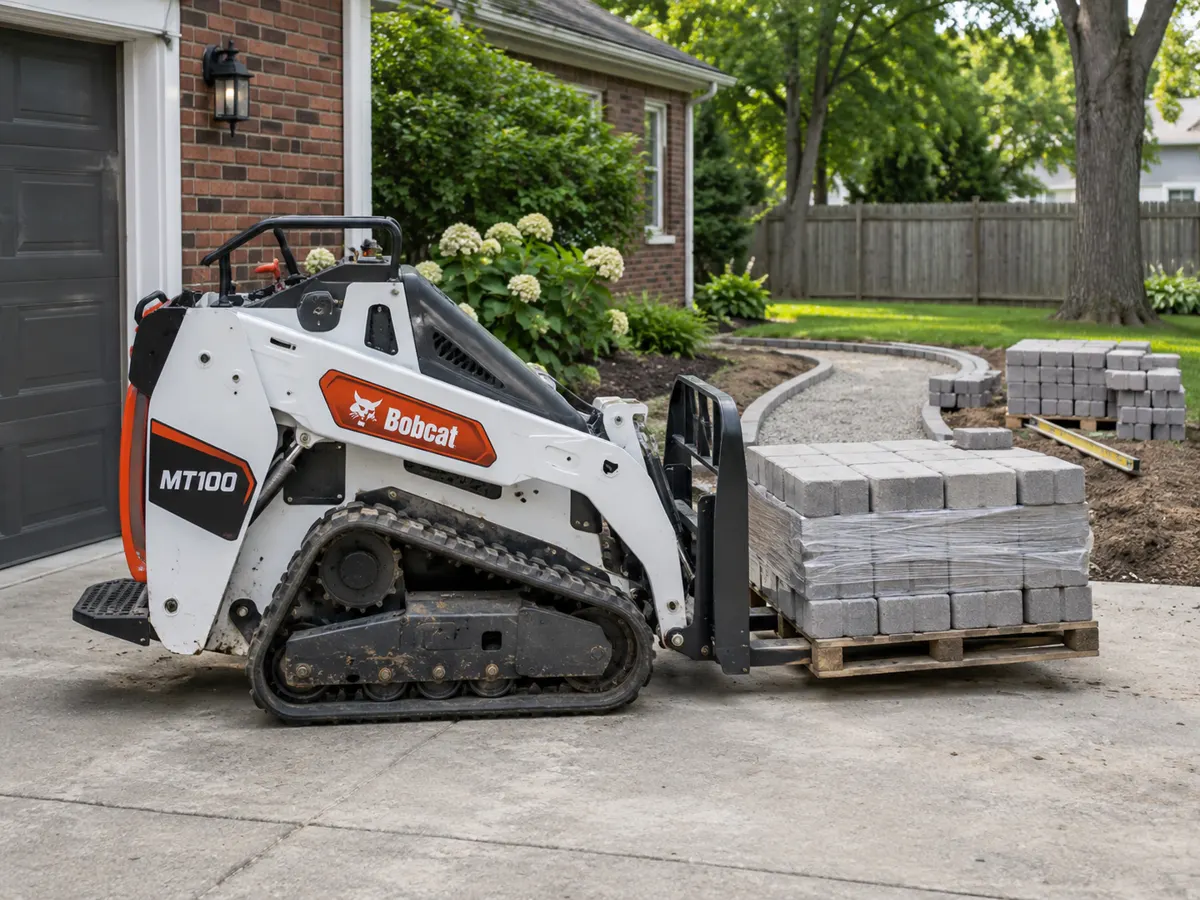
- That changes the equipment. A full-size loader rarely fits and would have nowhere to turn. The job runs on walk-behind tools and, when the strip is wide enough, the Bobcat MT100 stand-on loader for the digging and carrying. Spoil and stone both move along the same strip, so the number of trips is what sets your time, and a small machine making many trips still beats a wheelbarrow.
- The other difference is water. A walkway beside the house sits where roof water lands. Pitch it away from the foundation, keep it below siding and sill level, and plan what the downspouts will do before the pavers go down.
What to check and when to stop
- Gas service lines, electric service, water service and sewer laterals often run through the side yard to the street. Contact MISS DIG 811 at least three business days before you dig; the locate is free and required by Michigan law. It marks public utilities to the meter or the house connection. Private lines such as irrigation, landscape lighting and an invisible fence are yours to find.
- Keep machine work clear of the gas meter and the AC condenser. If the walkway has to pass a meter closer than you are comfortable with, do that stretch by hand. If digging exposes a line you were not expecting, stop and call before you go further.
- If the side yard slopes hard toward the house, or water already pools against the foundation, a walkway will not fix it. That is a grading and drainage job first, and sometimes a professional's job.
The walkway, step by step
The sequence follows our paver patio guide. The notes here are about doing it in a narrow strip.
A walkway often takes the same package as a small patio: sod cutter, MT100, plate compactor and paver saw. Rental time is the time the equipment is out with unlimited run hours; the week rate covers 3 to 7 days.
Set the line, the width and the fall
Run string lines on both edges at finished height. Keep the finished surface below siding and the sill, and pitch it away from the house. Mark the gate, hose bibs, downspouts, meter and condenser, and plan where the path bends around them. Contact MISS DIG 811 at least three business days before digging.
Stakes, string, line level, tape, marking paint.
Cut the sod along the strip
The gas sod cutter runs an 18 in strip, so a typical walkway is two or three passes. Water the area the day before. On a path narrower than the cutter or with lots of bends, the manual kick cutter is slower and more precise. Roll the sod and set it aside; it patches the lawn edge when you are done.
Classen gas sod cutter or manual sod cutter.
Dig the strip and carry spoil to the driveway
Dig to the depth on your supplier's spec and keep the bottom firm. The MT100 at 35.6 in wide works a strip if the strip and the gate are wider than it is; it digs in passes and carries each bucket to the driveway. Where the side yard is tighter than the MT100, the E10 retracts to 28 in and digs from one spot, but it cannot carry spoil, so pair it with wheelbarrows or do the dig by hand. Leave a few inches on each side of the finished width for edge restraint.
Bobcat MT100; Bobcat E10 for strips too narrow for the MT100.
Carry stone in and compact in lifts
Stone comes down the same strip. The MT100 bucket drops a lift at a time; rake it level, mist it, and run the plate compactor along the path in overlapping passes. Repeat until you reach finished base height, checking the fall away from the house with a level on each lift. Around the meter and condenser, hand tamp.
Bobcat MT100 or Canycom tracked buggy to carry; Wacker Neuson plate compactor.
Screed sand and lay from the driveway end
Screed bedding sand between pipes set to the string lines. Lay pavers starting at the driveway, standing on the laid surface, working toward the backyard. Set edge restraint along both sides as you go so the path does not spread. Pallets stay on the driveway and pavers travel down the path a few at a time, or on the MT100 forks within the machine's 1,000 lb rated capacity.
Hand tools. MT100 forks optional for moving part pallets.
Cut the edge pieces, compact, sand the joints
A long walkway has an edge piece on both sides of almost every course, so plan for a lot of cuts. The DeWalt 10 in paver saw on a stand at the driveway gives clean straight edges; the STIHL TS420 cut-off saw handles curves around the meter or a bend. Then run the plate compactor with a pad over the pavers, sweep in joint sand, and compact again.
DeWalt 10 in paver saw; STIHL TS420 for curves; plate compactor with pad.
Measure the strip, not just the gate
Narrowest point along the house
Measure between the house and the fence at the meter, the condenser, the hose bib and the gate. The MT100 body is 35.6 in; it needs that plus room to work the bucket. The E10 undercarriage retracts to 28 in.
The turn off the driveway
A machine entering the strip from the driveway has to turn into it. A tight corner at the garage can rule out the MT100 even when the strip is wide enough.
What is under the strip
Gas, electric, water and sewer service often run here. Get the MISS DIG locate before you measure for depth, and plan hand digging near marked lines.
Before ground disturbance: — contact MISS DIG 811 at least three business days ahead. Side yards carry service lines to the house. Private lines are not marked.
Your walkway checklist
Have these ready before you book.
- Walkway length and finished width
- Narrowest clear point between house and fence, and at the gate
- Excavation depth and base thickness from the paver supplier
- Obstacles along the strip: meter, condenser, downspouts, hose bibs
- Where spoil goes and where stone and pavers will be dropped
- MISS DIG 811 ticket date
- Delivery address and preferred dates
Let's match the machine to your job.
Tell us what you're working on. Our Hamburg team serves Southeast Michigan, seven days a week.
(810) 231-7368
Equipment for a side-yard walkway
Questions before you rent
My side yard is about 4 feet wide. Will the MT100 work in it?
Measure the clear width at the tightest point, which is usually the meter, the condenser or the gate post, not the open stretch. The MT100 body is 35.6 in, and it needs room beyond that to curl the bucket and back out. In a strip around 4 ft it usually works for digging and carrying straight runs; the spots next to obstacles are done by hand. If the tightest point is under about 3 ft, plan on the E10 for digging or on hand tools, and tell us the number so we can say which.
Can I dig a walkway beside the house with a machine?
Yes, with the MISS DIG 811 locate done first and hand digging within the marked zones. Service lines to the house often run through the side yard. Keep the machine clear of the gas meter and the AC condenser, and do not undermine the foundation; a walkway dig is shallow, but stay off the footing. If you hit anything you did not expect, stop and call.
Which way should the walkway slope?
Away from the house, so roof and surface water runs toward the lawn rather than the foundation, and the surface stays below siding and the sill. Your paver supplier's spec gives the pitch. Build that slope into the base, check it on every lift with a level, and do not try to create it later with thicker bedding sand. Plan where downspouts will discharge before you lay pavers; a downspout dumping onto the path will wash the joint sand out.
Why so many cuts on a walkway?
A walkway has two long edges and almost every course meets both of them, so unless the width works out to whole pavers you cut a piece per course per side. Curves and bends around a meter add more. The DeWalt 10 in paver saw on its stand at the driveway handles straight edge pieces cleanly; the STIHL TS420 cut-off saw is faster for curves and for cuts marked in place. Cut wet with either and plan for dust. Our cutting guide goes into the choice.
Do I need delivery for this job?
The sod cutter, compactor and paver saw fit in a pickup or on the 5x10 utility trailer. The MT100 rides on the 12 ft ramp trailer with a 2 in ball, which a half-ton pickup typically tows; we confirm your setup at the counter. Delivery runs seven days a week on our trucks, priced by drive time from Hamburg and confirmed at checkout: $85 round trip within 45 minutes for a truck and trailer load.