
Measure before you pick anything
The opening and the route decide the machine. The plan decides the hole.
- Open the gate all the way and measure from the latch hardware to the post at the narrowest point. That is the clear opening; the nominal gate size on the receipt is not. Then walk the route from where a trailer can park to the farthest hole and measure the tightest spot along it, between the house and the fence, past the air conditioner, under the low branch. Note slopes, steps, soft ground and anything buried that the tracks would cross: septic fields, irrigation heads, a downspout drain.
- Separately, take hole diameter, depth and count from your approved plan. Depth has to reach below the frost line, about 42 in in most of southeast Michigan, with your building department setting the number. These two sets of measurements go to the counter together.
Three ways in
- The Little Beaver handheld auger walks through anything a person does. One operator, gas engine on a torque tube so the twist stays off your arms, 6, 8 and 10 in bits, first bit included. It is the pick for a short run of modest holes in workable soil where nothing on tracks can get in, and for any yard with steps on the route.
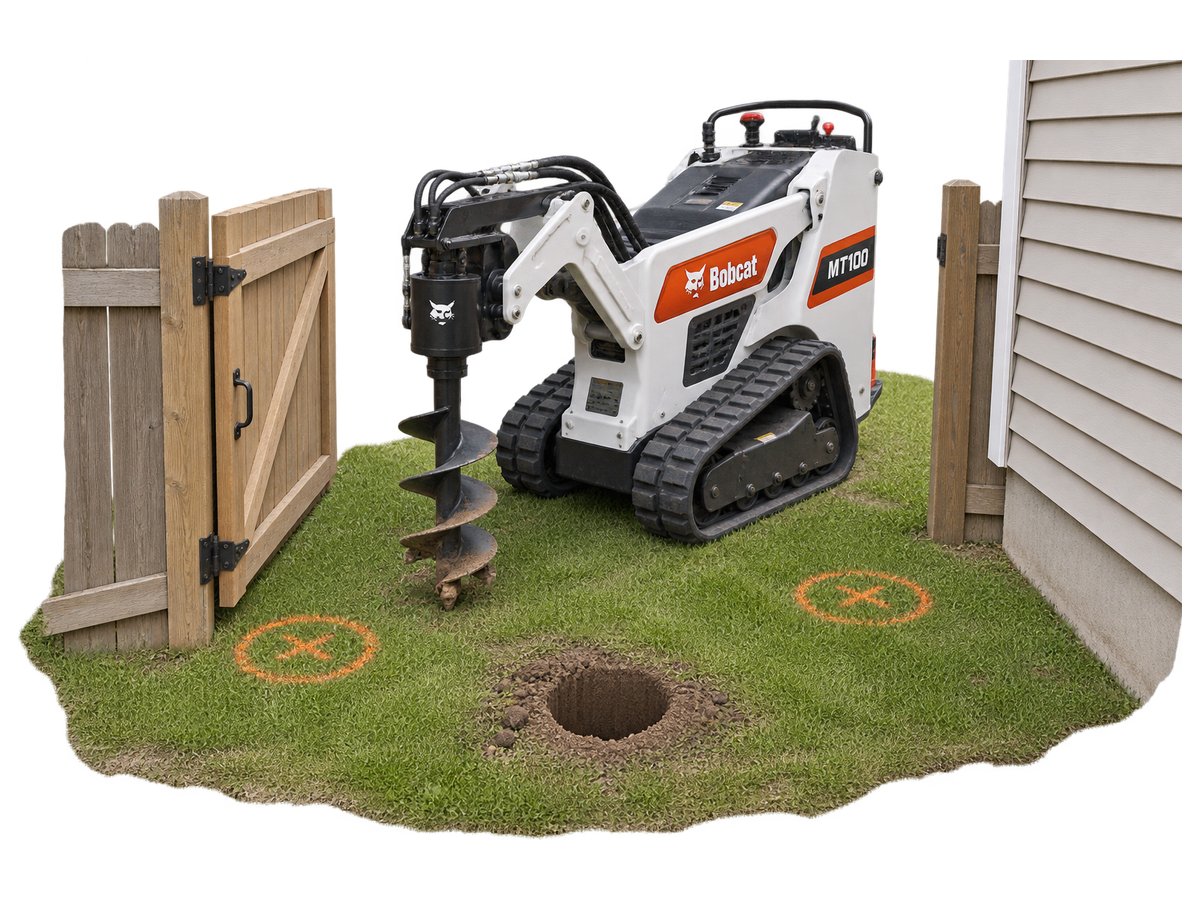
- The MT100 stand-on loader with hydraulic auger is 35.6 in wide at the body and runs on rubber tracks. It is built for a standard 36 in gate and does the heavy lifting on a full fence line or a set of deck footings behind the house. The auger drive and bit mount in front and can be wider than the machine, so the measurement that matters is the clear opening and the turn into it, not the machine's spec. Confirm its bit sizes at booking.
- The E10 mini excavator retracts its undercarriage to 28 in to pass a doorway or gate and extends to 43 in once through. It digs about 6 ft at the pin. It replaces the auger when the hole has roots, fieldstone or old concrete in it, when the footing is wider than a bit, or when the plan calls for something other than a round hole. On a slope, describe the grade to us before you book either tracked machine; we will tell you whether it is a sensible place to run it.
- Opening under 28 in, or steps on the route: Little Beaver, or pull a fence panel.
- Opening 28 to 36 in clear: E10 for digging; MT100 with auger if the bit and drive clear the opening and the turn.
- Opening 36 in or more with a straight approach: MT100 with auger for drilling, E10 for digging.
- Opening 6 ft or more: the full-size T66-2 with auger comes into play; see our fence planning guide.
Protecting the lawn on the way in
- Tracks spread the machine's weight and reduce rutting; they do not prevent lawn damage, and they do not make saturated ground workable. After a hard rain, give the yard a day. Lay plywood over soft spots and across anything you want to protect, and keep the machine on one path in and out rather than wandering. Drill from the path where you can.
- If you are a few inches short at the gate, removing one fence panel or a gate leaf is often easier than drilling the whole line with a handheld unit. Put it back when the machine is out. If the only route is across a neighbor's yard, get that agreed before delivery day, not during it.
What passes what, from our product pages.
Machine body widths. Attachments and bits add to them.
Measure the clear opening
Gate fully open, latch to post, at the narrowest point. Add the attachment: the auger drive and bit on the MT100 can be wider than the 35.6 in body. Write the number down; do not estimate.
Measure the route
The gate is rarely the tightest point. Check between the house and the fence, past utility meters and air-conditioning units, and under branches. Note slopes, steps and soft ground.
Know the holes
Diameter, depth and count from the plan, and what a probe finds at 2 ft. Roots, stone or old concrete move you from the auger to the E10.
Width at the body
Width is the machine body with the standard configuration. A bit or bucket can be wider. If you are a few inches short, pulling one fence panel is usually easier than running the job on a smaller machine.
Little Beaver handheld auger — one person
Bobcat E10 mini excavator — 28 in retracted / 43 in extended
Bobcat MT100 stand-on loader with auger — 35.6 in
Bobcat T66-2 track loader with auger — 67 in
Before ground disturbance: — arrange utility locating through MISS DIG 811 at least three business days ahead, and locate private lines yourself. Review site hazards with our team.
Your restricted-access checklist
Save these details before you request equipment.
- Clear opening at the gate, latch to post, gate fully open
- Tightest point on the route and what is beside it
- Slopes, steps and soft ground on the route
- Hole diameter, depth and count from the plan
- Soil at 2 ft: sand, clay, rock, roots, concrete
- MISS DIG 811 ticket date; private lines walked
- Fence panel or gate leaf that could come out if needed
- Where the trailer parks and where the machine unloads
Let's match the machine to your job.
Tell us what you're working on. Our Hamburg team serves Southeast Michigan, seven days a week.
(810) 231-7368
Explore equipment for this guide
Questions before you rent
My gate is 36 in. Will the MT100 with auger fit?
The machine body is 35.6 in wide and it is built for a standard 36 in gate, but a nominal 36 in gate rarely has 36 in clear once the latch hardware and the post are in the way. Measure the clear opening with the gate fully open. Then account for the auger drive and bit, which mount in front and can be wider than the machine, and for the turn into the opening. If the number is short, removing one fence panel for the day is usually the easier fix. Our backyard access guide walks through the measurements.
What if the only way in is a 30 in side gate?
The E10 mini excavator retracts to 28 in and passes a standard doorway, so it digs post holes and footings where the MT100 cannot go; it extends to 43 in for stability once through and digs about 6 ft at the pin. For drilling rather than digging, the Little Beaver handheld auger walks in with you. If the plan calls for many large holes that only a loader-mounted auger drills well, pull a panel and bring the MT100 through the wider opening.
The route is across the lawn. How much damage should I expect?
Tracks spread the machine's weight and reduce rutting compared with wheels, but they do not prevent lawn damage and they do not make wet ground workable. The MT100 weighs about 3,400 lb and the E10 about 2,600 lb. Keep to one path in and out, lay plywood over soft spots and anything you want to protect, and wait a day after a hard rain. A dry week in summer leaves tracks you can rake out; a wet April leaves ruts.
Can the auger work on a slope?
We do not publish slope limits for the MT100 or the Little Beaver, so describe the grade and the ground to us before you book and we will tell you whether it is a sensible place to run a tracked machine. On steep or soft ground the handheld auger is often the practical answer because the operator stands where the machine would struggle. Holes on a slope still have to meet the plan depth measured from finished grade on the downhill side.
How does the machine get to a house with no driveway access?
The MT100 rides on our 12 ft ramp trailer with a 2 in ball, which a half-ton pickup typically handles; the E10 rides on the 16 ft trailer with a 2 5/16 in ball. Either way, the trailer has to park where the machine can unload and drive to the gate, so tell us where that is. Delivery runs seven days a week on our trucks, priced by drive time from Hamburg: $85 round trip within 45 minutes for truck and trailer loads, $125 at 46 to 75 minutes, and a quote beyond that, confirmed at checkout.