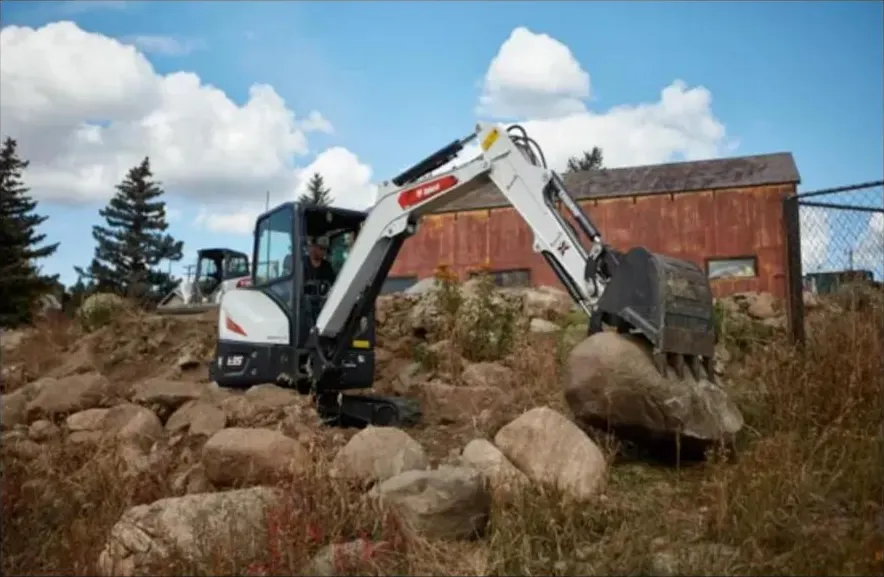
Mini excavator
Place. Reach. Control.
Best when the fill has to go down beside something you cannot hit.
- Sets fill beside a wall or pipe from a distance
- Pulls the spoil pile back into the trench it came from
- Blade on the E35 pushes and levels fill

Text us at (810) 231-7368
Send a text from your phone, or open your computer's messaging app.
Menu
Not sure what you need? Our team can help.
Hamburg, Michigan • Serving Southeast MichiganEquipment comparison
Foundation walls, utility trenches, footings and retaining walls each want a different backfill machine. Pick by what you are filling and what the fill has to do afterward.
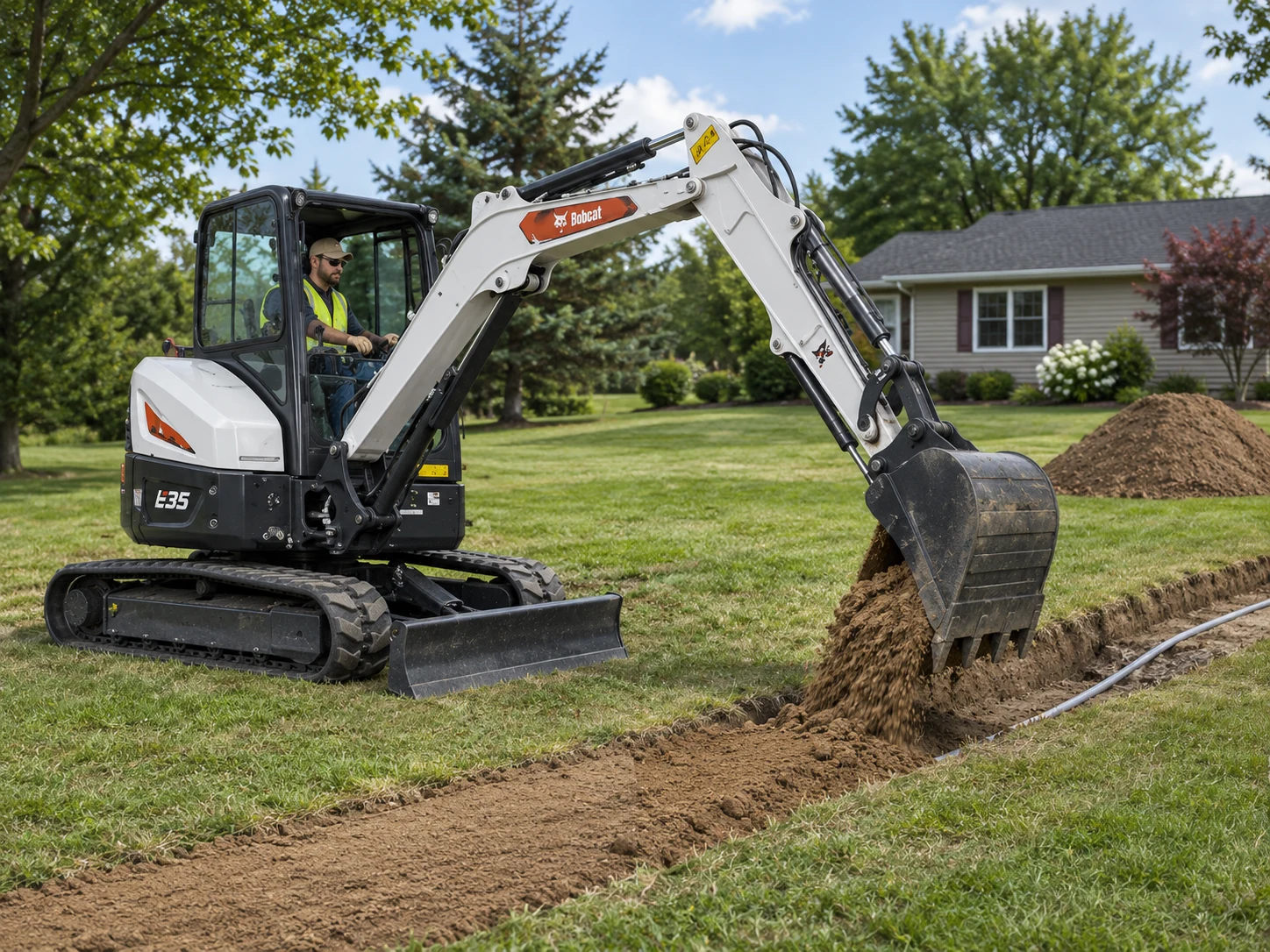
Mini excavator
Best when the fill has to go down beside something you cannot hit.
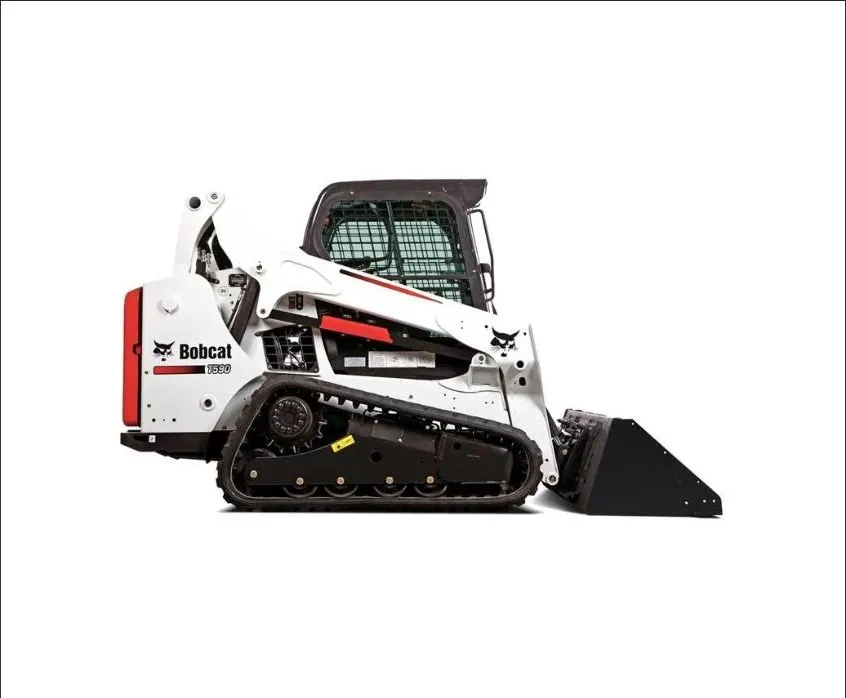
Skid steer / track loader
Best when the fill is a pile across the site and the hole is open on one side.
An excavator sits in one place and swings fill into the hole, so it can backfill against a fresh wall or over a pipe without putting its own weight on the edge. A loader drives up to the hole and pushes or dumps, which is fast when the fill is piled nearby and there is firm ground to drive on, and risky when the edge is soft or the wall is new. Compaction is a third machine in both cases.
Best when the fill has to go down beside something you cannot hit.
Best when the fill is a pile across the site and the hole is open on one side.
Pick the job to see where to start.
A new wall is the most expensive thing on the site and the easiest to crack. An excavator places fill against it from a distance, a lift at a time, without the machine's weight on the wall or the edge of the excavation.
The E35 (about 10 ft dig, 3,318 lb rated lift) reaches over the excavation and sets fill where you want it; its blade pushes and levels the pile between swings. The E48 adds reach and lift for a deep basement or a big stockpile, and does not dig meaningfully deeper. The E10 does a crawl space or an addition footing through a gate. Wait for the builder's go-ahead on waterproofing and drain tile cover before any fill goes in, and bring in the stone they call for around the tile.
Trench backfill is the spoil pile going back where it came from. The excavator that dug the trench pulls the pile back in from alongside. A loader pushes it in fast where the trench is open and the ground beside it is firm.
Bed the pipe or conduit by hand with whatever the installer specifies before any machine fills over it, and keep rocks and chunks off the first lift. Then the E10 or E35 pulls spoil back in. Compact in lifts of a few inches with the plate compactor; the plate is 23 by 20 in, so a 6 in trencher slot is too narrow for it. Ward's does not list a rammer for narrow trenches, so plan to fill a narrow slot in thin lifts and settle it with water where the installer allows, or call us to talk through it. Crown the fill a little; it settles.
Footing and post holes are small. The fill around them goes back by shovel or a small bucket, and the question is more about where the leftover spoil goes than how to place it.
For a deck or shed with a dozen holes, the MT100 carries the spoil away and brings stone or soil back through a 36 in gate; the fill itself goes in by hand so you do not shove the post. A pole barn with a long run of holes and a big spoil pile is T66-2 work: push the spoil back around the posts after they are set and braced, then grade the site. Tamp each hole in lifts with a hand tamper or the plate compactor around the post.
Retaining wall backfill is two materials: drainage stone right behind the wall, then soil behind that, placed in lifts as the wall goes up. The stone has to land in a narrow zone without knocking blocks; soil behind it is bulk work.
The E10 or E35 drops stone precisely behind each course from the uphill side. The MT100 or T66-2 brings soil in and pushes it into the zone behind the stone. Compact each lift with the plate compactor, staying back from the wall face as your wall supplier directs; machine weight right behind a dry-stacked wall pushes it out. Get the drainage stone depth, fabric and lift height from the wall system's instructions or your engineer.
Gate fully open, latch included, and the turn into it. The bucket is machine width on the MT100; the E10 extends to 43 in to work.
A loader needs firm ground at the edge. Fresh spoil and rain-soaked clay are not firm. An excavator works from farther back.
Yards of soil and of stone, where the piles are, and the lift and material spec from the builder or installer.
Width is the machine body. Measure the clear opening and the route, and account for the attachment.
Bobcat E10 mini excavator — 28 in retracted / 43 in extended
Bobcat MT100 stand-on loader — 35.6 in
Bobcat T66-2 track loader — 67 in
Kubota SVL65-2 track loader — 68 in
Bobcat E35 mini excavator — 69.7 in
Bobcat E48 mini excavator — 72.8 in
Trench safety: — trench walls can collapse. Slope or shore anything a person stands in, and keep spoil and machines back from the edge.
Save these details before you request equipment.
Tell us what you're working on. Our Hamburg team serves Southeast Michigan, seven days a week.
(810) 231-7368
Usually yes, and it is the simplest plan. The excavator that dug the trench or footing pulls its own spoil pile back in from where it sits. If you rented the excavator for the dig and returned it, a loader can push the pile back in when the hole is open on one side and the ground beside it is firm. Where fill has to be placed carefully, against a new wall or over a pipe, an excavator's reach is worth having back on site. The week rate covers 3 to 7 days, which often spans dig, inspection and backfill.
It reaches farther and lifts more: 207 in of reach and a 4,921 lb rated lift against the E35's 204 in and 3,318 lb. That means more of the hole covered from one spot and a heavier bucket of wet fill per swing. Its dig depth is nearly the same as the E35's, so do not rent it to go deeper. The E48 is close to 10,000 lb and most customers take delivery; the E35 tows behind a 3/4-ton truck on our 16 ft trailer. For most residential backfill, the E35.
In lifts of a few inches, with the plate compactor, where the plate fits. The Wacker Neuson plate is 23 by 20 in and delivers 3,375 lb of force, so it works in a trench wider than about 2 ft and anywhere open. The 36 in ride-on roller is for wide fills like a driveway base. For a 6 in trencher slot nothing in our fleet fits; Ward's does not list a rammer. Thin lifts, a hand tamper and settling with water where the installer allows are the usual answer, and we are happy to talk it through.
Order it from a supplier and have it dropped as close to the hole as the truck can get, then move it with the loader or the excavator. If you are hauling it yourself, the 7x14 dump trailer holds 10.9 cu yd and is rated 14,000 lb GVWR; it takes a 2 5/16 in ball and a brake controller, and wet material hits the weight limit well before the trailer is full. Delivery of our equipment runs seven days a week, priced by drive time from Hamburg: $85 round trip within 45 minutes for a single machine, $125 for a dual-machine load, confirmed at checkout.
Ask the builder or the engineer, and the building department if an inspection is required before fill goes in. Concrete cure, waterproofing, drain tile cover and whether the wall is braced all come into it, and none of them is a rental question. What we can tell you is that an excavator placing fill in lifts from a distance is the gentlest way to do it once you have the go-ahead, and that driving a loaded machine along the edge of a fresh excavation is the thing to avoid.