
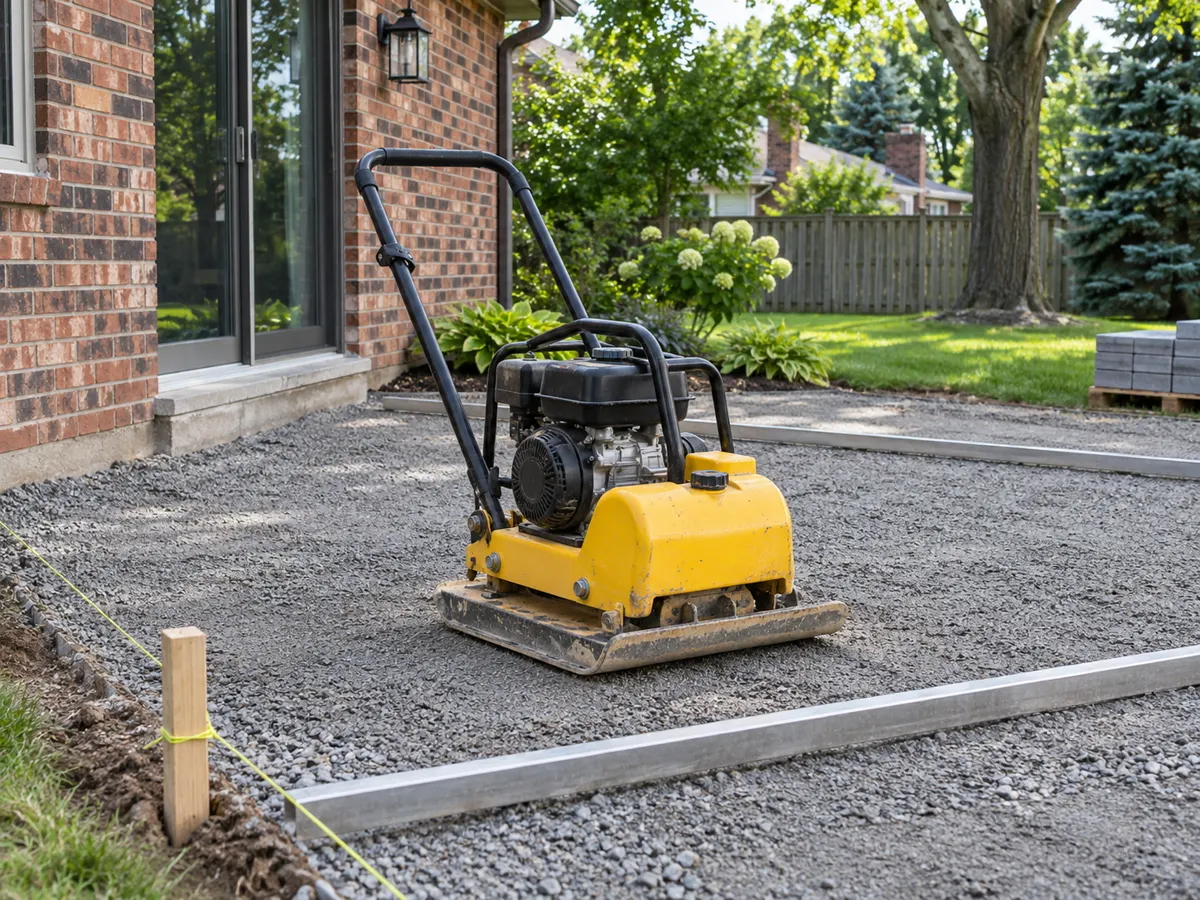
Why the base matters more than the pavers
- Pavers do not carry load on their own. They spread it to the bedding sand, which spreads it to the stone base, which spreads it to the soil. If the base is thin, uneven or loose, the surface follows it down over the first freeze and thaw cycles. The result is a low spot that holds water, a rocking paver at the edge, or a border that leans out.
- Compacting in lifts is the whole trick. A plate compactor densifies the top few inches of loose stone. Dump the full base depth at once and compact it, and the top packs while the bottom stays loose. Place a few inches, compact, check grade, repeat. Each lift locks into the one below it.
- Depth comes from your paver supplier's spec for your paver and your use. A walkway for foot traffic needs less base than a patio that will hold a hot tub or get driven on. Bring the spec to the counter; it sets how much soil comes out and how much stone goes in.
Where base jobs go wrong
- Digging into soft or disturbed soil and building on it. If the bottom of the excavation is spongy, wet or full of old fill, compacting the stone on top will not fix it. Dig out the soft pocket to firm ground, or stop and talk to the counter about drainage first.
- Losing the slope. The finished base should already fall away from the house at the pitch the pavers will have. Set string lines at finished base height and check after every lift. Fixing slope with extra bedding sand is a common cause of settling, because thick sand compresses.
- Compacting dry, dusty stone. Crushed stone packs best slightly damp. The plate compactor carries a water tank for a reason; use it, or mist the stone with a hose.
Base prep, step by step
The sequence is the same for a patio or a walkway. The width of the job and the gate decide the machines.
On a walkway, the same steps apply in a narrow strip. The MT100 bucket and the plate compactor are often the only machines; the roller is for long, wide runs. Rental time is the time the equipment is out with unlimited run hours, and the week rate covers 3 to 7 days.
Set lines, slope and depth
Stake the footprint and run string lines at finished paver height, then drop them to finished base height. Plan the fall away from the house. Mark sprinkler heads and anything else you know is buried, and contact MISS DIG 811 at least three business days before you dig.
Stakes, string, line level, tape. Metal detector optional for finding pins and buried metal; it does not replace MISS DIG.
Remove the sod and topsoil
Cut the sod with the gas sod cutter (18 in strip, up to 2.5 in deep) so it rolls up and can be reused. Topsoil under the sod is organic and compresses; it comes out too, down to the depth on your spec.
Classen gas sod cutter; manual sod cutter for a narrow walkway.
Dig to depth and carry spoil out
For a gated backyard the Bobcat MT100 at 35.6 in wide digs in passes and carries spoil out in the bucket. For a wide patio, a deep spec or a footprint against the house, the Bobcat E35 digs cleaner and loads a dump trailer directly, but it is about 70 in wide and needs a clear 6 ft route. Probe the bottom; it should be firm and undisturbed.
Bobcat MT100 for gated yards; Bobcat E35 with the 7x14 dump trailer for larger digs; Bobcat E10 for doorway-width access.
Bring crushed stone to the footprint
Stone usually lands on the driveway. The MT100 bucket carries it to the footprint and dumps it in place. If a loader is not on the job, or the route is a slope or soft lawn, the Canycom tracked buggy (35 in wide, 2,200 lb payload) carries it without a bucket to learn. Full-size loaders carry more per trip where the route allows them in.
Bobcat MT100 or Canycom tracked buggy; Bobcat T66-2 or Kubota SVL65-2 with open access.
Spread in lifts and compact each one
Rake each lift to a few inches, mist it, and run the plate compactor over it in overlapping passes, changing direction between passes. Work the edges and corners deliberately; the plate is 23 by 20 in and reaches most of them, and anything it cannot reach gets a hand tamper. Check grade against the string after every lift and correct before the next one.
Wacker Neuson plate compactor. A long straight walkway or a drive-width base can use the 36 in ride-on roller instead.
Prove the base before sand goes down
Walk it. A finished base should feel like pavement, with no give under a boot heel and no loose stone rolling on top. Check slope end to end and side to side with the string and a level. Fix low spots with stone and another compaction pass, never with extra sand. Then screed the bedding sand and move on to laying pavers.
String line, 4 ft level, straightedge. The plate compactor comes back at the end to seat the pavers, with a pad.
The gate decides the digging and carrying machine
Measure the clear opening
Gate fully open, latch to post. The MT100 body and the Canycom buggy are under 36 in; forks and the soil conditioner on the MT100 are wider than the machine. The E35 needs a clear 6 ft.
Walk the route
Every bucket of spoil goes out and every bucket of stone comes in on the same path. Soft lawn, slopes, septic fields and the turn into the gate all count. Tracks spread weight; they do not prevent rutting.
Do the volume math
Footprint times excavation depth is spoil out. Footprint times base thickness is stone in. Both numbers tell you how many trips and whether a full-size loader is worth pulling a fence panel for.
Before ground disturbance: — contact MISS DIG 811 at least three business days ahead. It is free and required by Michigan law. Private lines are not marked; locate those yourself.
Your base prep checklist
Have these ready before you book.
- Footprint dimensions and shape
- Excavation depth and base thickness from the paver supplier
- Narrowest clear opening on the route, gate fully open
- Where spoil goes and where stone will be dropped
- Slope direction and fall away from the house
- Stone delivery date matched to the loader rental
- MISS DIG 811 ticket date
Let's match the machine to your job.
Tell us what you're working on. Our Hamburg team serves Southeast Michigan, seven days a week.
(810) 231-7368
Equipment for base prep
Questions before you rent
Plate compactor or ride-on roller for a base?
For a patio or walkway base, the plate compactor. It works in lifts, turns in a small footprint, and reaches into corners the roller cannot. The 36 in double-drum ride-on roller earns its place on long, wide runs such as a driveway base or a parking pad, where it covers ground much faster. Some jobs use both: the plate for the lifts and edges, the roller for a final pass across a wide area. Neither is a substitute for digging out soft soil.
How thick should each lift be?
A few inches of loose stone per lift, compacted before the next goes down. The plate compactor densifies the top of the layer it sits on; too thick and the bottom stays loose. Your paver supplier's spec gives the total base thickness for your paver and use, and you divide that into lifts. Keep the stone slightly damp with the compactor's water tank or a hose so the fines bind.
The bottom of my excavation is soft. What now?
Do not build on it. Probe to find how deep the soft material goes and dig it out to firm ground, then bring the hole back up with stone in compacted lifts. If the soft spot is wet, find out why: a downspout, a low area in the yard, or a high water table. A base over saturated soil moves no matter how well it is compacted, so drainage comes first. Call us if the pocket is large; the volume of stone changes the plan.
What gets through a 36 inch gate?
The MT100 body is 35.6 in, the Canycom tracked buggy is 35 in, and the plate compactor and sod cutter are walk-behind tools. Measure the clear opening with the gate fully open, because latch hardware and posts take inches off the nominal size. The MT100 bucket is machine width; forks and the soil conditioner are wider. Also check the turn into the gate. If you are a couple of inches short, removing one fence panel is often easier than running the whole job through a wheelbarrow.
What does delivery cost for this equipment?
Delivery runs seven days a week on our own trucks and is priced by drive time from Hamburg, confirmed at checkout. The MT100 or E35 with the compactor on the same trailer is a truck and trailer load at $85 round trip within 45 minutes. Add the Canycom buggy or a second machine and it becomes a dual load at $125. If you are towing yourself, the MT100 rides on the 12 ft ramp trailer with a 2 in ball; the E35 needs the 16 ft trailer, a 2 5/16 in ball and a 3/4-ton truck or larger.