
Leveling a yard, in order
Most yard leveling jobs follow the same six steps. Which machine does each step depends on the size of the yard, how far it is out of level, and how you get equipment to it.
The week rate covers 3 to 7 days, so a loader kept over a long weekend for stripping, grading and spreading often costs the same as a few single days. Fuel is billed at our cost.
Mark what is under and on the lawn
Call MISS DIG 811 at least three business days before any tilling, grading or digging; it is free and required by Michigan law, and it does not mark private lines like irrigation, landscape lighting or an invisible fence. Flag sprinkler heads and valve boxes yourself. Walk the yard after a rain and note where water stands and which way it runs. Grading changes drainage, so decide now where water should go.
Metal detector for lost sprinkler heads and property pins; it does not replace MISS DIG.
Remove or break up the existing surface
If the lawn is mostly weeds, ruts or bare dirt, strip it. The gas sod cutter takes an 18 in strip up to 2.5 in deep; water the yard a day ahead so it cuts cleanly. For thin, patchy turf you can skip the sod cutter and till it in with the mid-tine tiller (up to 10 in deep) or let the soil conditioner in step 5 chew it up. Stripped sod has to go somewhere; a dump trailer or a corner of the yard for compost.
Classen gas sod cutter; Maxim mid-tine tiller for small areas; 7x14 dump trailer for hauling sod away.
Cut the high spots and fill the low ones
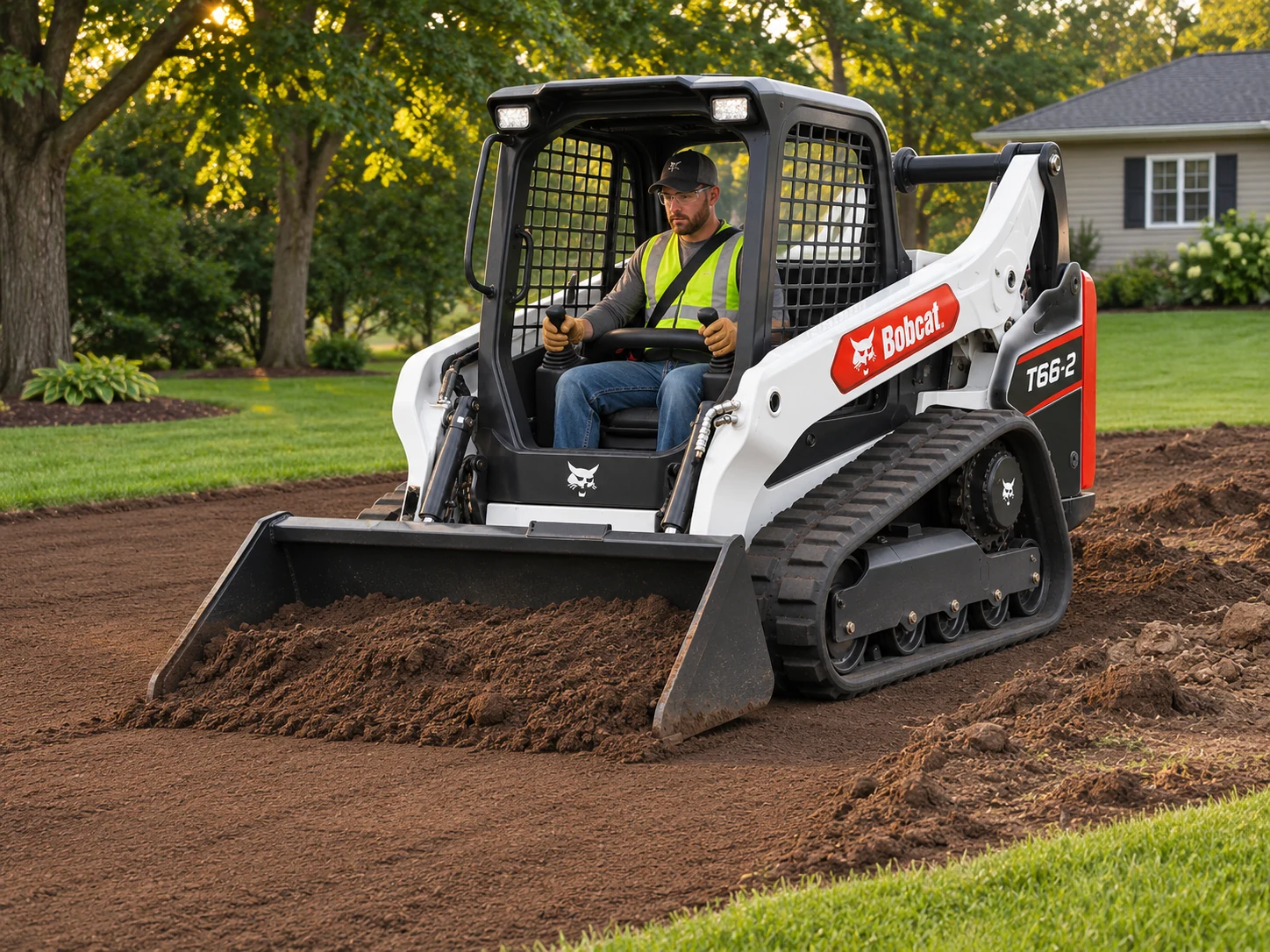
This is loader work. Cut the humps with the bucket edge, carry that soil to the hollows, and back-drag to blend. Set your grade so the yard falls away from the house. A full-size tracked loader (Bobcat T66-2 or Kubota SVL65-2) covers an open yard quickly and carries a full bucket of soil per trip. If the only way in is a gate near 36 in, the Bobcat MT100 does the same work with smaller bites. Tracks spread the machine's weight, which helps on soft ground, but they still mark the lawn you keep and do not make saturated ground workable.
Bobcat T66-2 or Kubota SVL65-2 for open yards; Bobcat MT100 through a 36 in gate.
Bring in and spread new material
Have the topsoil dropped as close to the work as the truck can get, then move it with the same loader you graded with. Spread it in a consistent layer rather than piling it in the low spots only; a thick patch of loose soil settles unevenly. If the pile is on the driveway and the yard is behind a gate, the MT100 or the Canycom tracked buggy makes the trips. Count the loads so you know how many yards actually went down.
Same loader as step 3; Canycom tracked buggy (35 in wide, 2,200 lb payload) when the route is a gate and a slope.
Finish grade and build the seedbed
A soil conditioner (Harley rake) does the tilling, raking and box-blading in one pass: it pulls rocks and roots to the surface, breaks clods and leaves a level, loose seedbed. The 72 in hydraulic conditioner runs on the T66-2; it is marked not compatible with the Kubota SVL65-2. The 48 in compact conditioner runs on the MT100, but it is 56.75 in overall, so it will not ride through a 36 in gate on the machine. Without a conditioner, finish with the bucket back-dragged and a hand rake, and accept more raking time.
72 in soil conditioner on the T66-2; 48 in soil conditioner on the MT100. Attachments are half price with the loader.
Seed, roll and water
Seed or lay sod, then roll with a water-filled lawn roller to press seed into soil contact and settle the surface. Roll when the ground is damp, not soggy, and drain the roller before you return it. The 24, 36 and 48 in rollers weigh 221, 331 and 480 lb when full; pick by yard size and what you can pull. A lawn roller is for seed and sod only. It does not compact a base.
Lawn roller, 24, 36 or 48 in.
Which situation is yours?
Pick the one closest to your yard.
Fenced backyard, one gate
MT100 with bucket, conditioner carried in separately
The MT100 is 35.6 in wide with the bucket at machine width, so it is the loader that reaches a yard behind a standard gate. It grades, carries topsoil and runs the 48 in soil conditioner for the seedbed.
Measure the clear opening with the gate fully open, including the latch, and the turn into it. The 48 in conditioner is 56.75 in overall and will not pass a 36 in gate mounted on the machine; plan to carry it in or ask us about the route. The MT100's rated operating capacity is 1,000 lb, so topsoil moves in smaller bites than a full-size loader. For a yard with a lot of fill to move, pulling one fence panel for a T66-2 is often less work than running the whole job small.
- Opening under 36 in clear: no loader fits. The Canycom buggy is 35 in and carries material, but it does not grade.
- Gate is 6 ft or a panel comes out: a T66-2 does every step faster.
- Steep slope inside the gate: a buggy on the carry and hand finish may be safer than a loader at the edge of its stability.
- Clear gate opening and the width of the path to it?
- How many yards of topsoil, and where will the truck drop it?
- Is there irrigation in the yard, and do you know where the lines run?
- mt100
- mini-skid-steer-harley-rake-soil-conditioner
- canycom
Open yard, lots of dirt to move
T66-2 with bucket and the 72 in soil conditioner
An open yard with a lot of cut and fill wants a full-size tracked loader. The T66-2 carries 2,450 lb rated per bucket, back-drags a wide swath and runs the 72 in conditioner that builds the seedbed in one pass.
Tracks spread the weight on a lawn you are tearing up anyway. The Kubota SVL65-2 does the same grading work, but the 72 in conditioner is marked not compatible with it, so if you want the conditioner, book the T66-2. The S570 wheeled loader is quicker on a driveway and ruts turf, so it is not the pick here. Plan the delivery so the loader is on site when the topsoil truck arrives.
- Ground is saturated: give it a day after hard rain. Tracks do not make wet ground workable.
- Small yard, small fix: a sod cutter, a tiller and hand raking may be all you need.
- Yard holds water at the low spot after grading: that is a drainage problem; see the standing-water situation.
- Rough square footage and how far out of level is the worst spot?
- Where can the equipment trailer and the topsoil truck park?
- Septic field, well head or buried downspout lines on the route?
- t66-2
- skid-steer-soil-conditioner-hydraulic
- svl65-2
Yard holds water
Solve the water before you level
Leveling a wet yard without fixing where the water goes just moves the puddle. Look at downspouts, the slope away from the house and whether there is a low outlet the yard can drain to before you order topsoil.
If the fix is a downspout extension or a French drain to a lower outlet, the trencher cuts a 6 in wide slot up to 36 in deep with little lawn damage. Where roots or rock stop it, or the line needs to be wider, the E10 or E35 digs it. If there is no lower place for the water to go, or the yard sits on heavy clay that stays wet for days, talk to a drainage contractor before renting anything. Grade the yard after the drain is in and the trench is backfilled and settled.
- Water only after storms and it drains within a day: grading alone may do it.
- Water sits for days: likely a soil or outlet problem, not a surface problem.
- Wet spot is over the septic field: stop and call a septic professional.
- Where does the water come from: roof, neighbor's lot, a spring?
- Is there a point lower than the wet spot where water could leave the yard?
- Have you called MISS DIG 811 for the trench route?
- trencher
- e10
- e35
Common mistakes
- Filling low spots with loose topsoil and seeding right away. Loose fill settles, and the hollow comes back in a season. Spread, let it settle or roll it, then top up before seed.
- Grading toward the house. Every pass should leave the yard falling away from the foundation. Check with a line and a level, not by eye.
- Running equipment on saturated ground. Tracks spread weight, and they still cut ruts in mud. After a hard rain, give the yard a day.
When to bring in a professional
- Call a drainage or excavating contractor when water stands for days with no lower outlet, when the regrade would change how water reaches a neighbor's property, or when the yard sits over a septic field. Call a surveyor if the leveling runs near a property line you are not sure of; a metal detector helps you find a pin but does not establish the boundary.
Before you book, check the site
Measure the narrowest opening
Gate fully open, latch included, plus the turn into it. The MT100 bucket is machine width; the 48 in conditioner is wider than the machine.
Walk the route
Slopes, soft spots, septic field, irrigation heads and buried downspout lines between the trailer and the yard.
Know the numbers
Square footage, the drop from high to low spot, and how many yards of topsoil you ordered.
Machine widths, from our product pages
Width is the machine body. Attachments can be wider: the 48 in compact conditioner is 56.75 in overall on a 35.6 in MT100, and the 72 in conditioner is wider than the 67 in T66-2. Measure the clear opening and the route before you call it a fit.
Canycom tracked buggy — 35 in
Bobcat MT100 stand-on loader — 35.6 in
Trencher 6 in x 36 in — 35.8 in
Bobcat T66-2 track loader — 67 in
Kubota SVL65-2 track loader — 68 in
Before ground disturbance: — arrange utility locating through MISS DIG 811 at least three business days ahead, and locate private lines (irrigation, lighting, invisible fence) yourself.
Your project checklist
Save these details before you request equipment.
- Square footage and the high-to-low drop
- Where water stands now and where it should go
- Topsoil quantity ordered and drop location
- Narrowest gate or path on the route
- Irrigation heads and lines marked
- MISS DIG 811 ticket requested
- Delivery location and preferred dates
Let's match the machine to your job.
Tell us what you're working on. Our Hamburg team serves Southeast Michigan, seven days a week.
(810) 231-7368
Explore equipment for this guide
Questions before you rent
Do I need a soil conditioner, or will the bucket do?
The bucket handles rough grading: cutting high spots, carrying fill, back-dragging. A soil conditioner is for the last step, when you want a loose, level, rock-free seedbed in one pass instead of hours of hand raking. On a small yard the bucket plus a rake is fine. On anything you would call a regrade, the conditioner saves the most labor of any attachment on the job. It rents at half price with the loader.
Will the MT100 and its conditioner fit through my gate?
The MT100 body is 35.6 in and its bucket is machine width, so it passes a clear 36 in opening when the latch and the turn allow it. The 48 in conditioner is 56.75 in overall, so it does not ride through that gate on the machine. Measure the clear opening with the gate fully open and tell us what you get; we will tell you how the attachment gets in. If you are a few inches short, removing a fence panel is often the simpler answer.
Do I need MISS DIG for yard leveling?
Yes if you are tilling deep, trenching or cutting more than the surface. Michigan law requires contacting MISS DIG 811 at least three business days before digging, trenching, augering, deep tilling or grinding below grade, and it is free. MISS DIG marks public utilities only. Irrigation, landscape lighting, invisible fence and a line to a shed are yours to find; a metal detector helps you look but does not replace the locate.
How long should I rent the loader for?
Plan around the topsoil delivery and the weather, not the hours on the meter. You pay for the time the machine is out, with unlimited run hours and no daily cap. The week rate covers 3 to 7 days, so a long weekend of stripping, grading and spreading often costs the same as a few single days. If you run over, the extra time is prorated, never more than the next full period. Fuel is billed at our cost.
How does the equipment get to my yard?
The MT100 rides on our 12 ft ramp trailer with a 2 in ball, which a half-ton pickup typically handles; we confirm your setup at the counter. The T66-2 and SVL65-2 ride on the 16 ft equipment trailer with a 2 5/16 in ball behind a 3/4-ton truck or larger. Delivery runs seven days a week on our own trucks, priced by drive time from Hamburg: $85 round trip within 45 minutes for a loader, $125 at 46 to 75 minutes, confirmed at checkout. Beyond 75 minutes we quote by phone.