
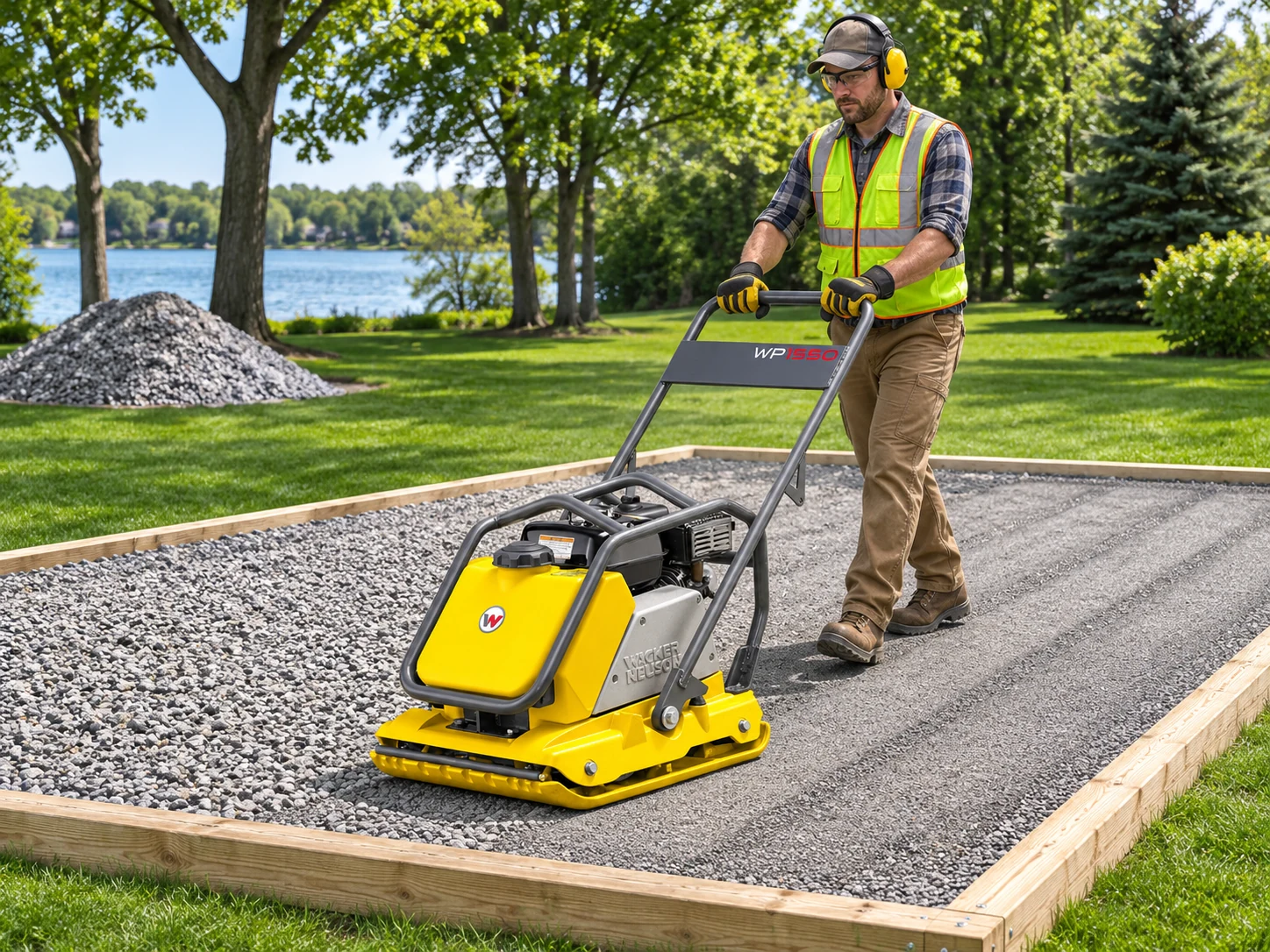
Building a gravel shed pad, in order
A shed pad is a small version of a patio base: cut it in, bring in stone, compact in lifts, level the top. Get the spec for depth and stone from the shed manufacturer or your building department before you rent anything.
A loader and a plate compactor ride on one truck. A loader plus an excavator is a dual-machine load, priced at its own delivery tier and confirmed at checkout. The week rate covers 3 to 7 days, which fits a dig-one-weekend, stone-the-next schedule.
Mark the footprint and call MISS DIG
Stake the corners, run string lines and check them square. Most shed makers want the pad larger than the building; use their number. Call MISS DIG 811 at least three business days before you dig. It is free, required by Michigan law and marks public utilities only. The line from the house to an existing shed, irrigation and landscape lighting are private and yours to find. Check setbacks and whether a permit applies with your township.
Stakes, string, a line level. Metal detector for buried metal and pins; it does not replace MISS DIG.
Cut the footprint to depth
Strip the sod and dig to the depth your spec calls for, keeping the floor level across the footprint rather than following the lawn. On a level site with a 36 in gate, the Bobcat MT100 cuts and carries the soil. On a sloped site where one side has to come down a foot or more, or a footprint tight against a fence or building, the Bobcat E10 digs it without driving over the edge; its undercarriage retracts to 28 in for a doorway or gate. Open access and a bigger pad: the E35 digs and loads spoil into a trailer faster. Soil has to go somewhere; plan the pile or the dump trailer now.
MT100 for a level, shallow cut; E10 or E35 for slopes and tight footprints. Gas sod cutter to lift turf first.
Get rid of the spoil, bring in the stone
Excavated soil fills a trailer by weight before it looks full. The 7x14 dump trailer holds 10.9 cu yd and is rated 14,000 lb GVWR; it needs a 2 5/16 in ball and a brake controller. Have the stone dropped as close to the pad as the truck can get. If the pad is behind a gate, the MT100 or the Canycom tracked buggy (35 in wide, 2,200 lb payload) makes the trips from the driveway pile. Open access: the same loader that dug the pad moves the stone.
Dump trailer for spoil; MT100 or Canycom buggy through a gate; T66-2 or SVL65-2 with open access.
Place and compact in lifts
Spread the stone in lifts of a few inches and compact each lift before adding the next. One thick lift compacts on top and stays loose underneath, and the shed settles later. The Wacker Neuson plate compactor (3,375 lb force, 23 x 20 in plate) is the tool for a shed-size pad and for the edges. A pad the size of a garage or a parking area goes faster under the 36 in ride-on roller. Ward's does not list a rammer for tight trenches.
Plate compactor; 36 in ride-on roller for large pads.
Screed the top lift and check it
Bring the top lift to your string lines, screed it flat with a straight board, and compact once more. Check level corner to corner and across the diagonals. A pad that is out of level makes a shed door that never closes right. If the spec calls for a perimeter frame or edging, set it before the final lift so the stone has something to compact against.
Plate compactor, a long straight board, a 4 ft level.
See the paver patio guide for the same base method in more detail
Which situation is yours?
The site decides the dig machine. Pick the one closest to yours.
Level lawn behind a gate
Bobcat MT100, then the plate compactor
A shallow, level cut in lawn is loader work, and the MT100 is the loader that passes a standard gate. It strips, cuts, carries the spoil out and brings the stone in on the same rental.
The MT100 is 35.6 in wide with the bucket at machine width, rated for 1,000 lb per load. It takes a few inches per pass, so a deep cut is slow but a shed pad cut is well within it. Lift the sod first with the gas sod cutter (18 in, up to 2.5 in deep) so you are not pushing turf around. The plate compactor fits through any gate.
- Clear opening under 36 in: no loader fits. Dig by hand or pull a fence panel.
- Spec depth is deep or the soil is full of roots: the E10 digs it cleaner.
- Stone pile on the driveway and a slope on the route: the Canycom buggy carries it steadier than a raised bucket.
- Pad dimensions and depth from the shed maker's spec?
- Clear gate opening, latch included, and the turn into it?
- Where will the spoil go, and where will the stone be dropped?
- mt100
- compactor
- sod-cutter
Sloped site or tight against a fence
Bobcat E10 for the cut, loader or buggy for the stone
Cutting a level bench into a slope means taking a foot or more off the high side. An excavator does that from one spot, swinging spoil to a pile, without driving over the edge you just cut. A loader has to drive across the bench to work it.
The E10 digs to about 6 ft, retracts to 28 in to get through a gate, and places spoil beside the pad or into a trailer. For a larger pad with open access the E35 does the same work faster. Neither machine spreads stone well; pair the excavator with the MT100 or the Canycom buggy for the material, or carry stone in with the excavator bucket on a small pad and rake it.
- The high side needs a retaining wall to hold: that is a design question for a contractor before you dig.
- Slope is slight and the site is open: a T66-2 bucket cuts and spreads in fewer steps.
- Water runs down the slope onto the pad: plan a drain or swale on the uphill side.
- How much drop across the footprint, high corner to low corner?
- What is uphill of the pad, and where does runoff go now?
- Have you called MISS DIG 811 and found your private lines?
- e10
- e35
- canycom
Large pad with open access
Full-size tracked loader and the ride-on roller
A pad for a large shed, a garage-size building or a parking area moves enough stone that a full-size bucket pays for itself, and a 36 in roller compacts the lifts in far fewer passes than a plate.
The T66-2 (67 in, 2,450 lb rated) or SVL65-2 (68 in, 2,100 lb rated) cuts the footprint, loads the dump trailer and spreads stone. The ride-on roller (3,400 lbf, 36 in drum) compacts the body of the pad; keep the plate compactor for the edges and corners the roller cannot reach. For a building with footings rather than a floating gravel base, the excavation becomes an E35 job and the building department sets the depth.
- Pavement all the way to the site: the wheeled S570 is quicker and costs less, and ruts turf.
- Saturated subgrade: wait. Stone placed on mud pumps and never firms up.
- Building needs footings or a slab: see the pole barn guide and the concrete category.
- Pad size and depth, and how many yards of stone that comes to?
- Can the stone truck and the equipment trailer reach the site?
- Is the subgrade firm after you cut it, or does it move underfoot?
- t66-2
- roller
- dump-trailer-12-5-cubic-yds
Common mistakes
- Compacting one thick lift. The top firms up and the bottom stays loose. Spread a few inches, compact, repeat.
- Building on topsoil. Strip the organic layer; it keeps settling as it breaks down. Your spec's depth assumes you are down to mineral soil.
- Skipping the perimeter. Stone with nothing to hold it spreads at the edges and the pad slumps. Set the frame or edging before the final lifts.
When a gravel pad is not enough
- A pad for a shed with a floor is a floating base. A building with posts in the ground, a concrete slab or a footing is a different project with a depth set by the building department and the frost line (about 42 in in most of southeast Michigan). Those jobs start with an E35 and often a mixer or a concrete buggy; our pole barn guide walks through the order. If the site needs a retaining wall to hold the high side, get that designed before you cut.
Before you book, check the site
Measure the narrowest opening
Gate fully open, latch included, and the turn into it. The MT100 bucket is machine width; the E10 retracts to 28 in and extends to 43 in to work.
Check the route and the drop point
Where the stone truck can dump, where the trailer parks, and what the tracks cross between the two and the pad.
Know the spec
Pad dimensions, depth and stone type from the shed maker or building department. Bring the yards of stone you ordered.
Machine widths, from our product pages
Width is the machine body. The E10 digs with its undercarriage extended to 43 in, so it needs that much room where it works, not just where it enters. Measure the clear opening and the route.
Bobcat E10 mini excavator — 28 in retracted / 43 in extended
Canycom tracked buggy — 35 in
Bobcat MT100 stand-on loader — 35.6 in
Bobcat T66-2 track loader — 67 in
Bobcat E35 mini excavator — 69.7 in
Before ground disturbance: — arrange utility locating through MISS DIG 811 at least three business days ahead, find private lines yourself, and check setbacks and permits with your township.
Your project checklist
Save these details before you request equipment.
- Pad dimensions, depth and stone type from the spec
- Drop across the footprint, high corner to low
- Clear gate opening and the turn into it
- Where spoil goes and where stone is dropped
- Setback and permit check with the township
- MISS DIG 811 ticket requested
- Delivery location and preferred dates
Let's match the machine to your job.
Tell us what you're working on. Our Hamburg team serves Southeast Michigan, seven days a week.
(810) 231-7368
Explore equipment for this guide
Questions before you rent
How deep should the pad be and what stone should I use?
Take that from the shed manufacturer's site prep sheet or your local building department, not from us. Specs vary with the shed, the soil and whether the building is anchored. What we can tell you is how to build whatever depth they give you: strip the topsoil, place the stone in lifts of a few inches, and compact each lift. Bring the spec to the counter and we will match the equipment to it.
Plate compactor or ride-on roller?
For a shed-size pad, the plate compactor. It delivers 3,375 lb of force on a 23 by 20 in plate, fits through any gate and gets into the corners. The 36 in ride-on roller is for pads the size of a garage floor or a parking area, where the plate would take all day. On a large pad you often want both: the roller for the body, the plate for the edges. Ward's does not list a rammer for narrow trenches.
Do I need an excavator for a shed pad?
Usually not. A level site with a shallow cut is loader work, and the MT100 does it through a gate. An excavator earns its place when the site slopes and one side has to come down a foot or more, when the footprint is tight against a fence or house, or when the soil is full of roots. The E10 handles those on a residential lot and passes a 36 in gate retracted. If the building needs footings or a slab instead of a floating pad, that is an E35 job with a depth set by the building department.
How do I get rid of the dirt I dig out?
The 7x14 dump trailer holds 10.9 cu yd behind 3 ft walls and is rated 14,000 lb GVWR. It takes a 2 5/16 in ball and a truck with a brake controller. Wet soil is heavy, and the trailer hits its weight limit well before it looks full, so load by weight, not by volume. If you would rather not tow it, ask about having us deliver the trailer with the machine. Some people keep the spoil and use it to fill low spots in the yard.
How long will I need the equipment?
That depends on the pad size, the soil and whether the stone arrives on the same day. You pay for the time the equipment is out, with unlimited run hours and no daily cap. Rental periods are 1 to 4 hours, 4.5 to 24 hours, one week (3 to 7 days) and four weeks. If you dig one weekend and place stone the next, the week rate often costs the same as two single days. Extra time is prorated, never more than the next full period, and fuel is billed at our cost.
What does delivery cost for a loader and a compactor?
A loader with a plate compactor rides on one truck and is a standard truck/trailer load: $85 round trip within 45 minutes of Hamburg, $125 at 46 to 75 minutes, confirmed at checkout. A loader plus an excavator is a dual-machine load at $125 within 45 minutes and $200 at 46 to 75 minutes. Beyond 75 minutes we quote by phone. Delivery runs seven days a week on our own trucks.