
Pergola prep, in order
A pergola is a few posts carrying a light frame. Everything depends on those posts being on layout, plumb and anchored to the depth your plan calls for.
If the pergola attaches to the house with a ledger, the footing and connection details are part of the permit set. We match the machine to those details; we do not design them.
Get the footing numbers before you rent anything
Ask your township whether the pergola needs a permit; many do once it is attached to the house or over a certain size. Either way, your plan or the manufacturer's instructions give post spacing, footing diameter and depth. Depth in Michigan generally means below the frost line, about 42 in in most of southeast Michigan, with your building department setting the number. Write down the count of holes and the diameter for each.
No rental yet. Plan, tape, pencil.
Square the post locations and mark them
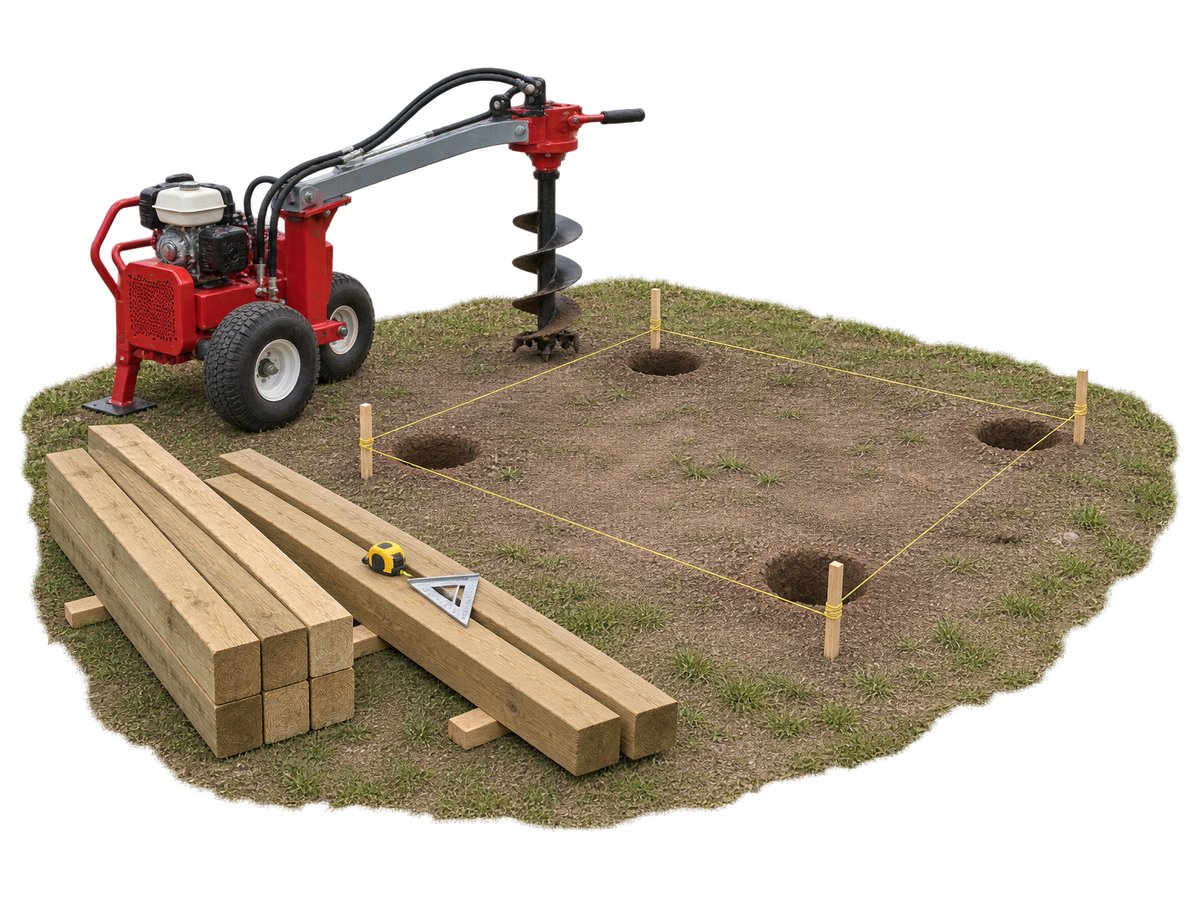
Set batter boards or stakes outside the footprint and run string lines. Check square by measuring the diagonals until they match. Mark each post center with paint, then mark the hole outline at the bit diameter so you can see it after the strings come down. Contact MISS DIG 811 at least three business days before drilling; it is free and required by Michigan law, and it does not mark private lines such as irrigation or landscape lighting.
String, stakes, marking paint. A metal detector to check each hole location for buried metal.
Auger the post holes
Four to six holes in workable soil is Little Beaver territory: one operator, 6, 8 or 10 in bits, first bit included. If your plan calls for a larger diameter, the ground is clay or stony, or the count is higher, the MT100 with hydraulic auger drills faster and passes a standard gate at 35.6 in; confirm its bit sizes at booking. Drill a few inches past the marked center on each side and plumb the post in the hole, rather than trusting the auger to land on the mark.
Little Beaver handheld auger, or MT100 stand-on loader with hydraulic auger.
Pergola on an existing slab or patio
If the posts land on an existing concrete slab that your plan says can carry them, you anchor post bases instead of digging. The TE 70 rotary hammer drills anchor holes in concrete; tell us the anchor diameter so we match the bit. If the plan calls for footings below the slab, you cut and break the slab at each post before you dig, and that becomes a concrete job: see our fence-post concrete guide for the breaking tools.
Hilti TE 70 rotary hammer for anchors. STIHL TS420 cut-off saw and TE 3000 demolition hammer if the slab has to open.
Mix, set posts and brace them
A towable concrete mixer holds 1.5 to 2 bags per batch, which is the right scale for four to six post bases. Set each post or post base, plumb it in two directions and brace it before the concrete sets up. Rinse the mixer right after the last batch. Let the concrete cure to the point your plan or the bag directions call for before you load the posts with beams.
Concrete mixer. Levels, braces and stakes are your own.
Get the lumber to the back yard
Pergola beams and posts are long, heavy and usually delivered to the driveway. If the lift of material is large, forks on the MT100 move bundles through a 36 in gate; the machine's rated capacity is 1,000 lb, so split heavy units. Forks on a full-size loader carry more when a 6 ft route is open. Stage the lumber on blocks next to the footprint so you are not carrying beams across wet concrete.
MT100 with forks, or T66-2 with 48 in forks on an open route.
What good preparation looks like
- Before any post goes in: string lines still up, diagonals equal, every hole at plan depth measured from finished grade, bottoms cleaned of loose soil, MISS DIG marks visible and nothing in a hole you did not expect. Concrete arrives after the holes are checked, and the posts are braced plumb before anyone walks away.
- The rental side is short. The auger goes out for a day and comes back. The mixer goes out on pour day. Forks ride along with the MT100 if you take it for the holes; attachments rented with a Ward's skid steer are half price, so adding forks to an auger rental is the cheap way to move the lumber on the same trip.
What changes the plan
- Clay or fieldstone at 2 ft moves you from the Little Beaver to the MT100 auger. Roots from a stump that used to be there, or old concrete, move you from drilling to digging: the E10 excavator passes a gate at 28 in retracted and digs the hole whatever is in it. A footing wider than any bit, or a belled footing, is also an E10 job.
- A pergola over a pool, on a deck, or carrying a roof or a heavy shade structure is a different project with different loads. Get the footing design from your engineer or the manufacturer before you book, and call us with the numbers.
Check the route before you book.
Measure the clear opening
Gate fully open, latch to post. The MT100 body is 35.6 in; the auger and the forks can be wider than the machine. Lumber bundles on forks are wider still.
Walk the route
Patio edges, planting beds, irrigation heads and septic fields between the driveway and the footprint. Tracks spread weight; they do not prevent all lawn damage. Plywood over soft spots.
Know the numbers
Post count, footing diameter and depth from the plan, and what the probe found at 2 ft.
Your pergola prep checklist
Save these details before you request equipment.
- Permit question answered by the township
- Post count, footing diameter and depth from the plan
- Layout squared, diagonals equal, centers marked
- MISS DIG 811 ticket date; private lines walked
- Soil at 2 ft at two post locations
- Clear opening at the gate and route to the footprint
- Concrete bag count and mixer or ready-mix decision
- Lumber delivery date and where it will be staged
Let's match the machine to your job.
Tell us what you're working on. Our Hamburg team serves Southeast Michigan, seven days a week.
(810) 231-7368
Explore equipment for this guide
Questions before you rent
What size holes do pergola posts need?
Your plan or the manufacturer's instructions set the footing diameter and depth, and your building department confirms the depth, which in most of southeast Michigan means below a frost line of about 42 in. We do not set those numbers at the counter. Bring the diameter and we match it to a bit: the Little Beaver takes 6, 8 and 10 in, and the MT100 auger takes larger sizes that we confirm at booking. The first bit is included.
Can I put a pergola on my existing patio?
Only if your plan says the slab can carry it, and that is a question for the manufacturer, your building department or an engineer rather than for us. If the answer is yes, you anchor post bases to the slab, and the TE 70 rotary hammer drills the anchor holes; tell us the anchor size. If the plan wants footings below the slab, each post location gets cut and broken open first with the cut-off saw and electric demolition hammer, then dug. Plan on debris hauling for that version.
Do I need a mixer for four posts?
Four to six post bases is usually too small for a ready-mix order and a long afternoon in a wheelbarrow. The towable concrete mixer holds 1.5 to 2 bags per batch and tows on a 2 in ball. Count your bags from the hole volume on the plan; if the number surprises you, call and we will talk through whether a truck makes more sense. Rinse the drum right after the last batch to avoid a cleaning fee.
How do I get the beams into the back yard?
If you are renting the MT100 for the auger, add forks: attachments rented with a Ward's skid steer are half price. The MT100 passes a standard 36 in gate at 35.6 in and its rated capacity is 1,000 lb, so split heavy bundles rather than trusting the fork rating. On an open 6 ft route, 48 in forks on the T66-2 carry more per trip. Long beams on forks are wider than the machine; measure the turn at the gate.
Do I need to call MISS DIG for a pergola?
Yes. Augering is excavation under Michigan law. Contact MISS DIG 811 at least three business days before you drill; it is free. MISS DIG marks public utilities only. Irrigation, landscape lighting, invisible fence and a line to a shed are private and are not marked, so walk them yourself or hire a private locator. A metal detector helps you check each hole location for buried metal; it does not replace the locate.