
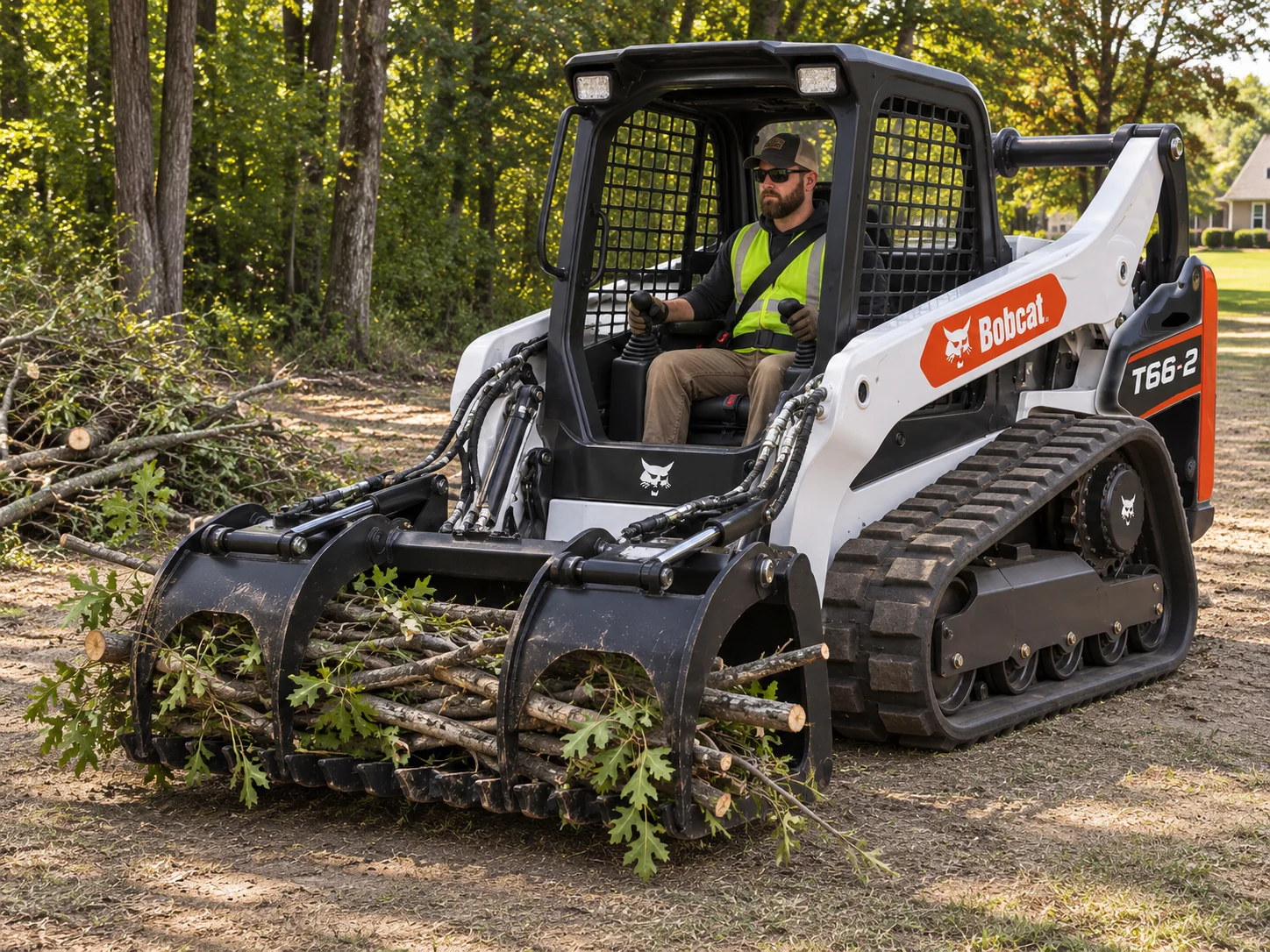
Why a grapple instead of a bucket
- A bucket slides under a brush pile and comes up with the bottom six inches of it, plus a lot of dirt. A root grapple closes on the pile from above and lifts the tangle as one piece, and its open tines let soil, leaves and small debris fall through on the way to the trailer. For brush, logs, roots and storm debris, it is the right tool, and it is the one most often added to a loader rental for cleanup.
- What a grapple does not do is pull anything still rooted in the ground beyond small root pulls, cut anything, or lift more than the loader behind it can carry. Stumps are a grinder or excavator job. Standing trees and hanging limbs are a tree service job. Treat the grapple as a very large pair of hands for material that is already loose.
Moving the pile, in order
Each stage names the Ward's machines that fit and what to check before moving on.
A loader and the dump trailer or a towable chipper can arrive together. A dual load is priced at its own delivery tier and confirmed at checkout; delivery is priced by drive time from Hamburg.
Look at the pile and decide where it goes
Pace the pile's footprint and estimate its height. Pull a few pieces out of the side to see what is inside: old piles hide soil, rocks, fence wire, rotten logs and sometimes animals. Decide the destination before you rent: a chipper set up nearby, a dump trailer to a yard-waste site, a new pile somewhere out of the way, or a burn where the township allows it. Each destination changes where the loader needs to drive.
No rental needed yet. A phone photo with a person in it for scale helps us size the loader.
Full-size loader or the MT100
The 66 in root grapple fits the Bobcat T66-2 and Kubota SVL65-2 on turf and soft ground, and the wheeled Bobcat S570 where the pile sits on pavement or firm gravel. Those loaders carry a few times what the MT100 does per trip. The MT100 stand-on loader with the 36 in grapple is the choice when the only way in is a 36 in gate; it takes smaller bites and more trips. Attachments rented with a Ward's skid steer are half price. The grapple's own weight counts against the loader's rated capacity, so real loads are smaller than the headline number.
T66-2 or SVL65-2 with 66 in root grapple; S570 with the same grapple on hard ground; MT100 with 36 in root grapple through a gate.
Check the gate and the ground
The 66 in grapple on a 67 in loader needs a clear 6 ft opening plus room to make the turn; measure latch to post with the gate open. The MT100 body is 35.6 in and the 36 in grapple is a hair wider, so a 36 in clear opening is tight and the route has to be straight. Walk the loaded route for septic fields, irrigation heads, soft spots and slopes. Tracks spread weight and reduce rutting; they do not prevent lawn damage, and saturated ground is not workable. Lay plywood where the route is soft.
Tape measure. Plywood sheets for soft stretches and the lawn edge where the trailer parks.
Work the pile from the side, low and steady
Approach the pile from the side where you can see what you are grabbing. Open the grapple wide, push the lower tines in low, close the upper jaw, then curl and lift. Shake it a little so soil drops out before you travel. Keep the load low while moving and watch for long limbs swinging beyond the grapple. Pull the pile apart in layers rather than taking everything in one bite; a grab that is too heavy stalls the lift or tips the machine forward.
Loader with grapple. Nobody on foot within reach of the grapple or in the travel path.
Feed the chipper or fill the trailer
Into a chipper: set the brush down near the feed table rather than pushing it in with the grapple, and let the people feeding control what goes in. Into the dump trailer: the 7x14 holds 10.9 cu yd behind 3 ft walls with a 14,000 lb GVWR. Brush is bulky, so you fill it by volume; set the load in gently, press it down with the grapple, and strap it. Rotten logs and dirt-filled root wads are heavy, so with those watch the weight rather than the fill line.
7x14 dump trailer (2 5/16 in ball, brake controller required). Vermeer 6 in or 12 in chipper if chipping on site.
Rake out what the tines left
A grapple leaves a scatter of twigs, bark and leaf litter where the pile stood, and often a dead patch of ground underneath. Rake the small stuff, scoop the last layer with the bucket if the loader has one along, and either seed the bare ground or plan to. If the pile sat for years, the ground under it may be lower than the lawn and want topsoil.
Bucket on the same loader; hand rakes; lawn roller if you seed.
Before choosing a loader, measure the way in.
Measure the narrowest opening
The attachment sets the limit here: 66 in grapple on a 67 in loader, 36 in grapple on a 35.6 in MT100. Measure latch to post with the gate fully open and check the turn into it.
Walk the loaded route
Loaded trips back and forth over the same line are what rut a lawn. Pick a route on the firmest ground, lay plywood on soft stretches, and after a hard rain give it a day.
Plan where the trailer parks
The loader should reach the trailer or chipper without crossing the softest ground or a septic field. Sometimes the right answer is parking the trailer at the street and making the loader trips longer.
Machine and grapple widths, from our product pages
Width with the grapple is what passes the gate. Add a few inches each side before you call it a fit; if you are a few inches short, pulling a fence panel is often easier than running the whole job on the smaller machine.
Bobcat MT100 with 36 in root grapple — 35.6 in body / 36 in grapple
Bobcat T66-2 with 66 in root grapple — 67 in body / 66 in grapple
Kubota SVL65-2 with 66 in root grapple — 68 in body / 66 in grapple
Bobcat S570 (wheeled) with 66 in root grapple — 68 in with bucket / 66 in grapple
Your project checklist
Save these details before you request equipment.
- Pile footprint and height, paced off
- What is in it: brush only, or logs, roots, soil, wire
- Destination: chipper, dump trailer, new pile, permitted burn
- Narrowest access point and turning space
- Ground conditions on the loaded route
- Tow vehicle, ball size and brake controller if hauling
- Delivery location and preferred dates
Let's match the machine to your job.
Tell us what you're working on. Our Hamburg team serves Southeast Michigan, seven days a week.
(810) 231-7368
Explore equipment for this guide
Questions before you rent
Which loader should I put the grapple on?
On turf or soft ground, the tracked Bobcat T66-2 or Kubota SVL65-2 with the 66 in grapple; tracks spread the weight and keep working when it is damp. On pavement or a firm gravel lot, the wheeled S570 is quicker and takes the same grapple. Through a 36 in gate, the MT100 with its 36 in grapple is the only option and takes smaller bites. The grapple's own weight comes out of the loader's rated capacity, so a big grab of wet logs can be more than the machine wants; the load, the reach and the ground decide the real limit.
Can the grapple pull stumps or small trees?
It handles small root pulls, the kind of sapling clump a loader can tug loose. It does not remove real stumps or fell standing trees. Stumps go to the tracked stump grinder or, if the root ball has to come out, a mini excavator. Standing trees and hanging limbs go to a tree service. The grapple is for material that is already loose or nearly so.
How much brush fits in the dump trailer?
The 7x14 dump trailer holds 10.9 cu yd inside 3 ft walls, with a 14,000 lb GVWR. Loose brush fills it by volume well before weight, so compress it with the grapple and strap the load. Rotten logs, dirt-filled root wads and stumps are the opposite: they hit the weight limit before the trailer looks full. It needs a 2 5/16 in ball and a brake controller in your truck, and we check the setup at the counter.
Will the loader with the grapple fit through my gate?
Measure the clear opening latch to post with the gate fully open. The MT100 with the 36 in grapple needs at least a 36 in clear opening and a straight approach; the T66-2 or SVL65-2 with the 66 in grapple needs a clear 6 ft and room to turn. Width is only part of it: also check steps, tight corners and what the loaded machine will drive over. A few inches short usually means pulling one fence panel, which is easier than running the whole job on a smaller machine.
Should I arrange delivery or tow it myself?
Full-size loaders ride on our 16 ft equipment trailer with a 2 5/16 in ball and need a 3/4-ton truck or larger; the MT100 rides on the 12 ft ramp trailer with a 2 in ball, which a half-ton typically handles. Your tow rating has to cover trailer, machine and the grapple, confirmed at the counter. Delivery runs seven days a week on our own trucks, priced by drive time from Hamburg: $85 round trip within 45 minutes for a truck-and-trailer load, $125 for a dual load such as a loader plus the dump trailer, and a quote past 75 minutes. The fee is confirmed at checkout. Rental time is charged for time out, with no hour cap; the week rate covers 3 to 7 days.