
Taking out a berm or raised bed, in order
Berms and raised beds come out in the same order: plants, roots and edging first, then the mound, then the ground under it. Decide early whether the soil leaves the property or gets spread on site, because that choice sets the equipment.
A loader with a grapple and a bucket covers steps 2 through 5. Attachments rented with a Ward's skid steer are half price, and the week rate covers 3 to 7 days if the job runs over a weekend.
Find what is in and under the bed
Old beds hide irrigation lines, landscape lighting wire, drip tubing, weed fabric and sometimes a buried downspout line. Call MISS DIG 811 at least three business days before you dig; it is free, required by Michigan law, and marks public utilities only. Private lines are yours to find; a metal detector helps locate valve boxes, pins and buried metal edging but does not replace the locate. Note where the berm sits relative to the septic field and the property line.
Metal detector for buried edging, valve boxes and pins.
Remove shrubs, stumps and edging
Cut shrubs down and pull the root balls. A root grapple on a loader grabs a shrub at the base, rips it out and shakes the soil off; the 66 in grapple runs on the T66-2, SVL65-2 or S570, and a 36 in grapple runs on the MT100 in a gated yard. For a tree stump in the berm, grind it below grade with the SC30TX tracked stump grinder (35 in wide) or pull the root ball with a mini excavator if something will be built there. Pry out timbers, blocks or steel edging and stack them for disposal; check your local rules for treated lumber.
66 in root grapple on a full-size loader; 36 in grapple on the MT100; SC30TX stump grinder; 6 in chipper for the brush.
Cut the mound down
Work the berm from one end with the bucket, taking a few inches per pass and pushing or carrying the soil to where it is going. A full-size tracked loader (T66-2 or SVL65-2) flattens a long berm quickly with open access. Through a 36 in gate, the MT100 does the same job in smaller bites. A raised bed with a wall comes apart from the top down: pull the wall, then scoop the fill. Watch for the weed fabric; it wraps around a bucket and is easier to pull by hand once the soil is off it.
T66-2 or SVL65-2 with open access; MT100 through a gate.
Get the soil where it is going
Berm soil is often decent topsoil mixed with mulch and roots. If the yard has low spots, spread it there and save the haul. If it leaves, the 7x14 dump trailer holds 10.9 cu yd and is rated 14,000 lb GVWR, with a 2 5/16 in ball and a brake controller required. Wet soil and root balls hit the weight limit before the trailer looks full. Brush goes through the 6 in chipper for mulch or into the trailer. Estimate the volume before you book: length times width times height of the mound, roughly, then halve it for the slopes.
7x14 dump trailer; loader to load it; 6 in chipper for brush.
Grade the spot into the lawn
The ground under a berm is usually lower than the lawn around it, or compacted, or both. Back-drag with the bucket to blend the spot into the existing grade and make sure it falls away from the house. For a seedbed, the soil conditioner pulls the leftover roots and rocks and leaves it loose and level: the 72 in on the T66-2 (not compatible with the Kubota) or the 48 in on the MT100. A bucket and a hand rake do the same on a small spot.
Loader bucket; 72 in or 48 in soil conditioner, half price with the loader.
Seed and roll
Add topsoil if the spot is still low, seed or sod, and roll with a water-filled lawn roller when the ground is damp. The roller presses seed into the soil; it is not for compacting a base. Drain it before you return it.
Lawn roller, 24, 36 or 48 in.
Which situation is yours?
Pick the one closest to your bed.
Berm full of overgrown shrubs
Full-size loader with a root grapple and a bucket
The grapple pulls shrubs, roots and timbers in one grab and lets the soil fall through its tines. Swap to the bucket and the same machine cuts the mound and loads the trailer.
The 66 in root grapple fits the T66-2, SVL65-2 and S570. On the 67 in T66-2 it is nearly machine width, so re-measure any opening with the grapple on. The tracked loaders are the pick for a lawn; the wheeled S570 ruts turf and is for pavement or a gravel lot. Run brush through the 6 in chipper and spread the chips, or trailer it. Rent the grapple with the loader and it is half price.
- Gate under 6 ft: switch to the MT100 with the 36 in grapple, in smaller bites.
- A tree stump over about a foot across: grind it with the SC30TX or pull it with the E35; a grapple will not.
- Shrubs you want to keep: dig them by hand before the machine arrives.
- How long and tall is the berm, and how many shrubs?
- Narrowest point between the trailer and the berm?
- Does the soil stay on site or leave in a trailer?
- t66-2
- grapple-66
- chipper-shredder-6-max
Raised bed in a fenced backyard
Bobcat MT100 with bucket, 36 in grapple if there are roots
The MT100 is 35.6 in wide and passes a standard gate with its bucket at machine width. It pulls the wall apart, scoops the fill and carries it to the driveway or a low spot.
The MT100's 1,000 lb rated capacity means more trips than a full-size machine, which is fine for a bed-size pile. The 36 in root grapple on the MT100 handles shrub roots and timbers in a tight yard. Timber, block or stone walls come out by hand or with the bucket; stack them for disposal. If the fill is clean topsoil, spreading it into the lawn saves hauling it out through the gate.
- Clear opening under 36 in: hand tools and a wheelbarrow, or pull a fence panel.
- A lot of fill leaving the yard on a slope: the Canycom buggy carries steadier than a raised bucket.
- Mortared block wall: that is demolition; see the concrete and masonry category.
- Bed dimensions and wall height?
- Clear gate opening and the turn into it?
- Where does the fill go, and is there irrigation under the bed?
- mt100
- 36-compact-stand-on-skid-steer-root-grapple-attachment
- canycom
Berm with a tree stump in it
Stump grinder or mini excavator, then a loader
A loader bucket will not get a real stump out. Grind it below grade if lawn is going back over the spot, or pull the root ball with an excavator if something will be built there.
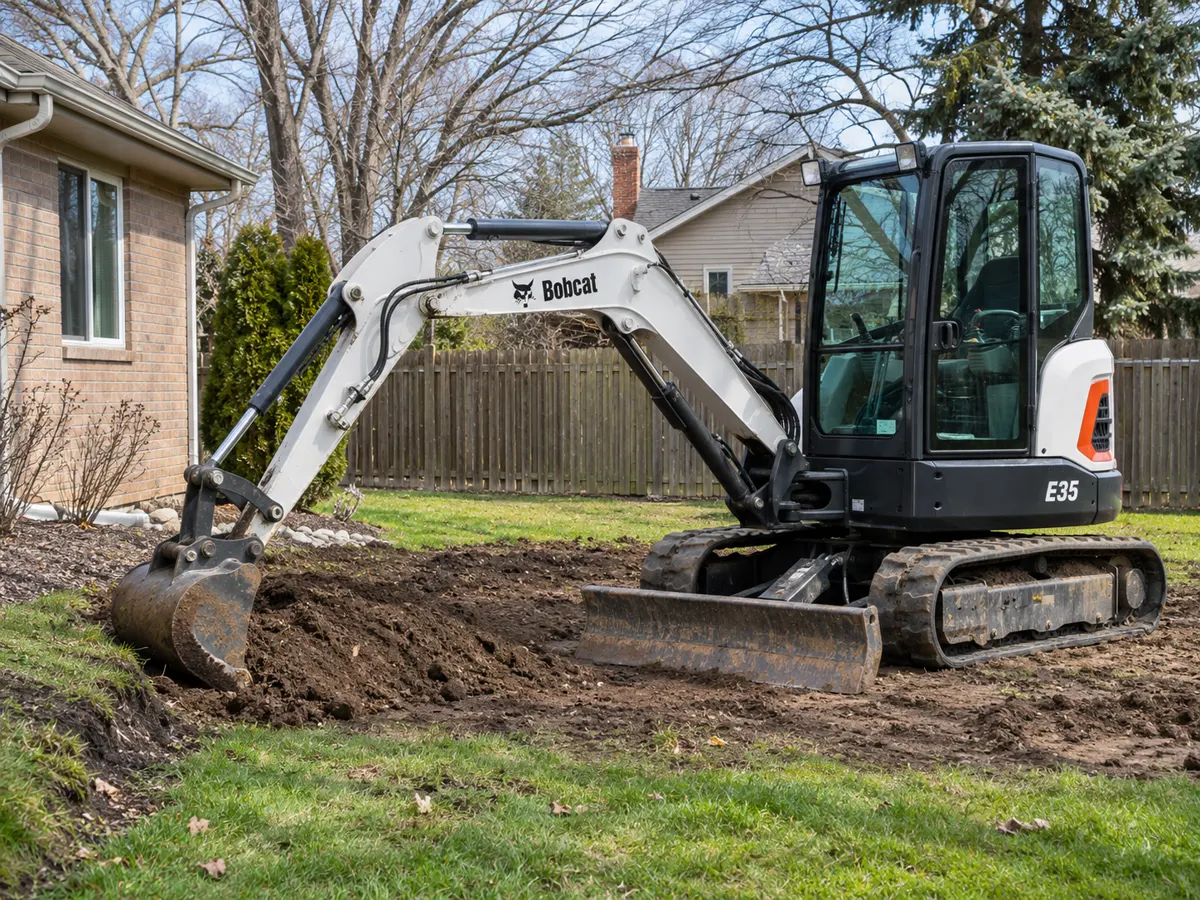
The Vermeer SC30TX tracked grinder is 35 in wide, passes a 36 in gate, handles slopes and leaves chips and a hole to backfill. The E35 lifts a root ball out and loads it; the E10 does small stumps where access is tight. The tree itself has to be down first; a standing tree is a job for a tree service. Once the stump is handled, the loader takes the berm down as in the steps above.
- Stump sits over a gas line, septic tank or near the foundation: grind, do not pull, and have locates in hand.
- Several stumps and lots of roots: the root grapple on the loader clears the debris the excavator pulls.
- Stump is small, under a few inches: the grapple may lift it with the shrubs.
- Stump diameter at ground level?
- Is the tree already down to a stump?
- What goes in that spot afterward: lawn or a structure?
- stump-grinder
- e35
- grapple-66
Common mistakes
- Not finding the irrigation first. Berms are where sprinkler lines were rerouted around. A bucket through a line turns a yard job into a repair.
- Loading the dump trailer by volume. Wet soil and root balls hit 14,000 lb GVWR long before the trailer looks full. Load by weight.
- Spreading berm soil without pulling the roots and fabric. Shrub roots and weed fabric in the new seedbed keep coming to the surface. Run the soil conditioner or rake them out before seed.
When to stop and call someone
- A berm built to hold back a slope or hide a drainage swale may be doing a job. If the yard behind it drains across it, or it sits uphill of the house, talk to a landscape or drainage contractor before you flatten it. A standing tree is a tree service job before any of this starts. A berm over the septic field means a septic professional before any machine goes near it.
Before you book, check the site
Measure the narrowest opening
Gate fully open, latch included, and the turn into it. The 66 in grapple is nearly the width of a 67 in loader; the MT100 bucket is machine width.
Walk the route
Where the trailer parks, what the tracks cross to the berm, and where the soil pile or spread area is.
Size the berm
Length, width and height, the number of shrubs, the biggest stump, and what the edging is made of.
Machine widths, from our product pages
Width is the machine body. Add the attachment before you call it a fit: the 66 in grapple on a 67 in T66-2 leaves nothing to spare at a 6 ft gate. Measure the clear opening and the route.
Vermeer SC30TX stump grinder — 35 in
Bobcat MT100 stand-on loader — 35.6 in
Bobcat T66-2 track loader — 67 in
Kubota SVL65-2 track loader — 68 in
Bobcat E35 mini excavator — 69.7 in
Before ground disturbance: — arrange utility locating through MISS DIG 811 at least three business days ahead, and find irrigation, lighting and other private lines yourself.
Your project checklist
Save these details before you request equipment.
- Berm or bed dimensions and rough soil volume
- Number of shrubs and the largest stump diameter
- Edging material: timber, block, stone, steel
- Soil staying on site or leaving by trailer
- Narrowest opening on the route, with attachment
- Irrigation and lighting lines located
- MISS DIG 811 ticket requested
Let's match the machine to your job.
Tell us what you're working on. Our Hamburg team serves Southeast Michigan, seven days a week.
(810) 231-7368
Explore equipment for this guide
Questions before you rent
Do I need a grapple, or will the bucket pull shrubs?
A bucket can push a small shrub over and scoop the roots, with a lot of soil coming along. A root grapple closes on the base of the plant, lifts it and lets the soil fall through the tines, so you get a clean root ball and a pile that is mostly brush. For a berm with a handful of small shrubs the bucket is fine. For a row of mature yews or junipers the grapple saves the most time of anything on the job, and it is half price when rented with the loader.
How much soil will the dump trailer hold?
The 7x14 dump trailer holds 10.9 cu yd behind 3 ft walls and is rated 14,000 lb GVWR. Wet topsoil and root balls are heavy enough that the trailer reaches its weight limit before it looks full, so load by weight, not by volume. It takes a 2 5/16 in ball and a truck with a brake controller, and your tow rating has to cover the loaded trailer. Estimate the berm's volume (length by width by height, then about half for the slopes) and we will tell you how many trips that looks like.
There is a tree stump in the berm. Grind it or dig it?
If lawn is going back over the spot, grind it. The SC30TX tracked grinder is 35 in wide, chews the stump below grade and leaves the surrounding ground mostly intact; you backfill the hole and seed. If a patio, footing or drain line is going exactly there, the root ball has to come out, and that is an E35 job, or an E10 for a small stump with tight access. Either way the tree has to be down first. A standing tree is a tree service job.
Do I need MISS DIG to remove a berm?
Yes. You are digging below grade, and Michigan law requires contacting MISS DIG 811 at least three business days before. It is free. It marks public utilities only; irrigation, landscape lighting, invisible fence and a line to a shed are private and you need to find those yourself, from your records or with a private locator. A metal detector helps find valve boxes and buried metal edging but does not replace the locate.
How long will the loader take?
It depends on the size of the berm, how many shrubs are in it and whether the soil is leaving by trailer. You pay for the time the machine is out, with unlimited run hours and no daily cap. Rental periods run 1 to 4 hours, 4.5 to 24 hours, one week (3 to 7 days) and four weeks. If you clear shrubs one day and grade the next, the week rate often costs the same as two single days. Extra time is prorated, never more than the next full period, and fuel is billed at our cost.