
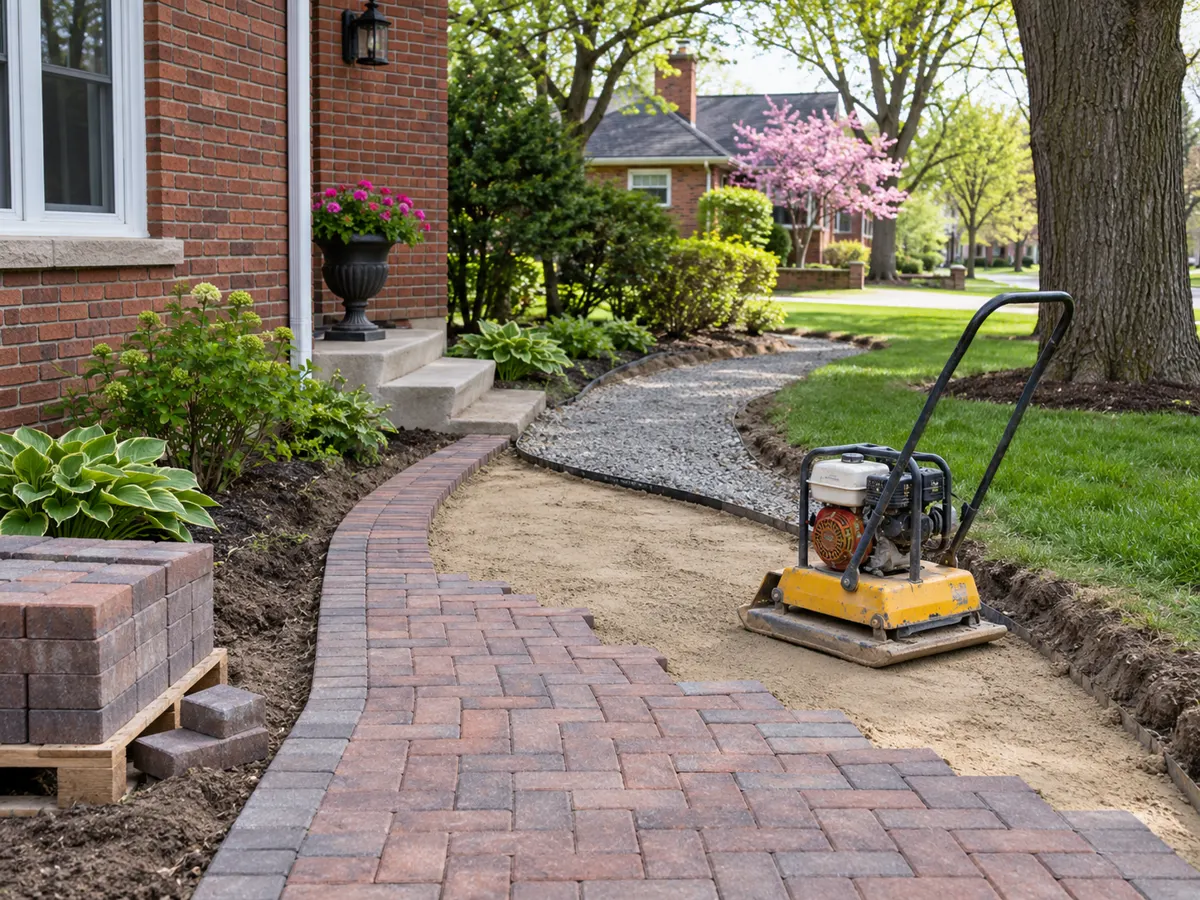
What you can keep from the old walkway
- A gravel walkway is usually a few inches of loose stone over soil, sometimes over landscape fabric, held in by plastic or steel edging. Almost none of that is a paver base. Round pea stone does not lock together under compaction, loose crushed stone was never compacted in lifts, and fabric that has worked its way up through the gravel will be in the way of the dig.
- What may be worth keeping is a layer of crushed, angular stone that is already firm underfoot. Dig a test hole at a couple of spots. If you find compacted crushed stone that resists a bar, it can become the bottom of your new base once the loose top and any fabric are gone. If you find pea stone, dirt mixed with gravel, or soft ground, it all comes out and the new base starts from firm soil.
- The line of the old path is also worth keeping. It already goes where people walk. Widen or straighten it if you want, but a paver walkway that follows the worn route gets used.
The shortcut that fails
- Laying pavers on the old gravel with a layer of sand on top is the common shortcut. The surface looks fine for a season. Then the loose gravel shifts under the sand, pavers tip at the edges, and weeds come through joints that opened. The paver supplier's base spec exists for a reason: a compacted depth of angular stone that does not move.
- The second mistake is underestimating the haul. Old gravel plus the soil under it is heavy. A pile that looks modest on the lawn fills a dump trailer by weight long before it fills it by volume. Plan where it goes before you start pulling it up.
- Third, old edging. Steel or plastic edging with spikes has to come out fully, spikes included, or it ends up in the sod cutter or the compactor. Walk the edge with a magnet or the metal detector before you run machines.
From gravel path to paver walkway
The removal steps are new. The base and paver steps follow our paver patio guide.
The haul is the step people skip in planning. Book the dump trailer for the day the material comes out and have it parked where the MT100 can load it. Rental time is the time the equipment is out, with unlimited run hours.
Dig test holes and plan the haul
Dig down at two or three points along the path. Note what you find at each depth: loose stone, fabric, compacted crushed stone, soil. Decide whether anything stays. Measure length and width and work out the volume of material leaving. Contact MISS DIG 811 at least three business days before the dig; a path to the house often crosses service lines.
Shovel, digging bar, tape. Metal detector optional to find edging spikes.
Pull the edging and lift the loose gravel
Remove edging and every spike. Scrape the loose gravel into piles with the MT100 bucket, or by hand on a narrow path. If there is fabric, roll it back as you go; gravel on top of fabric comes up cleaner than gravel mixed into soil. Separate clean stone you might reuse elsewhere from the mixed material that is leaving.
Bobcat MT100 with bucket; hand tools on a narrow path.
Dig to depth and widen for edge restraint
Cut the sod on either side with the gas sod cutter if the new walkway is wider than the old path. Dig to the depth on your paver supplier's spec, plus a few inches each side for edge restraint. The MT100 at 35.6 in wide digs and carries where the path and any gate are wider than it; otherwise it is hand digging. Stop at firm soil or firm existing crushed stone.
Classen gas sod cutter; Bobcat MT100.
Load the spoil and take it away
Old gravel and soil go in the 7x14 dump trailer, which holds 10.9 cu yd but carries 14,000 lb gross, and gravel and dirt reach the weight limit well before the walls are full. The trailer needs a 2 5/16 in ball and a brake controller in the tow vehicle. The MT100 loads it from the driveway. A small path's worth may fit the 5x10 utility trailer at 2,000 lb, in several trips.
7x14 dump trailer; 5x10 utility trailer for small volumes; Bobcat MT100 to load.
Place new stone in lifts and compact
Bring crushed stone down the path with the MT100 bucket, spread a few inches at a time, mist it and compact each lift with the plate compactor before the next. Build the fall away from the house into the base and check it on every lift. A firm base feels like pavement underfoot.
Bobcat MT100 to carry; Wacker Neuson plate compactor.
Sand, pavers, cuts, edge restraint, compact
Screed bedding sand, lay pavers from one end standing on the laid surface, and set edge restraint along both sides. Cut edge pieces on the DeWalt 10 in paver saw, or with the STIHL TS420 for curves. Compact with a pad on the plate, sweep in joint sand and compact again. Put the sod strips back along the edges.
DeWalt 10 in paver saw; STIHL TS420 for curves; plate compactor with pad.
Check the path and the trailer spot
Width along the path
The MT100 body is 35.6 in. Measure the narrowest point along the old path and at any gate, fully open. Where it is tighter than the machine, that stretch is hand work.
Where the trailer parks
The dump trailer stays on the driveway or street. Every load of spoil travels from the path to the trailer, so the shorter and firmer that route, the better.
What is under the path
A walkway to the front door often sits over the water service or the sewer lateral. Get the MISS DIG locate and hand dig near marks.
Before ground disturbance: — contact MISS DIG 811 at least three business days ahead. Free and required by Michigan law. Private lines are not marked.
Your walkway conversion checklist
Have these ready before you book.
- Path length, current width and planned width
- What the test holes found at each depth
- Rough volume of material leaving and where it goes
- Excavation depth and base thickness from the paver supplier
- Narrowest clear point on the route for the MT100
- Tow vehicle with a 2 5/16 in ball and brake controller for the dump trailer, or delivery
- MISS DIG 811 ticket date
Let's match the machine to your job.
Tell us what you're working on. Our Hamburg team serves Southeast Michigan, seven days a week.
(810) 231-7368
Equipment for a gravel-to-paver conversion
Questions before you rent
Can I lay pavers right on top of the old gravel?
Not if you want them to stay flat. Loose gravel, and especially round pea stone, shifts under load and never locks together, so the pavers tip and the joints open. A paver base is compacted angular crushed stone built up in lifts to the depth your supplier specifies. If your test holes find a firm layer of compacted crushed stone under the loose top, that layer can stay as the bottom of the new base. Everything loose comes out.
How much material will I be hauling away?
Length times width times depth of what comes out, in feet, divided by 27 gives cubic yards. Add the sod and soil if you are widening. Gravel and dirt are heavy, and the 7x14 dump trailer reaches its 14,000 lb gross limit well before its 10.9 cu yd walls are full, so load by weight, not by how full it looks. Tell us your numbers and we will say whether it is one trip or several, or whether the 5x10 utility trailer at 2,000 lb covers a small path.
What do I need to tow the dump trailer?
A tow vehicle rated for the loaded weight, a 2 5/16 in ball on a rated hitch, working lights, and a brake controller; the dump trailer has electric brakes and will not be released without one. We load and chain at the yard and check your setup at the counter. If your truck is not set up for it, delivery runs seven days a week, priced by drive time from Hamburg and confirmed at checkout; the trailer with the MT100 is a dual load at $125 round trip within 45 minutes.
Is the MT100 worth it for a walkway?
For pulling up gravel, digging to depth, loading the trailer and carrying new stone back in, yes, if the path and any gate are wider than its 35.6 in body with room to work. It turns a few hundred wheelbarrow trips into bucket loads. On a very narrow path or one with tight bends it cannot work in, the job is hand tools and a wheelbarrow, and the plate compactor is the one machine you still rent. Measure the tightest point and tell us.
Do I need MISS DIG for a walkway?
Yes. Michigan law requires contacting MISS DIG 811 at least three business days before digging, and a walkway to the house commonly runs over the water service, sewer lateral, gas service or electric. The locate is free. It does not mark private lines such as irrigation, landscape lighting or an invisible fence; find those yourself and hand dig near anything marked.