
What are you seeing?
Pick the symptom closest to yours. Each one shows the likely causes to check before you rent anything.
Likely causes to check
Rent equipment only after
Potholes that come back
Find where water sits, reshape, then compact
A pothole starts where water stands. Tires pump the wet fines out, the hole grows, and more water collects in it. Filling the hole with loose stone fixes the surface for a few weeks. Fixing it for good means getting water off that spot and compacting the repair.
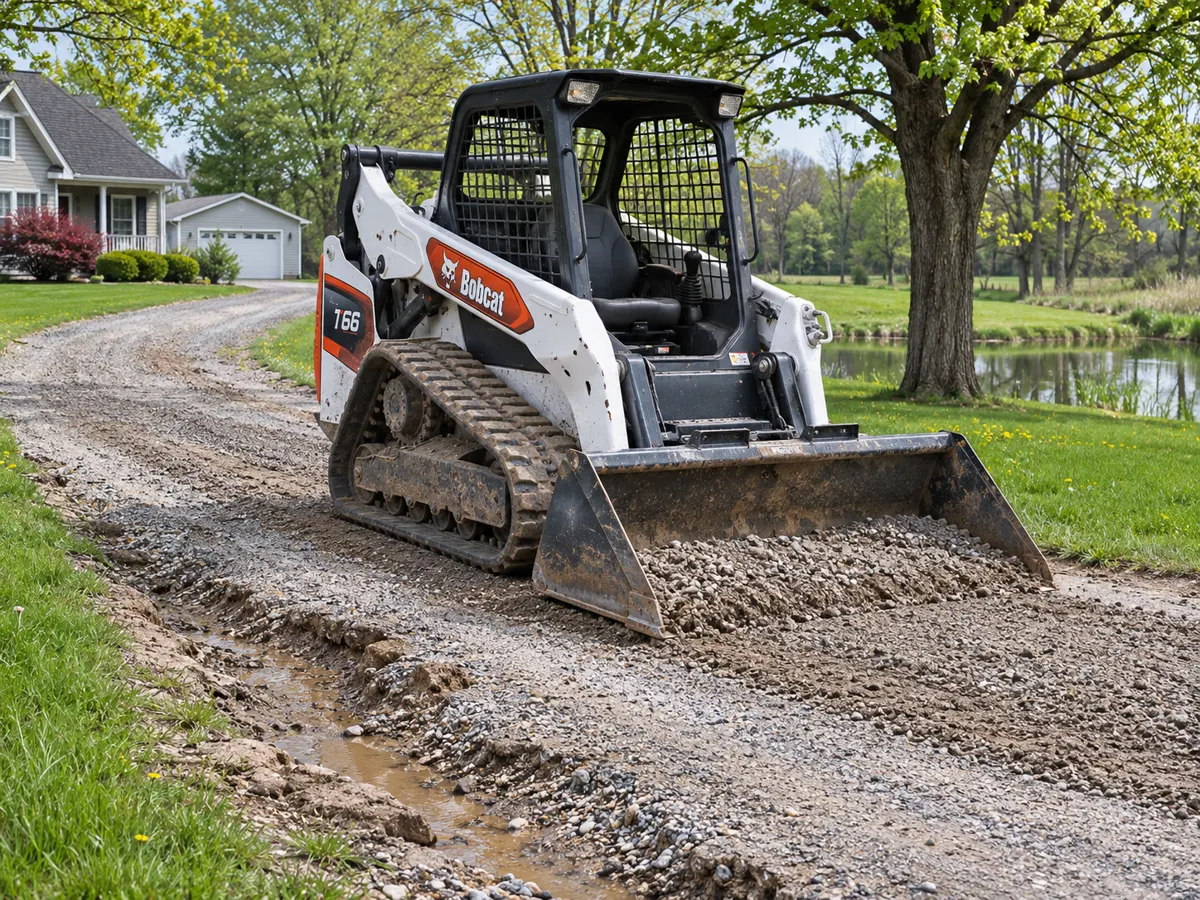
Once drainage is sorted, the repair is a grading job. A full-size tracked loader, the Bobcat T66-2 or Kubota SVL65-2, cuts the high edges around the holes and pulls stone back into them. On a drive that has lost its crown across a long stretch, the 72 in soil conditioner on the T66-2 loosens, mixes and re-levels the existing stone in one pass before you add new material. Compact the result: the 36 in ride-on roller for a full-length drive, the plate compactor for a handful of patches.
- Water runs down the drive and stops at the holes: the drive has no crown or has gone flat. Reshape so the center is high and water sheds to the sides.
- Water comes from the lawn or roof onto the drive: downspouts, a slope toward the drive, or a blocked ditch. Redirect that first.
- Holes punch through to soft dirt: the stone layer is too thin or has mixed into the subsoil. You will need new stone, not just reshaping.
- Holes only where vehicles stop and turn: expect those spots to need the most compaction and the firmest stone.
- You have watched the drive during or right after rain and know where water stands.
- You know whether there is enough existing stone to reshape or whether a load is coming.
- You have checked the narrowest point on the drive for a 67 to 68 in loader and the 36 in roller.
- t66-2
- skid-steer-soil-conditioner-hydraulic
- roller
Washboard ripples
Re-mix the surface and compact it
Washboard forms when loose stone on top has nothing binding it and tires push it into ripples, usually on hills and where people accelerate or brake. The stone is still there; it just is not locked together.
The soil conditioner on the T66-2 is the right attachment: it tills the rippled surface, mixes the fines back in, and rakes it level in the same pass. A bucket alone can back-drag the ripples down, which works on short sections but tends to push the fines off the drive. Follow with the 36 in ride-on roller while the stone is damp so it locks together. If the ripples only cover a short stretch, a bucket and the plate compactor are enough.
- Ripples return within weeks on the same hill: the surface stone has few fines and no binder. Ask your stone supplier for a mix that packs rather than more of the same round stone.
- Ripples plus dust: the fines are blowing and washing away. New material with more fines fixes both.
- Ripples on a drive with no crown: reshape at the same time or water will undo the work.
- You know whether the problem is a short stretch or the whole drive.
- You know what stone is on the drive now and whether the supplier recommends a different mix.
- You have confirmed the T66-2, not the Kubota, if you want the 72 in soil conditioner.
- t66-2
- skid-steer-soil-conditioner-hydraulic
- roller
Washed-out edge or channel
Fix the water path before you replace the stone
A channel cut along or across the drive means water had nowhere else to go. Filling the channel without fixing the path puts the stone right back in the stream. The ditch, culvert or swale that should be carrying that water is blocked, too small, or missing.
Clearing a shallow ditch or re-cutting a swale along the drive is excavator work. The Bobcat E35 cleans a ditch and places the spoil clear of the drive; the E10 reaches tighter spots. Once the water path works, the loader brings stone back to the washed edge, shapes the shoulder so it sheds water, and the roller or plate compactor locks it. If the washout runs across the drive at a low spot, the drive may need a culvert; sizing one and setting it to the right fall is a job to talk through with the counter or a contractor.
- Water crosses the drive from a neighbor's land or a road ditch: this may involve the road commission or a drain easement. Ask before you dig.
- The washout is at a culvert end: the pipe is likely plugged or undersized. Clean it first and watch the next rain.
- A small channel from a single downspout: extend the downspout and refill; no excavator needed.
- Standing water in the ditch that never drains: the outlet is the problem, not the ditch.
- You have walked the drive in rain and know the direction water comes from and where it should go.
- You have a MISS DIG 811 ticket if you will be digging a ditch, swale or culvert bed.
- You know whether the ditch spoil stays on site or needs a dump trailer.
- e35
- t66-2
- compactor
Soft, muddy spots
Dig out the soft spot and rebuild it in lifts
A spot that stays soft and pumps mud up through the stone has lost its base. Either the stone was never thick enough there, or clay and water have worked up into it. Adding stone on top of mud buries the mud; it does not fix it.
Dig the soft spot out to firm ground with the loader bucket or, for a deep or wet pocket, the E35. Haul the muck off or spread it where it can dry. Rebuild with clean crushed stone in lifts of a few inches, compacting each with the plate compactor before the next. A full-size tracked loader carries and spreads the stone; the S570 wheeled loader does the same on a dry, firm drive and is quicker on hard surfaces. Finish with the roller across the repair and the surrounding drive so the patch matches.
- Soft spot sits in a low area that holds water: add drainage to the repair plan or it will go soft again.
- Soft spots across the whole drive in spring: frost coming out of the ground. Wait for it to firm up before grading, and keep heavy loads off until it does.
- A spot over a septic line or drain field: do not dig. Confirm what is below first.
- Pocket deeper than a foot or two: the volume of stone goes up fast. Get a delivery quote before you rent.
- You have probed the spot and know roughly how deep the soft material goes.
- You know where the muck will go.
- You have a stone delivery lined up for the same day as the loader.
- t66-2
- e35
- compactor
The repair that keeps failing
- The most common gravel driveway repair is a load of stone dumped into the holes and driven over. It looks fixed for a month. The stone was loose, the hole still collects water, and the fines wash out again. A durable repair has three parts in order: move the water off the spot, reshape the drive so the center is higher than the edges, and compact the stone so it locks together.
- The second common mistake is grading when the drive is dry and dusty. Loose dry stone does not pack. Grade and compact when the material is damp, after a rain or with a hose, and the fines bind the larger stone. Grading saturated stone is the opposite problem: it smears and rutting gets worse. A day after a hard rain is usually right.
- Third, watch the shoulders. A drive that is wider at the center than at the edges, with grass and sod built up along the sides, traps water on the surface. Cut the sod edge back so water can leave the drive.
Your driveway checklist
Have these ready before you book.
- Length and width of the drive, and the narrowest point along it
- Where water stands or flows during rain (a phone video helps)
- Which symptom: potholes, washboard, washout, soft spots, or several
- Whether existing stone is enough to reshape or new stone is coming
- Stone delivery date so the loader is on site the same day
- MISS DIG 811 ticket if you will cut a ditch or culvert bed
- Delivery address and preferred dates
Let's match the machine to your job.
Tell us what you're working on. Our Hamburg team serves Southeast Michigan, seven days a week.
(810) 231-7368
Equipment for driveway repair
Questions before you rent
Tracked loader or the wheeled S570 for a driveway?
On a firm, dry gravel drive the wheeled Bobcat S570 is quick and nimble and does the grading well. If the drive has soft spots, if the shoulders are lawn, or if you will be working after rain, the tracked T66-2 or SVL65-2 keeps working where wheels spin and rut. Tracks spread the weight; they do not stop all rutting on wet ground. If you want the 72 in soil conditioner, that attachment pairs with the T66-2 and is not offered on the Kubota.
Do I need the ride-on roller or is the plate compactor enough?
For a full-length drive, the 36 in double-drum ride-on roller covers the width in a few passes and packs the stone evenly. For a few potholes or one soft spot, the plate compactor is enough and is easier to move around. The plate also works better for compacting a dug-out pocket in lifts, where the roller cannot get down into the hole. Many driveway jobs use the plate for the patches and the roller for the final pass.
How much new stone will I need?
That depends on how much is already there and how deep the soft spots go, and your stone supplier is the right person to size the load. Measure the length and width of the drive, estimate how many inches you are adding, and probe the soft spots so you know their depth. If the existing stone has just been pushed to the edges, the soil conditioner can recover a lot of it before you buy more. Have the stone delivered the same day the loader is on site so you spread it while it is fresh.
Do I need MISS DIG for a driveway repair?
Reshaping the surface stone does not go below grade. Digging out a soft spot, cutting a ditch, or setting a culvert does, and Michigan law requires contacting MISS DIG 811 at least three business days before that kind of digging. The locate is free. It does not mark private lines such as the water line to the house, an invisible fence or landscape lighting, so check those yourself.
Can I tow the loader and roller myself?
The T66-2, SVL65-2 and S570 ride on our 16 ft equipment trailer with a 2 5/16 in ball and need a 3/4-ton truck or larger; the tow rating has to cover trailer, machine and attachment, and we check the setup at the counter. The roller is a trailer load too. Many customers take delivery instead: it runs seven days a week on our trucks, priced by drive time from Hamburg, $85 round trip within 45 minutes for a truck and trailer load and $125 for a dual-machine load, confirmed at checkout.