
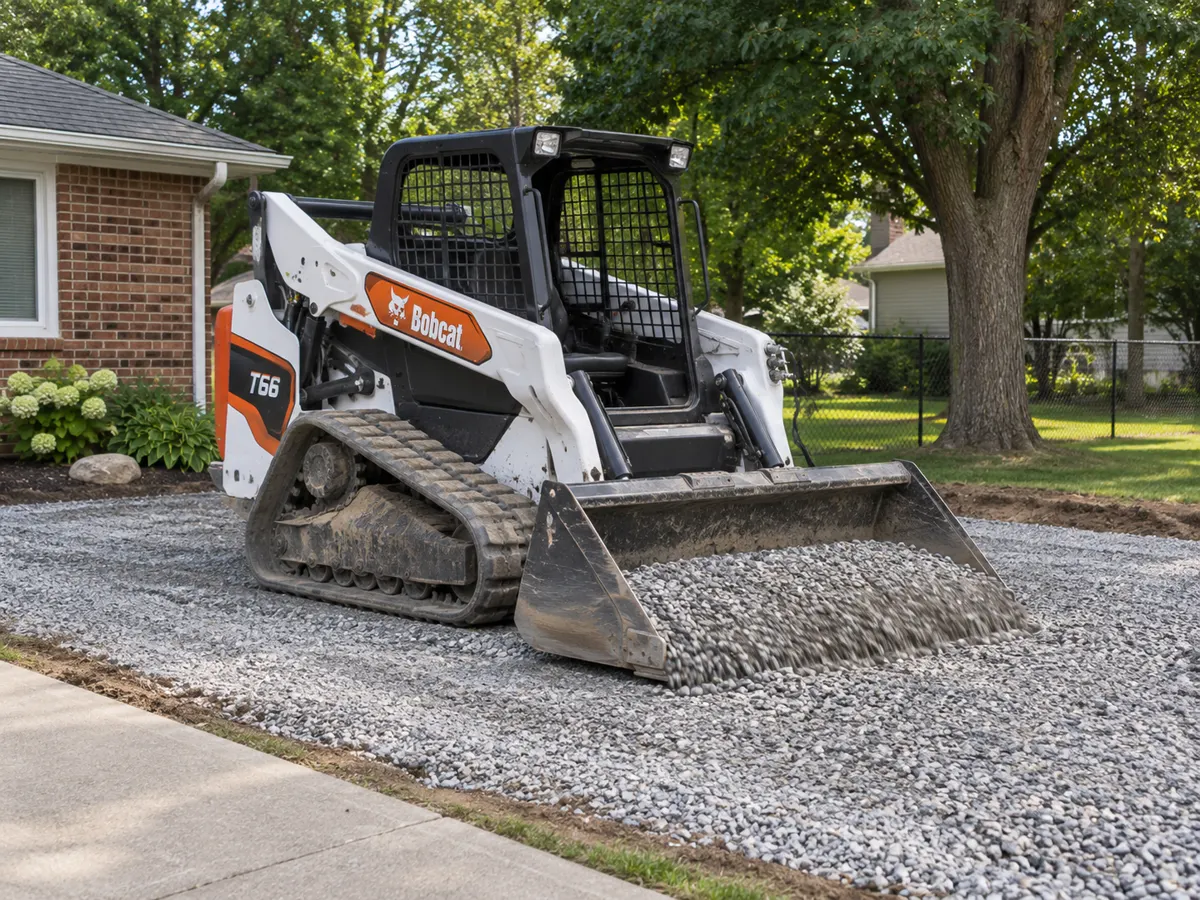
What a parking pad has to do that a path does not
- A parking pad carries vehicles, often one that sits in the same spot for months. Tires concentrate weight on a few square inches and a parked trailer tongue jack concentrates it further. The pad needs more base depth than a walkway, built on firm subsoil with the topsoil gone, and it needs to shed water so the stone stays locked instead of floating in mud.
- The common failure is a pad built by spreading stone on the lawn. The grass dies, the stone sinks into the topsoil over a season or two, and the pad becomes a soft, rutted strip that is lower than the driveway next to it. Stripping the sod and topsoil and building up from firm ground is the whole difference.
- Your stone supplier can size the base depth for the load you are parking. Bring them the pad dimensions and what will sit on it. That depth sets how much soil comes out and how many yards of stone go in, and those two numbers decide the equipment.
Check before you dig
- Many townships regulate how much of a front yard can be paved or graveled, how close a parking area can sit to the property line, and whether a pad in the road right-of-way needs a permit. A quick call to the township saves rebuilding. If the pad touches the road, the road commission may also have a say about the apron and the ditch.
- Contact MISS DIG 811 at least three business days before digging. It is free and required by Michigan law. Front yards carry service lines, and a pad beside the drive often sits right over them. MISS DIG does not mark private lines; irrigation and landscape lighting are yours to locate.
- If the spot holds water now, or the ditch beside the road backs up onto it, drainage comes first. A pad built in a wet spot stays soft. Talk to the counter about where the water should go before you order stone.
Building the pad
The machines change with the pad size. A small single-car pad with a tight route can run on the MT100; most pads call for a full-size loader and the ride-on roller.
Loader and roller on one trailer is a dual-machine delivery, priced at its own tier and confirmed at checkout. Rental time is the time the machines are out, including weekends, with unlimited run hours, and the week rate covers 3 to 7 days.
Stake the pad and plan where water goes
Stake the corners and run string at finished height, matching the edge of the existing driveway so there is no lip. Plan a slight fall so water runs off toward the lawn or ditch, not toward the house or garage. Check township rules on setbacks and coverage, and contact MISS DIG 811 at least three business days ahead.
Stakes, string, line level, marking paint. Metal detector optional for property pins; it does not replace MISS DIG.
Remove the sod and the topsoil
The gas sod cutter (18 in, up to 2.5 in deep) lifts the grass in rolls you can reuse elsewhere. Below it is topsoil, which compresses and holds water. Dig it out to firm subsoil. A full-size tracked loader, the Bobcat T66-2 or Kubota SVL65-2, strips a pad in a few passes and piles the soil for hauling or spreading elsewhere on the lot. The MT100 does the same on a small pad with a narrower route.
Classen gas sod cutter; Bobcat T66-2 or Kubota SVL65-2; Bobcat MT100 for a small pad.
Move the spoil off the pad
Topsoil can go to a garden or a low spot on the property, or leave in the 7x14 dump trailer (10.9 cu yd, 14,000 lb gross, brake controller required). Soil is heavy and the trailer reaches its weight limit before it looks full. The loader fills the trailer from the pile.
Bobcat T66-2, Kubota SVL65-2 or Bobcat S570 to load; 7x14 dump trailer.
Spread crushed stone in lifts
Have the stone delivered when the loader is on site. Spread the first lift a few inches thick across the pad, then compact it before the next. The 36 in double-drum ride-on roller covers a pad in a few passes per lift; it carries water so the drum does not pick up stone. Keep the stone damp. Check the string after each lift so the pad finishes flush with the drive and falls the right way.
Bobcat T66-2, Kubota SVL65-2 or Bobcat S570 with bucket; 36 in ride-on roller.
Tie the pad into the driveway and the lawn
Where the pad meets the existing drive, feather the stone so there is no step and roll the seam. Where it meets the lawn, either cut the sod edge clean so water can leave the pad, or set an edge restraint if you want a defined line. The plate compactor handles the seams and corners the roller cannot reach.
Wacker Neuson plate compactor for edges and seams.
Final roll and a look after the first rain
Roll the finished surface in two directions. Then watch it in the first rain: water should leave the pad, not pool on it. A low spot that holds water gets a little more stone and another pass while the loader is still around. Once a vehicle has sat on it through a wet week, you will know whether the base is doing its job.
36 in ride-on roller.
Pick the loader by the route and the volume
Can a full-size loader reach the pad?
The T66-2 is 67 in wide, the SVL65-2 is 68 in, and the S570 is 68 in with bucket. A pad beside the driveway is usually open, which is what makes a full-size loader the first choice.
Tracks or wheels
Stripping sod and topsoil is soft-ground work: the tracked T66-2 or SVL65-2. The wheeled S570 is quick for spreading stone once the pad is firm, and it ruts turf if it leaves the pad.
Volume sets the machine
Pad area times topsoil depth is spoil out; pad area times base depth is stone in. A full-size loader moves more than twice what the MT100 carries per trip (2,450 lb or 2,100 lb rated vs 1,000 lb).
Widths of the machines in this guide
Width is the machine body from our product pages. The roller is 41.7 in overall with a 36 in drum. Confirm the route before you book.
Bobcat MT100 stand-on loader — 35.6 in
Double drum 36 in ride-on roller — 41.7 in
Bobcat T66-2 track loader — 67 in
Kubota SVL65-2 track loader — 68 in
Bobcat S570 wheeled loader — 68 in with bucket
Before ground disturbance: — contact MISS DIG 811 at least three business days ahead, and check township rules on parking areas and setbacks. Private lines are not marked.
Your parking pad checklist
Have these ready before you book.
- Pad dimensions and what will park on it
- Topsoil depth from a test hole, and base depth from the stone supplier
- Where the spoil goes: on site or hauled
- Where water will leave the pad
- Township rules on setbacks, coverage and right-of-way checked
- Stone delivery date matched to the loader rental
- MISS DIG 811 ticket date
Let's match the machine to your job.
Tell us what you're working on. Our Hamburg team serves Southeast Michigan, seven days a week.
(810) 231-7368
Equipment for a gravel pad
Questions before you rent
Which loader for a parking pad?
For most pads, a full-size tracked loader: the Bobcat T66-2 or Kubota SVL65-2. Stripping sod and topsoil is soft-ground work, and these carry 2,450 lb and 2,100 lb rated per bucket, so the stone moves fast. The wheeled S570 is a good pick for spreading stone on a pad that is already firm, and on pavement, but it ruts lawn. The MT100 fits a small single-car pad or a route under 6 ft; at 1,000 lb rated capacity it makes more trips. Tell us the pad size and the route and we will say which.
Roller or plate compactor?
The 36 in ride-on roller for the pad itself. It compacts each lift across the full area in a few passes and leaves a flat, tight surface that a plate compactor takes much longer to produce. The plate compactor is the right tool for the seam against the driveway, the corners, and any spot the roller cannot reach. Many pad jobs rent both for the day the stone goes down.
How deep should the base be?
Deeper than a walkway, and your stone supplier should size it for what you are parking. A boat trailer and a loaded RV are different loads. Whatever the depth, the topsoil comes out first; a base built on topsoil sinks. Build the depth in lifts of a few inches, each compacted, rather than one thick layer. Keep the finished surface flush with the existing drive so you do not create a lip that catches tires and water.
How much stone will I need?
Pad length times width times base depth, all in feet, divided by 27 gives cubic yards of loose stone, and compaction takes some of that back, so order a little over. Your stone supplier can convert that to tons for the material you choose. Have it delivered the same day the loader is on site so you spread and compact it while it is fresh and damp. If the pad is large, stage the pile where the loader can reach it without crossing the finished lifts.
Should I have the loader and roller delivered?
The T66-2, SVL65-2 and S570 each need the 16 ft equipment trailer, a 2 5/16 in ball and a 3/4-ton truck or larger, and the roller is a trailer load as well, so most customers take delivery for this job. Delivery runs seven days a week on our trucks, priced by drive time from Hamburg and confirmed at checkout: $85 round trip within 45 minutes for one truck and trailer load, $125 for a dual-machine load such as loader plus roller.